PARIS: European countries agreed at a summit in Paris Thursday to ramp up rather than lift sanctions on Russia over its war against Ukraine, as Britain and France began sketching out plans to send a “reassurance” force after any peace.
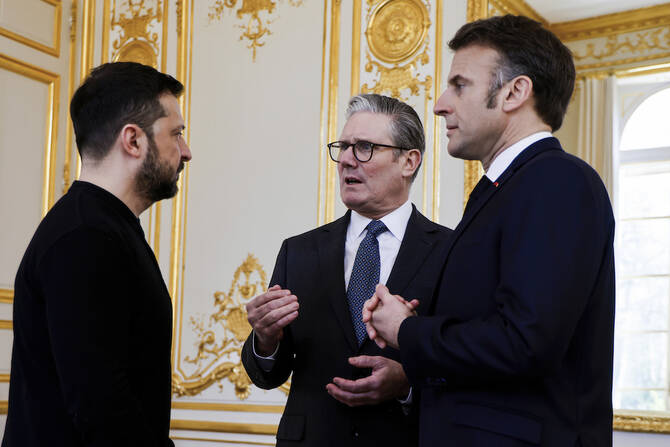
President Emmanuel Macron hosted the meeting of Ukraine’s European allies and President Volodymyr Zelensky in the latest effort to agree a coordinated policy after Donald Trump shocked Europe by opening direct talks with the Kremlin.
The US claims tentative progress toward a ceasefire to end the three-year conflict sparked by Russian President Vladimir Putin’s full-scale invasion in February 2022.
But as yet a peace deal appears far off and the meeting of over two dozen European heads of state and government also underlined differences within the “coalition of the willing,” with not all states signing onto the French-British plan to deploy troops postwar.
“He really wants to divide Europe and America, Putin really wants that,” Zelensky said after the summit, adding Kyiv wants Washington to be “stronger” toward the Kremlin.
He warned “everybody understood and understands that today Russia does not want any kind of peace.”
There appeared to be consensus around the table at the Elysee Palace that sanctions imposed against Russia should not be weakened, and rather intensified, until there is peace.
“There was complete clarity that now is not the time for the lifting of sanctions, quite the contrary — what we discussed is how we can increase sanctions to support the US initiative to bring Russia to the table,” British Prime Minister Keir Starmer said alongside Zelensky.
In a separate briefing, German Chancellor Olaf Scholz said lifting sanctions would be a “grave mistake” and “makes no sense” without a truce.
As well as boosting Ukraine’s own armed forces, a key pillar of ensuring security and preventing further Russian invasions could be to deploy European troops to Ukraine, although until now it has been far from clear how this could happen.
Macron said after the summit that France and Britain were leading efforts to send a “reassurance force” to Ukraine after any end to the fighting.
“It does not have unanimity today, but we do not need unanimity to do this,” he added, saying a Franco-British delegation would head to Ukraine in the coming days for talks.
Macron emphasized that members of such a force would not be peacekeepers, deployed on the front line or any kind of substitute for the Ukrainian army.
Also, he said, not all of Ukraine’s European allies would be represented in the force, with some states not “having the capacity” and some reluctant due to the “political context.”
The Franco-British delegation would begin talks over where such a force could be deployed.
It would have the “character of deterrence against any potential Russian aggression,” he said.
Macron added that the summit agreed that he and Starmer would together “co-pilot” Europe’s ‘coalition of action’ for stable and durable peace.”
But Zelensky struck a more downbeat note, warning that “there are many questions” but “so far, there are few answers” about the force, who would lead it and what it can do.
Italy’s Prime Minister Giorgia Meloni, who has long made clear her reserves over the troop deployment plan, said she hoped the United States will be involved in the next European meeting on Ukraine and repeated Rome’s refusal to send troops to defend any peace deal.
But Starmer, hailing the summit, said: “This is Europe mobilizing together behind the peace process on a scale that we haven’t seen for decades, backed by partners from around the world.”
Ukraine has offered through the United States a 30-day ceasefire, but Russia has so far failed to respond, with the European allies growing all the more impatient.
Underscoring how far apart the sides remain, Ukraine accused Russia Thursday of violating a US-brokered agreement to refrain from targeting energy infrastructure with an artillery strike that caused a power outage in the city of Kherson.
The Ukrainian army meanwhile rejected Russian claims it had itself targeted energy sites.
“I think there should be a reaction from the US,” Zelensky told reporters in Paris, saying that energy facilities had been damaged in a strike Thursday and that it was “unclear who is monitoring” the pledges to halt such strikes.
Thursday’s meeting comes after the White House said Russia and Ukraine had agreed on the contours of a possible ceasefire in the Black Sea, during parallel talks with US officials in Saudi Arabia.


![]()

Paris summit rejects Russia sanctions relief, mulls Ukraine force
Short Url
https://arab.news/vmv33
Paris summit rejects Russia sanctions relief, mulls Ukraine force
- President Emmanuel Macron hosted the meeting of Ukraine’s European allies and President Volodymyr Zelensky
- The US claims tentative progress toward a ceasefire to end the three-year conflict


Latest updates




© 2026 SAUDI RESEARCH & PUBLISHING COMPANY, All Rights Reserved And subject to Terms of Use Agreement.