BEIRUT: Lebanon said Thursday that Israeli strikes killed six people in the country’s south, with Israel saying it struck Hezbollah operatives.
The strikes were the latest in a series of Israeli attacks on south Lebanon, despite a November ceasefire between Israel and Iran-backed Hezbollah after more than a year of hostilities.
The Lebanese health ministry said “two people were killed in an enemy strike on the village of Baraashit” in Nabatieh district.
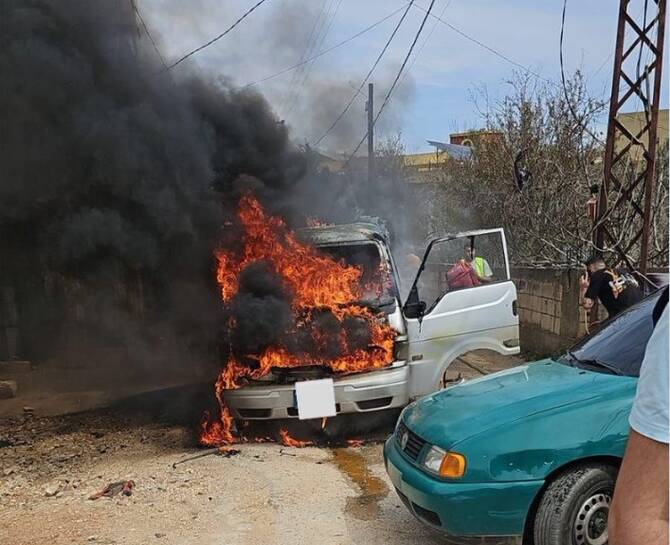
Earlier the ministry said an “Israeli enemy strike on a car in Yohmor Al-Shaqeef led to the death of three people,” in a statement reported by the National News Agency.
The news agency said a drone targeted a vehicle near the town, in a strike that came at the same time as artillery shelling.
The Israeli military said in a statement that “several Hezbollah terrorists were identified transferring weapons in the area of Yohmor in southern Lebanon,” adding that the army “struck the terrorists.”
NNA also reported that “one person was killed and another wounded in the Israeli drone targeting... of a car in the (southern) town Maaroub.”
The Israeli military said that overnight, the air force “struck and eliminated... a battalion commander” in Hezbollah’s elite Radwan Force in the Derdghaiya area, near Maaroub.
It accused him of having “advanced and directed numerous terror attacks against Israeli civilians” and troops during the war, and of also directing “terror attacks against Israel’s Home Front” in recent months.
Israel has continued to carry out raids in Lebanon since the November 27 ceasefire, striking what it says are Hezbollah military targets that violated the truce agreement.
Last weekend saw the most intense escalation since the truce, with Israeli strikes in the south killing eight people, according to Lebanese officials.
Israel’s raids were in response to rocket fire, the first to hit its territory since the ceasefire.
No party has claimed responsibility for the rocket fire, which a military source said originated north of the Litani River, between the villages of Kfar Tebnit and Arnoun.
Hezbollah, heavily weakened by the war, denied involvement.
Under the ceasefire, Hezbollah was to pull its forces north of the Litani River, about 30 kilometers (20 miles) from the Israeli border, and dismantle any remaining military infrastructure in the south.
Israel was to withdraw its forces across the UN-demarcated Blue Line, the de facto border, but still holds five positions in south Lebanon that it deems strategic.

Lebanon says Israel strikes kill six people
Short Url
https://arab.news/rn78n
Lebanon says Israel strikes kill six people
- The Lebanese health ministry said “two people were killed in an enemy strike on the village of Baraashit” in Nabatieh district
- Earlier the ministry said an “Israeli enemy strike on a car in Yohmor Al-Shaqeef led to the death of three people“
In first Christmas sermon, Pope Leo decries conditions for Palestinians in Gaza
VATICAN CITY: Pope Leo decried conditions for Palestinians in Gaza in his Christmas sermon on Thursday, in an unusually direct appeal during what is normally a solemn, spiritual service on the day Christians across the globe celebrate the birth of Jesus.
Leo, the first US pope, said the story of Jesus being born in a stable showed that God had “pitched his fragile tent” among the people of the world.
“How, then, can we not think of the tents in Gaza, exposed for weeks to rain, wind and cold?” he asked.
Leo, celebrating his first Christmas after being elected in May by the world’s cardinals to succeed the late Pope Francis, has a more quiet, diplomatic style than his predecessor and usually refrains from making political references in his sermons.
But the new pope has also lamented the conditions for Palestinians in Gaza several times recently and told journalists last month that the only solution in the decades-long conflict between Israel and the Palestinian people must include a Palestinian state.
Israel and Hamas agreed to a ceasefire in October after two years of intense bombardment and military operations, but humanitarian agencies say there is still too little aid getting into Gaza, where nearly the entire population is homeless.
In Thursday’s service with thousands in St. Peter’s Basilica, Leo also lamented conditions for the homeless across the globe and the destruction caused by the wars roiling the world.
“Fragile is the flesh of defenseless populations, tried by so many wars, ongoing or concluded, leaving behind rubble and open wounds,” said the pope.
“Fragile are the minds and lives of young people forced to take up arms, who on the front lines feel the senselessness of what is asked of them and the falsehoods that fill the pompous speeches of those who send them to their deaths,” he said.
Later on Thursday the pope will deliver a twice-yearly “Urbi et Orbi” (to the city and the world) message and blessing, which usually addresses global conflicts.
Leo, the first US pope, said the story of Jesus being born in a stable showed that God had “pitched his fragile tent” among the people of the world.
“How, then, can we not think of the tents in Gaza, exposed for weeks to rain, wind and cold?” he asked.
Leo, celebrating his first Christmas after being elected in May by the world’s cardinals to succeed the late Pope Francis, has a more quiet, diplomatic style than his predecessor and usually refrains from making political references in his sermons.
But the new pope has also lamented the conditions for Palestinians in Gaza several times recently and told journalists last month that the only solution in the decades-long conflict between Israel and the Palestinian people must include a Palestinian state.
Israel and Hamas agreed to a ceasefire in October after two years of intense bombardment and military operations, but humanitarian agencies say there is still too little aid getting into Gaza, where nearly the entire population is homeless.
In Thursday’s service with thousands in St. Peter’s Basilica, Leo also lamented conditions for the homeless across the globe and the destruction caused by the wars roiling the world.
“Fragile is the flesh of defenseless populations, tried by so many wars, ongoing or concluded, leaving behind rubble and open wounds,” said the pope.
“Fragile are the minds and lives of young people forced to take up arms, who on the front lines feel the senselessness of what is asked of them and the falsehoods that fill the pompous speeches of those who send them to their deaths,” he said.
Later on Thursday the pope will deliver a twice-yearly “Urbi et Orbi” (to the city and the world) message and blessing, which usually addresses global conflicts.
© 2025 SAUDI RESEARCH & PUBLISHING COMPANY, All Rights Reserved And subject to Terms of Use Agreement.