

Punjab says received 38 percent less rainfall in last four months, warns of drought 

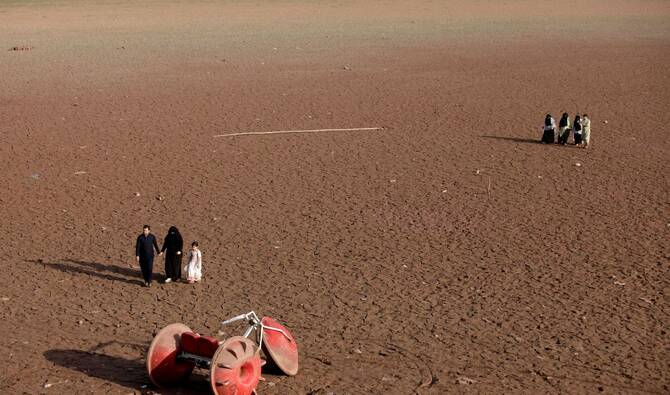
People walk near a three-wheeler parked at a dry portion of land that used to have water, at the bank of Rawal lake in Islamabad, Pakistan June 20, 2018. (REUTERS/ file)
Short Url
Updated 27 March 2025
Follow

Punjab says received 38 percent less rainfall in last four months, warns of drought 

  • Punjab, Pakistan’s most populous province, plays leading role in country’s agricultural production
  • Pakistan’s Met Department this week warned of possible drought in Punjab, Sindh and Balochistan

ISLAMABAD: Pakistan’s eastern and most populated Punjab province on Thursday warned that it may face a drought in the near future as it has received 38 percent less rainfall in the last four months compared to the usual amount, a statement from the Provincial Disaster Management Authority (PDMA) said. 

Earlier this week, Pakistan’s Meteorological Department (PMD) warned that the existing drought situation in Sindh, Punjab and Balochistan provinces may “exacerbate and intensify” in the coming months due to below-normal rainfall, rising temperatures and acute shortage of stored water in the country’s dams.

The situation is particularly alarming for Punjab, which plays a leading role in Pakistan’s agricultural production. The province contributes about 68 percent to the annual food grain production in Pakistan and has 51 million acres of cultivated land, as per official figures. 

“In the last four months, Punjab has received 38 percent less rainfall which is threatening a possible drought,” the PDMA said in a statement. 

A meeting was held under the chairmanship of DG PDMA Punjab Irfan Ali Kathia to deal with the possible drought in Cholistan in southern Punjab. 

“Additional funds will be provided to the relevant districts to deal with the possible drought,” the PDMA said. 

Participants of the meeting were informed in the briefing that due to a lack of rain last winter, the country’s reservoirs are facing a water shortage. 

“Water supply is being ensured in all areas. Water is being provided to remote areas through pipelines and water bowsers,” it said. 

The PDMA urged all relevant departments to be on alert, with Kathia instructing all departments to make provision of basic medicines to deal with possible drought. 

“Possible steps are being taken to deal with heat wave and possible drought,” the statement said.

Pakistan has the fourth-highest rate of water consumption in the world. The country’s agriculture sector uses the most amount of freshwater than any other sector. Rainfall has steadily declined over the past few decades and experts have been warning for years the country will approach “absolute scarcity” of water by 2025.

The results of the latest census in 2023 counted 241.49 million people across Pakistan with a growth rate of 2.55 percent. Linked to that, per capita water availability has been on a downward trend for decades.


Pakistan’s first digital Islamic banking platform partners with central bank to boost rural financial access

Updated 8 sec ago
Follow

Pakistan’s first digital Islamic banking platform partners with central bank to boost rural financial access

  • Aik by BankIslami says Shariah-compliant digital finance can expand inclusion beyond urban centers
  • Merchants, vendors and small business owners in rural area trained in how digital Islamic banking works

ISLAMABAD: Pakistan’s first fully digital Islamic banking platform, Aik by BankIslami, said on Tuesday it had partnered with the State Bank of Pakistan to hold financial literacy sessions in a rural community near the capital, part of efforts to expand digital payments and banking in underserved areas.

The initiative forms part of Islamabad’s national shift toward a cashless system, with the central bank describing digitalization as key to widening financial access, reducing cash dependency and aligning the economy with global banking practices.

Under the initiative, a training session was held in Maira Bagwal village where merchants, vendors and small business owners were trained in how digital Islamic banking works and how electronic payments can replace cash-based transactions that still dominate Pakistan’s informal economy.

“Through ‘aik’ we are helping drive the growth of Islamic banking by giving communities simple access to Shariah-compliant digital financial services,” Aik Chief Officer Ashfaque Ahmed said in a statement. “When people adopt digital banking, financial inclusion improves, and more families are able to participate in a fair and transparent financial system.”

Aik and BankIslami said they would continue working with the State Bank to run more awareness drives and onboard local merchants into the digital ecosystem.

Organizers said the session highlighted how electronic payments can make daily transactions safer, faster and more transparent for residents unfamiliar with banking, while ensuring compliance with Islamic finance rules that prohibit interest-based lending.

The statement added that Aik and BankIslami are focused on making Shariah-compliant digital banking simple, accessible and relevant to rural customers, a segment often excluded from formal finance despite Pakistan having one of the world’s fastest-growing Islamic banking markets.

The program falls under Pakistan’s Smart Village initiative, which aims to bring digital tools like mobile wallets, merchant QR payments, online banking and e-government interfaces to remote areas where formal banking penetration remains low.