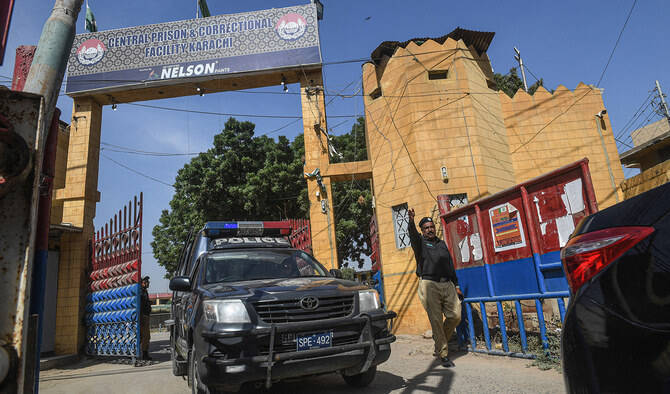
KARACHI: An Indian fisherman has died by suicide in a Karachi prison, a senior Pakistani jail official said on Wednesday, as the incident highlighted the plight of detainees caught in the tangle of strained India-Pakistan relations.
Indian and Pakistani fishermen are routinely detained by both countries’ maritime agencies for allegedly entering each other’s territorial waters. The poorly defined maritime boundary in the Arabian Sea, coupled with the limited navigational capabilities of many fishing boats, frequently leads to unintentional crossings.
According to Pakistani prison authorities, Gaurav, son of Ram Anand, hanged himself in the prison’s washroom on Tuesday night.
“He went to the washroom under the pretext of urinating and hanged himself with his drawstring,” Qazi Nazeer Ahmed, Inspector General of Prison Police in Pakistan’s Sindh province, told Arab News.
Malir Prison, where Gaurav took his own life, has come under scrutiny in recent years over the deaths of several detainees due to health complications.
Last month, a prisoner named Babu Kana died due to health issues, while in 2023, two Indian fishermen — Balo Jetha and Soma Deva — died after their health deteriorated during incarceration.
Ahmed said Gaurav was apparently suffering from “severe depression,” which pushed him to take the extreme step of ending his life.
“His sentence was completed, but the process from the Indian side [for his release] was not finalized,” he continued. “Fellow prisoners reported that Gaurav’s behavior did not indicate he would commit suicide, but he was depressed.”
Arab News reached out to the Indian High Commission, where officials declined to comment immediately.
Arshad Shah, Superintendent of Malir Jail, said Gaurav had been remanded to the Karachi prison on February 17, 2022.
“The duty doctor examined him before pronouncing him dead,” he told Arab News, adding the body had been handed over to the Edhi Foundation for repatriation.
Human rights activists on both sides of the border have long called for a faster process for the release of fishermen, who commit no crime but mistakenly cross invisible boundaries at sea and end up in jail, while their families suffer back home.
“According to our records, 216 Indian fishermen are still languishing in Pakistani jails, while 81 Pakistani fishermen are imprisoned in India,” Jatin Desai, an Indian rights activist, said, adding hundreds of fishermen remained in prison on both sides of the border.
However, the IG prison maintained Indian nationals were treated well in jail, adding that Pakistani authorities did not delay their release once legal formalities were completed.
“This is why prisoners are regularly released and returned to their country,” he added. “We regret that Gaurav could not reunite with his family back in India.”


![]()

Indian fisherman hangs himself in Pakistan prison amid delayed repatriation
Short Url
https://arab.news/vdct5
Indian fisherman hangs himself in Pakistan prison amid delayed repatriation
- Indian and Pakistani fishermen are frequently detained for straying into each other’s territorial waters
- Jail authorities in Pakistan say Gaurav’s release was delayed due to procedural reasons on Indian side
Latest updates


© 2026 SAUDI RESEARCH & PUBLISHING COMPANY, All Rights Reserved And subject to Terms of Use Agreement.