ISTANBUL: Police used pepper spray, plastic pellets and water cannon against protesters in Turkiye’s capital early Thursday, potentially reigniting tensions after two days of relative calm in the country’s biggest anti-government protests in over a decade.
The demonstrations began last week following the arrest of Istanbul Mayor Ekrem Imamoglu, a key rival to President Recep Tayyip Erdogan. Imamoglu, jailed on corruption charges many see as politically motivated, is also accused of supporting terrorism. The government insists the judiciary is independent, but critics say the evidence is based on secret witnesses and lacks credibility.
Early Thursday, student demonstrators tried to march and gathered to read a statement near the gates at Middle East Technical University, pro-opposition broadcaster Halk TV and local media reported. They were met by security forces who deployed pepper spray, water cannon and plastic pellets. A standoff ensued where the students hid behind a barricade of dumpsters until the police charged to detain them.
Melih Meric, a legislator with the Republican People’s Party or CHP, was seen soaked with water and suffering from pepper spray exposure. “My student friends only wanted to make a press statement, but the police strictly did not allow it, this is the result,” Meric said in social media videos.
Officials have not said how many people were detained.
Ozgur Ozel, the leader of party to which Imamoglu belongs, had promised that lawmakers would stand alongside protesters in the hope of lowering tensions. He also warned Tuesday that if the police provoked demonstrators he would “make a call for 500,000 people to (come to) the place that will disturb” the authorities the most.
At least 1,400 people were detained first six days of the protests, the interior minister said Tuesday.
Demonstrations involving hundreds of thousands have swept across major cities, including opposition-organized rallies outside Istanbul City Hall. Other major protests have been held in Istanbul’s districts of Kadikoy and Sisli districts in recent days.
Erdogan has accused the opposition of “sinking the economy” by calling for a boycott of companies it says support the governmen. The president said those responsible for hurting financial stability would be held “accountable.”
Meanwhile, Imamoglu, speaking from prison via social media Wednesday, denounced police violence against protesters, “I cannot call them police because my honorable police would not commit this cruelty to the young children of the nation,” he said.
Imamoglu has been confirmed as the main opposition party’s candidate for presidential elections due in 2028 but which could come earlier. He has performed well in recent polls against Erdogan, for whom his election as mayor of Turkiye’s largest city in 2019 was a major blow.


![]()

Police use force to break up protests at university in Turkiye’s capital
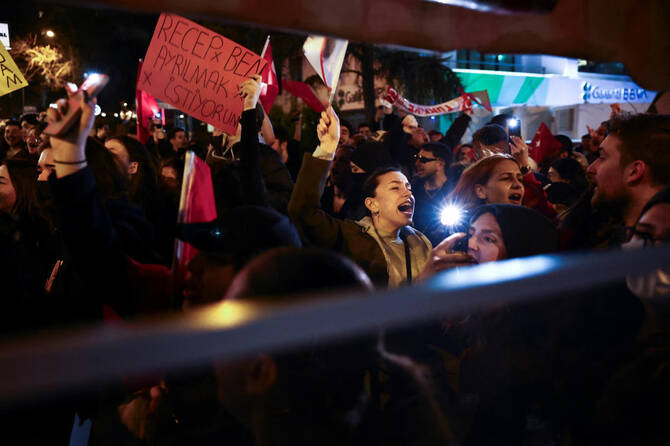
Police use force to break up protests at university in Turkiye’s capital
- At least 1,400 people were detained first six days of the protests, the interior minister said Tuesday
- A group of students gathered to read a statement near the university gates, pro-opposition broadcaster Halk TV and local media reported
Latest updates




© 2026 SAUDI RESEARCH & PUBLISHING COMPANY, All Rights Reserved And subject to Terms of Use Agreement.