

Gunmen kill five commuters traveling to Karachi in Pakistan’s volatile southwest

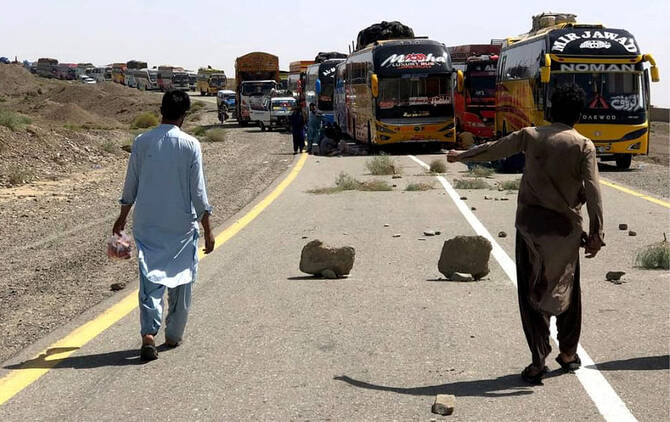
People walk past parked supply trucks alongside a road, after traffic was halted following an attack on a highway in Pakistan's restive province of Balochistan on August 26, 2024. (REUTERS/File)
Short Url
Updated 27 March 2025
Follow

Gunmen kill five commuters traveling to Karachi in Pakistan’s volatile southwest

  • The incident happened near Pasni, Balochistan, where armed men offboarded Punjabi passengers on a highway
  • No group has immediately claimed responsibility for the attack, though BLA usually launches such attacks

QUETTA: At least five passengers belonging to Pakistan’s eastern Punjab province were forcibly offboarded from passenger buses heading to Karachi from Gwadar on Wednesday after gunmen checked their identity cards and killed them near Pakistan’s coastal town of Pasni, a senior government official confirmed.

This is not the first time commuters from Punjab have been targeted in Pakistan’s restive southwestern Balochistan province, which shares porous borders with Iran and Afghanistan and has experienced a low-scale insurgency by Baloch separatist groups against the Pakistani state.

Baloch nationalists have long accused the Pakistani government and the country’s most prosperous Punjab province of monopolizing profits from Balochistan’s abundant natural resources, saying it has led to their political marginalization and economic exploitation.

Pakistani administrations have denied these allegations, however, citing several development initiatives launched in the province to improve local living conditions.

“Armed men stopped buses at the coastal highway near Kalmat, Pasni, and forcibly removed six passengers after checking their ID cards,” Moheem Khan Gichki, Assistant Commissioner Pasni, told Arab News over the phone.

“Five Punjab-based travelers who were traveling to Karachi from Gwadar were killed in the attack and one sustained injuries,” he continued. “The attackers also set one trawler and one vehicle on fire before escaping from the area.”

The coastal town of Gwadar, located on the shore of the Arabian Sea, is the heart of Pakistan and China’s multibillion-dollar development project called the China-Pakistan Economic Corridor (CPEC).

No group has claimed responsibility for the latest killings of the Punjab-based commuters, though suspicion is likely to fall on the outlawed Baloch separatist group Baloch Liberation Army, which has previously launched similar attacks on passenger buses on different highways of the volatile province.

In February, seven Punjab-based passengers were killed after the ethnic separatist group stopped Punjab-bound passenger buses in Barkhan district.

Prime Minister Shehbaz Sharif expressed sorrow in a statement issued by his office over the death of the commuters in the attack.

“Subversive elements are enemies of peace and development in Balochistan,” he said. “Cowardly attacks by such elements on innocent people clearly reflect their barbarity.”

Sharif also applauded the actions of the security forces and law enforcement agencies against anti-state groups while ordering an investigation into the incident to identify the perpetrators of the attack and bring them to justice.


Pakistani stocks breach 176,000 points barrier as investors expect further rate cuts

Updated 01 January 2026
Follow

Pakistani stocks breach 176,000 points barrier as investors expect further rate cuts

  • Pakistani financial analyst attributes surge to falling inflation, investors expecting further policy rate cuts
  • Pakistan’s finance ministry said Thursday that inflation had slowed to 5.6 percent year-on-year in December 

KARACHI: Pakistani stocks continued their bullish run on Thursday, breaching the 176,000 points barrier for the first time after trading ended, with analysts attributing the surge to investors expecting further cuts in the policy rate. 

The KSE-100 benchmark gained 2,301.17 points at close of business on Thursday, marking an increase of 1.32 percent to settle at 176,355.49 points. 

Pakistan’s central bank cut its key policy rate by 50 basis points to 10.5 percent last ‌month, breaking a four-meeting ‌hold in a move ‌that ⁠surprised ​markets. Pakistan’s consumer price inflation slowed to 5.6 percent year-on-year in December, while prices fell on a monthly basis as per data from the finance ministry. 

“Upbeat data for consumer price index (CPI) inflation at 5.6pc in December 2025 [with] investors expecting a further State Bank of Pakistan rate cuts on falling inflation data,” Ahsan Mehanti, CEO of Arif Habib Commodities Ltd., told Arab News. 

The stock market witnessed a trading volume of 1,402.650 million shares, with a traded value of Rs48.424 billion ($173 million), compared with 957.239 million shares valued at Rs44.231 billion ($158 million) during the previous session.

Topline Securities, a leading brokerage firm in Pakistan, credited the surge to strong buying at the first session.

“This positivity can be accredited to buying by local institutions on the start of the new calendar year,” it said. 

Pakistan’s Finance Adviser Khurram Schehzad highlighted that the bullish trend at the stock market reflected “strong investor confidence.”

“With lower inflation, affordable fuel, stronger reserves, rising digitization and a buoyant capital market, Pakistan’s economic outlook is clearly improving--supporting greater confidence, better investment sentiment and more positive momentum for 2026,” he said on social media platform X.