WASHINGTON: President Donald Trump’s nominee to be ambassador to Israel will face a confirmation hearing Tuesday on Capitol Hill as US and Arab mediators struggle to get a ceasefire deal between Israel and Hamas back on track after Israeli forces resumed the war in Gaza last week with a surprise wave of deadly airstrikes.
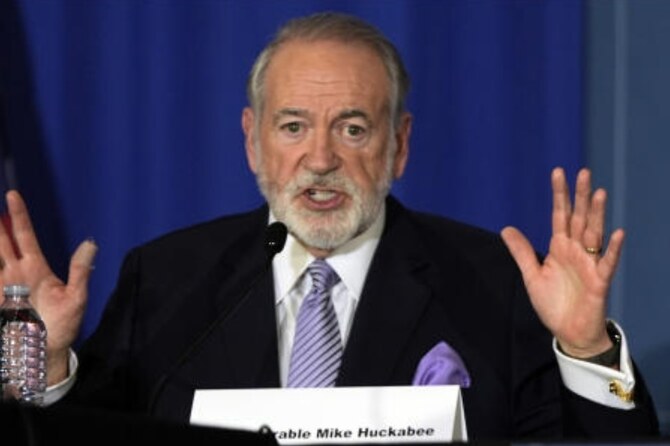
Trump nominated Mike Huckabee, a well-known evangelical Christian and vehement supporter of Israel, to take on the critical post in Jerusalem days after he won reelection on a campaign promise to end the now 17-month war.
If Huckabee, a Republican, is confirmed by the Senate, his posting will likely complicate an already unstable situation in the Middle East as the former governor of Arkansas has taken stances on the conflict that sharply contradict longstanding US policy in the region.
Huckabee, a one-time presidential hopeful, has spoken favorably in the past about Israel’s right to annex the West Bank and incorporate its Palestinian population into Israel. He has repeatedly backed referring to the West Bank by its biblical name of “Judea and Samaria,” a term that right-wing Israeli politicians and activists have thus far fruitlessly pushed the US to accept.
Most notably, Huckabee has long been opposed to the idea of a two-state solution between Israel and the Palestinian people. In an interview last year, he went even further, saying that he doesn’t even believe in referring to the Arab descendants of people who lived in British-controlled Palestine as “Palestinians.”
“There really isn’t such a thing,” he said on the podcast show “Think Twice” with Jonathan Tobin. “It’s a term that was co-opted by Yasser Arafat in 1962,” referring to one of the early leaders of the Palestine Liberation Organization.
During the same interview, Huckabee described himself as an “unapologetic, unreformed Zionist.”
As the situation in Gaza has deteriorated with the recent collapse of the Israel-Hamas ceasefire and hostage release deal, Israeli officials have begun to talk more seriously about re-occupation of the territory, something to which the Biden administration had been adamantly opposed.
Trump has made his own proposals about a potential US takeover of Gaza, which have attracted attention as well as strong criticism from Arab nations and others.
Huckabee will likely be asked about all of these points in addition to ongoing Israeli military action against Hezbollah in Lebanon and persistent threats to the country from Iran and Iranian-backed proxy groups, like the Houthi rebels in Yemen.
In remarks prepared for his testimony, obtained by The Associated Press, Huckabee does not specifically mention either annexation or Trump’s Gaza plan. But he can be expected to offer qualified praise of both, given that he blasts many past Mideast policies as “failed” and speaks of the need to look “at entirely new ways” of promoting peace.
He plans to reaffirm his strong endorsement of Trump’s policies toward Israel during his first term in office, notably his recognition of Jerusalem as Israel’s capital, his decision to move the US embassy to the holy city from Tel Aviv, his recognition of the Golan Heights as sovereign Israeli territory and his sealing of the Abraham Accords, in which several Arab nations normalized relations with Israel, including the United Arab Emirates and Bahrain.
“President Trump’s first term was the most consequential for Israel and the Middle East ever with his historic Abraham Accords, and finally moving our embassy to Jerusalem, the ancient, indigenous and biblical eternal capital of the Jewish people,” Huckabee’s prepared remarks say.
Trump’s pick for ambassador to Panama also testifying
Another nominee testifying before the committee on Tuesday is Kevin Cabrera, Trump’s nominee to be ambassador to Panama, a country that has bristled at the Republican president’s repeated calls for the US to retake control of the Panama Canal for national security reasons due to potential threats from China. The status of the canal was one of the top items on Secretary of State Marco Rubio’s agenda when he visited Panama City on his first trip as America’s top diplomat in February.
“One of the key aspects of our cooperation is ensuring the security of the Panama Canal, a critical international waterway that facilitates global trade and economic growth,” Cabrera will say according to remarks prepared for the hearing.
He plans to praise decisions by the Panamanian government to withdraw from China’s Belt and Road Initiative and to review contracts with a China-based company that is running ports at both ends of the canal. The company has preliminarily agreed to sell its interests in the subsidiaries that run the ports, but the deal is not yet complete.


![]()

Mike Huckabee, Trump’s pick to be Israel ambassador, will face senators as war in Gaza restarts
Short Url
https://arab.news/6du87
Mike Huckabee, Trump’s pick to be Israel ambassador, will face senators as war in Gaza restarts
- If Huckabee, a Republican, is confirmed by the Senate, his posting will likely complicate an already unstable situation in the Middle East
- He has spoken favorably in the past about Israel’s right to annex the West Bank and incorporate its Palestinian population into Israel


Latest updates



© 2026 SAUDI RESEARCH & PUBLISHING COMPANY, All Rights Reserved And subject to Terms of Use Agreement.