Egypt signs International Finance Corp. deal to expand private sector role in airports

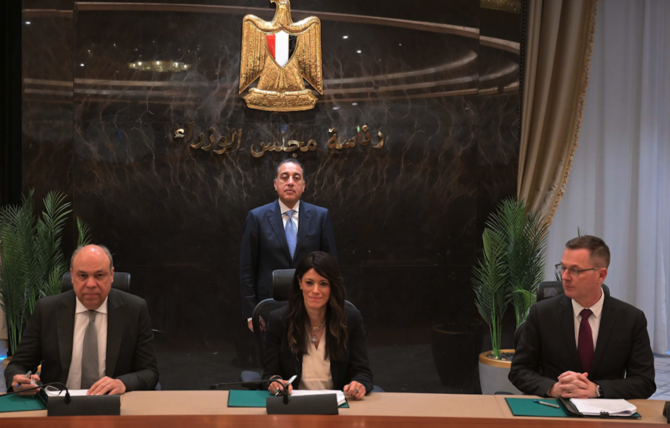
Prime Minister Mostafa Madbouly oversaw the signing ceremony. Facebook/Egyptian Prime Minister’s Office
Short Url
Updated 25 March 2025
Follow

Egypt signs International Finance Corp. deal to expand private sector role in airports

RIYADH: Egypt’s airport sector is set for increased private sector participation thanks to a new agreement with the International Finance Corp., which aims to modernize infrastructure, boost capacity, and attract foreign investment. 

Prime Minister Mostafa Madbouly oversaw the signing ceremony at the government’s new administrative capital, where Egypt’s Planning Minister Rania Al-Mashat, Civil Aviation Minister Sameh Al-Hefny, and IFC Vice President for Africa Sergio Pimenta formalized the deal. 

The agreement builds on Egypt’s ongoing partnership with the World Bank’s private sector arm, extending advisory services that support the country’s privatization efforts. 

“The agreement signed today ... is an extension to strengthen cooperation with the International Financing Corp. to provide advisory services for the governmental proposals program,” Madbouly said in a statement posted on the government’s official Facebook page. 

He added that the IFC “will provide consultative services to expand the participation of the private sector of the airport sector” in the Egyptian market.

“This is an important partnership that will contribute to the improvement of the services provided and the capacity of Egyptian airports,” Madbouly added. 

The agreement aligns with Egypt’s broader strategy to leverage the IFC’s expertise in attracting both local and foreign investments, providing technical support to national agencies, and fostering public-private partnerships, the prime minister highlighted. 

Planning Minister Al-Mashat noted that “the government is aiming to expand private sector partnerships in the airport sector, coinciding with strong growth in the tourism, transport, and storage sectors during the first quarter of the current financial year.” 

She highlighted that private sector investments now account for a record 63 percent of total investment, driven by a surge in tourism in 2024, bolstered by Egypt’s preparations for the Grand Egyptian Museum’s opening — a reflection of rising airport traffic and growing opportunities for private sector involvement.

Al-Mashat noted that the government has paved the way for these steps by enhancing macroeconomic stability, implementing measures to control public finances, enacting structural reforms to stimulate the private sector, and fostering an investment climate to attract both local and foreign investors. 

Civil Aviation Minister El-Hefny stated that under the agreement, the ministry aims to develop a strategic plan to identify airport projects suitable for private sector partnerships. 

IFC’s Vice President for Africa Pimenta said that enhancing Egypt’s airport infrastructure through public-private partnerships will drive economic growth. He added that the program will help attract global investors to build modern, high-efficiency airports, strengthening Egypt’s position as a global hub for travel and trade. 

Between July 2023 and May 2024, Egypt saw an influx of $900 million in investments from the IFC — a testament to the sustained momentum of financial inflows into the country’s economic landscape, Al-Mashat said during the “IFC Day in Egypt” event held in May. 


AI use reaches 91% in Middle East hospitality: PwC survey  

Updated 4 sec ago
Follow

AI use reaches 91% in Middle East hospitality: PwC survey  

RIYADH: The use of artificial intelligence in the Middle East’s hospitality sector is accelerating, with 91 percent of industry leaders already using or piloting AI-related tools, a new survey showed. 

In its latest report, professional services firm PwC said only 3 percent of tourism and hospitality organizations across the region have achieved full-scale, enterprise-wide implementation of AI technologies. 

PwC noted that countries across the Middle East are rapidly deploying AI and smart digital technologies to enhance visitor experiences and strengthen the tourism and hospitality sector’s contribution to national economic transformation agendas. 

The findings reflect a broader regional trend, as countries such as Saudi Arabia seek to position themselves as tourism and technology hubs as part of efforts to reduce reliance on crude oil revenues. 

Earlier this month, a separate PwC report found that artificial intelligence use among the workforce in the Middle East continues to rise, with 75 percent of employees in the region using AI in their jobs over the past 12 months. 

Commenting on the latest findings, Moussa Beidas, AI Go-to-Market Lead & Future Impact Center co-sponsor at PwC Middle East, said: “To realize AI’s promise, the industry must move beyond pilots and proofs of concept. True impact comes when intelligence is woven into every decision – empowering teams, optimising systems and elevating experiences.”  

He added: “The leaders who turn AI from a tool into an organizational mindset will shape the next era of tourism and hospitality.”  

The survey found that 74 percent of organizations in the Middle East’s hospitality sector now have dedicated AI budgets, signaling a shift from experimentation toward more structured and strategic adoption. 

About 85 percent of respondents reported measurable improvements in cost savings and operational efficiency through the use of AI technologies. 

However, challenges remain. Some 73 percent of participants cited a shortage of employees with AI expertise or experience in managing digital transformation, while 85 percent said they face difficulties integrating AI tools with outdated technology systems. 

According to PwC, AI adoption in tourism and hospitality is being driven primarily by a focus on enhancing the customer experience, with 97 percent of respondents citing it as their main motivation. 

Beyond guest engagement, more than 70 percent of hoteliers identified operational resilience and employee productivity as key drivers, highlighting AI’s growing role in improving internal efficiency and workforce effectiveness. More than 60 percent of participants also said they view AI as a way to differentiate from competitors. 

“AI is redefining how destinations, hotels and travelers connect. The winners won’t be those who collect the maximum data, but those who use it intelligently – to make every interaction seamless, ethical and valuable,” said Marco Rentsch, hospitality leader, PwC Middle East.  

He added: “For industry leaders, this means moving from disconnected systems to connected intelligence, where AI doesn’t replace human judgment and interaction, but amplifies it to create trust, efficiency and new forms of value across the entire travel ecosystem.”