

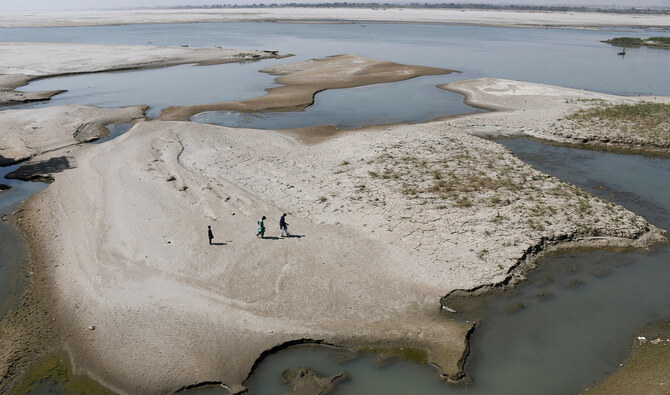

ISLAMABAD: Pakistan’s Meteorological Department (PMD) this week warned that the existing drought situation in Sindh, Punjab and Balochistan provinces may “exacerbate and intensify” in the coming months due to below-normal rainfall, rising temperatures and acute shortage of stored water in the country’s dams.
In its latest advisory issued on Monday, the PMD noted that drought conditions still persist in Sindh, southern parts of Balochistan and lower eastern plain areas of Punjab. It said that the overall, below-normal rainfall deficit of 40 percent was observed across Pakistan from Sept. 1 to Mar. 21, adding that the major rainfall deficits were observed in Sindh at 62 percent, Balochistan at 52 percent and Punjab at 38 percent.
The PMD noted that there is an “acute shortage” of stored water in the Tarbela and Mangla dams, while water in different rivers is flowing at an “extreme low level.” The advisory said that the mean temperature recorded during March in the lower half of the country is two to three degrees above normal.
“Keeping in view the current weather situation and seasonal climate outlook, the drought situation may exacerbate and intensify in the following drought affected areas of the country,” the advisory said.
The advisory said that in Sindh, a “moderate” drought situation is likely in Padidan, Shaheed Benazirabad, Dadu, Tharparkar, Umerkot, Khairpur, Hyderabad, Thatta, Badin and Karachi while a “mild” drought situation is likely in Ghotki, Jacobabad, Larkana, Sukkur, Khairpur and Sanghar.
In Balochistan, it said the drought conditions will be moderate in Gwadar, Kech, Lasbela, Panjgur and Awaran, with mild conditions in Chagai, Jaffarabad, Jhal Magsi, Sibbi, Nushki and Washuk.
In Punjab, the affected areas for mild drought conditions will be Bahawalnagar, Bahawalpur and Rahim Yar Khan.
The PMD said it is continuously monitoring the country’s meteorological conditions, warning of the emergence of a “flash drought” in the upcoming months due to the rainfall deficit and increasing temperatures.
“Hence, it is advised to all stakeholders to take pre-emptive measures for drought prone areas,” the PMD said. “Farmers/agriculturists are advised to keep themselves updated from PMD website.”
Pakistan has the fourth-highest rate of water consumption in the world. The country’s agriculture sector uses the most amount of fresh water than any other sector. Rainfall has steadily declined over the past few decades and experts have been warning for years the country will approach “absolute scarcity” of water by 2025.
The results of the latest census in 2023 counted 241.49 million people across Pakistan with a growth rate of 2.55 percent. Linked to that, per capita water availability has been on a downward trend for decades.
In 1947, when Pakistan was created, the figure stood at about 5,000 cubic meters per person, according to the World Bank. Today it is 1,000 cubic meters. It will decline further with the population expected to double in the next 50 years, climate change experts say, pointing out that Pakistan needs intervention on a range of water-related issues: from the impact of climate change to hydropower, from transboundary water-sharing to irrigated and rain-fed agriculture, and from drinking water to sanitation.


