OTTAWA: China and India are likely to try to interfere in the Canadian general election on April 28, while Russia and Pakistan have the potential to do so, the country’s spy service said on Monday.
The Canadian Security Intelligence Service (CSIS) made its comments at a time when Ottawa’s relations with both India and China are chilly. Beijing and New Delhi have denied previous allegations of interference.
Canada was slow in responding to efforts by China and India to interfere in the 2019 and 2021 elections but their outcomes were unaffected by the meddling, an official probe concluded in a final report released in January.
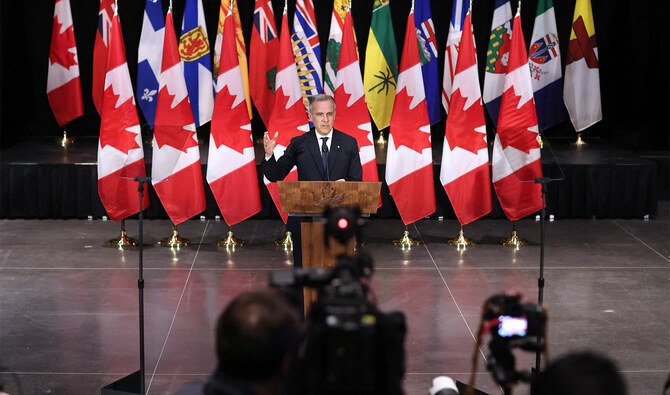
Vanessa Lloyd, deputy director of operations at CSIS, told a press conference that hostile state actors were increasingly leveraging artificial intelligence to meddle in elections.
“The PRC (People’s Republic of China) is highly likely to use AI enabled tools to attempt to interfere with Canada’s democratic process in this current election,” she said.
Earlier this month Beijing announced tariffs on more than $2.6 billion worth of Canadian agricultural and food products, retaliating against levies Ottawa slapped on Chinese electric vehicles and steel and aluminum products last year.
Canada said last week that China had executed four Canadian citizens on drug smuggling charges, and strongly condemned Beijing’s use of the death penalty.
Asked for a response to the CSIS comments at a regular news briefing on Tuesday, a Chinese foreign ministry spokesperson said China had always adhered to the principle of not interfering in the internal affairs of other countries, and had “never had any interest in interfering in Canada’s internal affairs.”
Canada last year expelled six Indian diplomats — including the head of mission — over allegations they were involved in a plot against Sikh separatists on Canadian soil.
“We have also seen that the government of India has the intent and capability to interfere in Canadian communities and democratic processes,” said Lloyd.
The Indian diplomatic mission in Ottawa was not immediately available for comment.
Russia and Pakistan could potentially conduct foreign interference activities against Canada, Lloyd added.
“It’s often very difficult to establish a direct link between foreign interference activities and election results ... Nevertheless, threat activities can erode public trust in the integrity of Canada’s democratic processes and institutions,” she said.


Canada says India, Pakistan among nations with potential to meddle in upcoming election
https://arab.news/jygwu
Canada says India, Pakistan among nations with potential to meddle in upcoming election

- Canada is set to hold general election on April 28 amid chilly relations with both India and China
- Its spy service says state actors are increasingly leveraging AI to meddle in electoral activities

Pakistan calls for new global cricket body, says ICC ‘hostage to Indian politics’
- Pakistan’s government has barred its team from playing against India in World Cup fixture on Feb.15
- India generates largest share of cricket’s commercial revenue, enjoying overarching influence in the sport
ISLAMABAD: Pakistan’s Defense Minister Khawaja Asif called for a new global cricket governing body on Tuesday, saying that the International Cricket Council (ICC) has become hostage to Indian political interests amid a fresh row between the neighbors ahead of the T20 World Cup 2026.
Pakistan’s government announced earlier this week that it has cleared its national men’s team to play the upcoming World Cup, scheduled to be held in India and Sri Lanka from Feb. 7. However, Islamabad said the national team will boycott its upcoming fixture against India on Feb. 15 without mentioning a reason. The ICC responded by saying that Pakistan’s decision was “not in the interest of the global game or the welfare of fans worldwide, including millions in Pakistan.”
Pakistan’s dispute with the ICC can be traced back to it expressing displeasure recently at the cricket body’s decision to replace Bangladesh with Scotland for the World Cup. Bangladesh had requested the global governing body shift its matches to any another venue outside India owing to security concerns, as political tensions surge Delhi and Dhaka surge.
“A new international organization of cricket is needed to keep the spirit of the gentleman’s game alive,” Asif wrote on social media platform X. “ICC has become hostage to Indian political interests in South Asia.”
India generates the largest share of cricket’s commercial revenue and hence enjoys overarching influence over the sport. Critics argue that this financial contribution translates into decisive leverage within the ICC.
A large part of that revenue comes from the Indian Premier League (IPL), the sport’s most lucrative T20 cricket competition, which is run by the Board of Control for Cricket in India (BCCI). Between 2024 and 2027, the IPL is projected to earn $1.15 billion, nearly 39 percent of the ICC’s total annual revenue, according to international media reports.
The ICC is headed by Jay Shah, the son of Indian Home Minister Amit Shah. The ICC chair is expected to be independent from any cricket board and hence take impartial decisions.
India and Pakistan engaged in a military confrontation that lasted for four days in May last year before Washington brokered a ceasefire. Militaries of the two countries pounded each other with drones, missiles, fighter jets and exchanged artillery fire in what was the worst fighting between them since 1999.
These bilateral tensions have made their way to cricket, with India refusing to shake hands with Pakistani cricketers during the September 2025 Asia Cup tournament between both sides. The two teams met for three matches, all of which India won, and did not shake hands before or after the fixtures.
The two countries have not played a full bilateral series since 2012–13 due to political tensions. They meet largely at neutral venues.


