‘Nazis got better treatment,’ judge says of Trump administration deportations

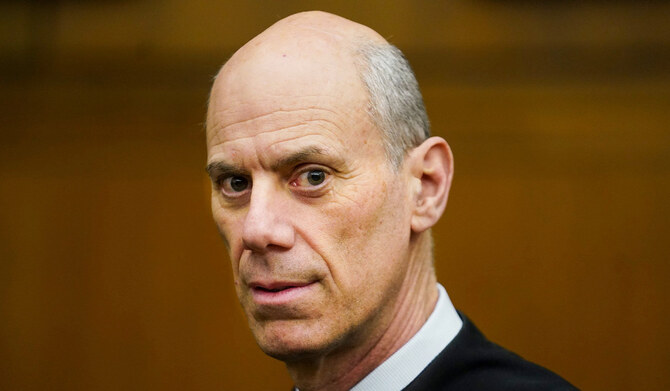
James Boasberg, chief judge of the US District Court in Washington. (Photo/social media)
Short Url
Updated 25 March 2025
Follow

‘Nazis got better treatment,’ judge says of Trump administration deportations

  • “Nazis got better treatment under the Alien Enemies Act,” said Millett, an appointee of former Democratic president Barack Obama

WASHINGTON: A federal judge on Monday sharply criticized the Trump administration’s summary deportation of alleged Venezuelan gang members, saying “Nazis got better treatment” from the United States during World War II.
President Donald Trump sent two planeloads of Venezuelan migrants to a prison in El Salvador on March 15 after invoking an obscure wartime law known as the 1798 Alien Enemies Act (AEA).
James Boasberg, chief judge of the US District Court in Washington, issued a restraining order that same day temporarily barring the Trump administration from carrying out any further deportation flights under the AEA.
The Justice Department is seeking to have the order lifted and a three-judge US Court of Appeals panel heard oral arguments in the closely watched case on Monday.
Justice Department attorney Drew Ensign said the judge’s order “represents an unprecedented and enormous intrusion upon the powers of the executive branch” and “enjoins the president’s exercise of his war and foreign affairs powers.”
Judge Patricia Millett appeared unconvinced and said the lower court judge was not disputing Trump’s presidential authority only the denial of individual court hearings to the deportees.
Attorneys for several of the deported Venezuelans have said that their clients were not members of the Tren de Aragua (TdA) gang, had committed no crimes and were targeted largely on the basis of their tattoos.
“Nazis got better treatment under the Alien Enemies Act,” said Millett, an appointee of former Democratic president Barack Obama. “They had hearing boards before people were removed.”
“People on those planes on that Saturday had no opportunity to challenge their removal under the AEA,” she said. “Y’all could have picked me up on Saturday and thrown me on a plane thinking I’m a member of Tren de Aragua and given me no chance to protest it.
“Somehow it’s a violation of presidential war powers for me to say, ‘Excuse me, no, I’m not. I’d like a hearing?’“
Judge Justin Walker, a Trump appointee, also suggested that court hearings were warranted but appeared more receptive to the arguments that the judge’s order impinged on presidential powers.
The third judge on the panel is an appointee of former Republican president George H.W. Bush.
The AEA, which has previously only been used during the War of 1812, World War I and World War II, gives the government vast powers to round up citizens of a “hostile nation” during wartime.

Lee Gelernt, a lawyer for the American Civil Liberties Union, which filed suit against the deportations, told the appeals court panel that the Trump administration was using the AEA “to try and short circuit immigration proceedings.”
The government would likely immediately resume AEA deportations if the temporary restraining order was lifted, Gelernt said.
“We are talking about people being sent to El Salvador, to one of the worst prisons in the world, incommunicado,” he said. “They’re essentially being disappeared.”
In a 37-page opinion issued on Monday, Boasberg, the district court judge, said that migrants subject to potential deportation under the AEA should be “entitled to individualized hearings to determine whether the Act applies to them at all.”
Trump has repeatedly lashed out at Boasberg, even going so far as to call for his impeachment, a remark that drew a rare public rebuke from Supreme Court Chief Justice John Roberts.
The contentious case has raised concerns among legal experts that the Trump administration would potentially ignore the court order, triggering a constitutional crisis.
Ahead of the hearing, Deputy Attorney General Todd Blanche announced plans to send three alleged TdA members facing extortion and kidnapping charges to Chile under the AEA.
Blanche said the Justice Department “is taking every step within the bounds of the law to ensure these individuals are promptly sent to Chile to face justice.”


US says Mexican cartel drones breached Texas airspace

Updated 4 sec ago
Follow

US says Mexican cartel drones breached Texas airspace

  • Drone breach comes some five months into a US military campaign targeting alleged drug-smuggling boats
  • US media also reported that the El Paso airspace closure may have been caused by the US military

HOUSTON: The Trump administration said Wednesday that Mexican cartel drones caused the temporary closure of a Texas airport, but some Democratic lawmakers pushed back, suggesting US military activity was responsible for the disruptive shutdown.
The report of the drone breach comes some five months into a US military campaign targeting alleged drug-smuggling boats, and could provide a pretext for President Donald Trump to follow through on his threats to expand the strikes to land.
Trump has specifically threatened to attack cartels inside Mexico, which said it had “no information” on drones at the border.
The US Federal Aviation Administration (FAA) said late Tuesday the airspace over the Texas border city of El Paso would be shut to all aircraft for 10 days, citing unspecified national “security reasons,” only to lift the closure after less than 24 hours.
Transportation Secretary Sean Duffy said in a post on X that the FAA and the Defense Department “acted swiftly to address a cartel drone incursion,” adding: “The threat has been neutralized, and there is no danger to commercial travel in the region.”
A US administration official meanwhile said the breach was by “Mexican cartel drones,” and that US forces “took action to disable the drones,” without providing specifics.
But Democratic Representative Veronica Escobar, whose district includes El Paso, questioned the Trump administration’s explanation, saying it was “not what we in Congress have been told.”
“The information coming from the administration does not add up and it’s not the information that I was able to gather overnight and this morning,” Escobar told journalists.
And top Democratic lawmakers from the House Committee on Transportation suggested the Pentagon may have been responsible for the situation, saying defense policy legislation allows the US military to “act recklessly in the public airspace.”
The lawmakers called for a solution that ensures “the Department of Defense will not jeopardize safety and disrupt the freedom to travel.”

- War against ‘narco-terrorists’ -

US media also reported that the El Paso airspace closure may have been caused by the US military, with CNN saying the shutdown was the result of Pentagon plans to use a counter-drone laser without coordinating with the FAA.
The Pentagon referred questions on the closure to the FAA, which said when it announced the move that “no pilots may operate an aircraft in the areas” covered by the restrictions and warned of potentially “deadly force” if aircraft were deemed a threat.
It updated its guidance Wednesday morning, saying on X that the closure was lifted.
Trump’s administration insists it is effectively at war with “narco-terrorists,” carrying out strikes on alleged traffickers in the Caribbean and eastern Pacific, while the US president has repeatedly said he plans to expand the strikes to land.
Mexican President Claudia Sheinbaum opposes US military intervention in her country but has so far managed to negotiate a fine diplomatic line with Trump.
She has stepped up extradition of cartel leaders to the United States and reinforced border cooperation amid tariff threats from Trump, for whom curbing illegal migration from Mexico was a key election promise.
Sheinbaum told a news conference Wednesday that she had “no information on the use of drones at the border,” but that her government was investigating.
The United States began carrying out strikes on alleged drug-trafficking boats in September, a campaign that has killed at least 130 people and destroyed dozens of vessels in the Caribbean Sea and eastern Pacific Ocean.
US officials have not provided definitive evidence that the vessels are involved in drug trafficking, prompting heated debate about the legality of the operations, which experts say amount to extrajudicial killings.
Trump also ordered a shocking special forces raid in Caracas at the beginning of January to capture Venezuelan leader Nicolas Maduro, whom Washington accused of leading a drug cartel.