

China holds key position in Aramco’s investment strategy, CEO tells Beijing forum

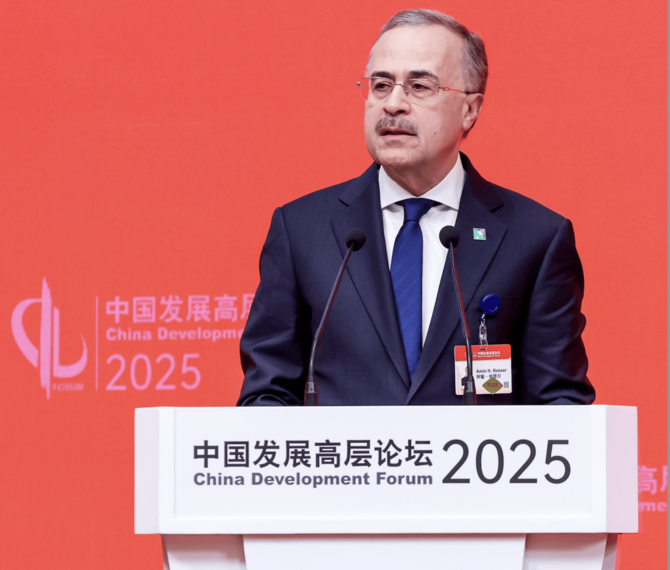
Amin Nasser speaking at the China Development Forum in Beijing. Supplied
Short Url
Updated 24 March 2025
Follow

China holds key position in Aramco’s investment strategy, CEO tells Beijing forum

RIYADH: Energy giant Saudi Aramco sees China as one of its key global investment destinations, with ongoing efforts to explore further opportunities across the power generation, chemicals, and technology sectors, according to its CEO. 

Speaking at the China Development Forum in Beijing, Amin Nasser emphasized his company’s three-decade-long partnership with the Asian country and its commitment to future growth and innovation. 

This comes as Aramco expands into new markets, including China, driven by the nation’s industrial growth, rising energy demand, and push for energy security. 

In his speech, Nasser said: “In China, Aramco is actively supporting energy and chemical feedstock security by investing in multiple downstream projects. In fact, China is among our key investment destinations.”

He highlighted current investments in Fujian, Liaoning, Zhejiang, and Tianjin, adding, “I emphasize ‘currently’ because we are continuing to identify additional opportunities, which include energy and chemicals, as well as technology.” 

Nasser also highlighted China’s role in the global economy, describing it as the world’s largest consumer and producer of petrochemicals, accounting for nearly half of global demand. 

“China is becoming a major hub for the entire chemicals industry value chain, which will be critical to industries of the future. China occupies a key position in Aramco’s global strategy,” he said. 

Aramco, as a long-term investor, is excited about the expanding opportunities in China, with Nasser expressing the company’s intent to elevate its relationship with the country. 

He underscored the importance of reliable oil and gas supply to China’s economic growth, predicting a shift in oil demand from light transport to petrochemicals due to rising demand for plastics, synthetic fibers, and advanced materials. 

“A reliable supply of these materials will be essential to China’s high-quality critical growth industries – including wind and solar energy, automotive, aerospace, and construction,” he added. 

In November, Aramco — in partnership with China Petrochemical & Chemical Corp. and Fujian Petrochemical Co. — began construction on a refinery and petrochemical complex in China’s Fujian province. 

At the time, the Saudi company said in a press statement that the facility would be fully operational by the end of 2030, featuring a 320,000-barrel-per-day oil refinery. 

The complex will also include a 1.5 million-tonnes-per-year ethylene unit, a 2 million-tonne paraxylene unit with downstream derivatives capacity, and a 300,000-tonne crude oil terminal. 


Arab Cities Culture and Creative Industries Index launched

Updated 11 sec ago
Follow

Arab Cities Culture and Creative Industries Index launched

  • UNESCO official says the index ‘strengthens the evidence base on culture and creative industries in the Arab region’
  • It is planned as an advanced policy-enabling tool designed to position culture and creative industries as core components of future governance models

DUBAI: The Mohammed bin Rashid School of Government launched the 2026 edition of the Arab Cities Culture and Creative Industries Index on Wednesday.

Building on UNESCO’s frameworks to quantify the contributions that culture and creativity make to urban development in the Arab region, the index is the first regionally grounded and evidence-based framework.

Ernesto Ottone Ramirez, UNESCO’s assistant director-general for culture; Hala Badri, director-general of Dubai Culture; and Ali Al-Marri, MBRSG’s executive president, attended a special panel at the World Governments Summit in Dubai, during which the index was announced.

Welcoming the launch of the Index, Ramirez said: “It strengthens the evidence base on culture and creative industries in the Arab region, providing reliable, comparable, and policy-relevant figures.

“Such data is essential to guide public investment, inform decision-making, support inclusive cultural policies, and monitor culture’s contribution to sustainable development.”

The launch marks a definitive transition from ambition-led strategies to data-informed cultural policymaking, according to Al-Marri, who said: “By positioning culture as a core component of governance and a productive economic sector with measurable impact, we provide Arab cities with the tools to benchmark their creative ecosystems against global standards while respecting our unique regional context.”

According to a media release, the index is planned as an advanced policy-enabling tool designed to position culture and creative industries as core components of future governance models, marking a significant paradigm shift in which culture is recognized not merely as a social asset but as a strategic pillar of economic resilience, innovation, and inclusive growth.

Badri emphasized that the launch of the index represents an important step in highlighting culture’s role in advancing societies and positioning the cultural and creative industries as key contributors to the emirate’s knowledge- and innovation-driven economy.