- Talks follow meeting between US, Ukrainian officials on Sunday
- Teams will also discuss “the line of control” between the two countries
RIYADH/KYI: A US delegation will seek progress toward a Black Sea ceasefire and a broader cessation of violence in the war in Ukraine when it meets for talks with Russian officials on Monday, after discussions with diplomats from Ukraine on Sunday.
The so-called technical talks come as US President Donald Trump intensifies his drive for a halt to Russia’s three-year-old assault against Ukraine. Last week, he spoke with both Ukrainian President Volodymyr Zelensky and Russian President Vladimir Putin.
A source briefed on the planning for the talks said the US side was being led by Andrew Peek, a senior director at the White House National Security Council, and Michael Anton, a senior State Department official.
They met the Ukrainians on Sunday night and plan to sit down with the Russians on Monday.
The White House says the aim of the talks is to reach a maritime ceasefire in the Black Sea, allowing the free flow of shipping.
White House national security adviser Mike Waltz told CBS’ “Face the Nation” on Sunday that the US, Russian and Ukrainian delegations were assembled in the same facility in Riyadh.
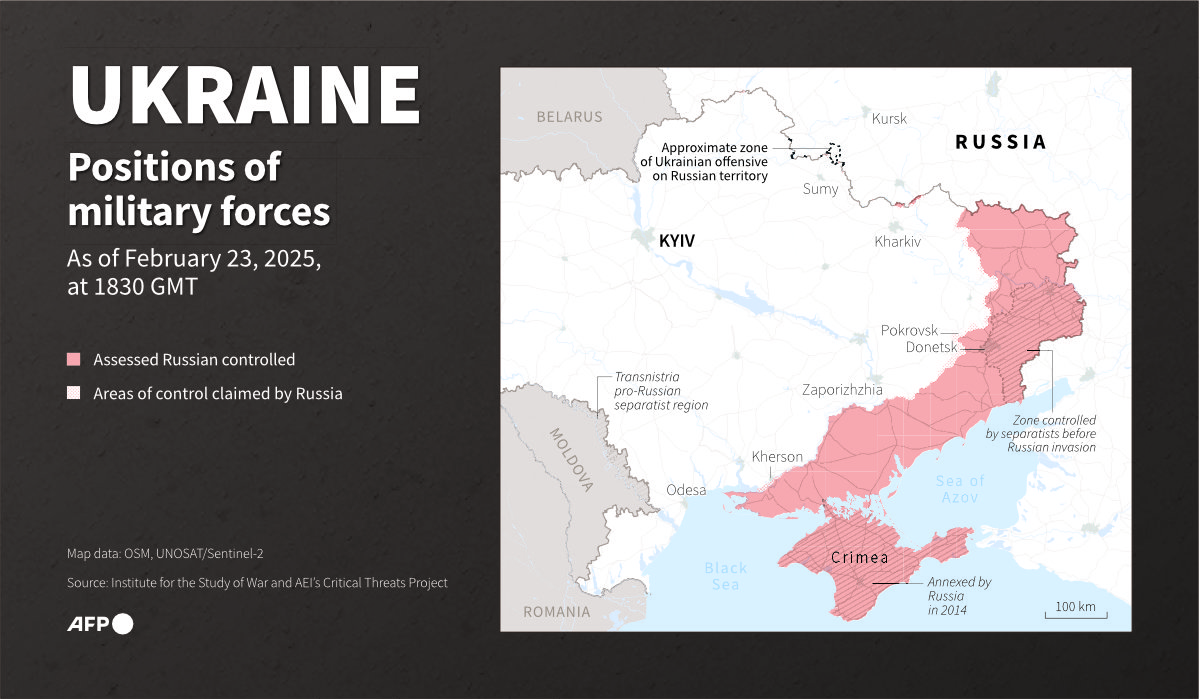
Beyond a Black Sea ceasefire, he said, the teams will discuss “the line of control” between the two countries, which he described as “verification measures, peacekeeping, freezing the lines where they are.” He said “confidence-building measures” are being discussed, including the return of Ukrainian children taken by Russia.
ussia will be represented by Grigory Karasin, a former diplomat who is now chair of the Federation Council’s Foreign Affairs Committee, and Sergei Beseda, an adviser to the director of the Federal Security Service.
Ukraine’s defense minister, Rustem Umerov, the head of the Ukrainian delegation, said on Facebook that the US-Ukraine talks included proposals to protect energy facilities and critical infrastructure.
After Russian forces made gains in 2024, Trump reversed US policy on the war, launching bilateral talks with Moscow and suspending military assistance to Ukraine, demanding that it take steps to end the conflict.
US special envoy Steve Witkoff, who met Putin in Moscow in early March, played down concerns among Washington’s NATO allies that Moscow could be emboldened by a deal and invade other neighbors.
“I just don’t see that he wants to take all of Europe. This is a much different situation than it was in World War Two, Witkoff told Fox News.
“I feel that he wants peace,” Witkoff said of Putin.
Somewhat under control
Trump has long promised to end Europe’s deadliest conflict since World War Two. But his outreach to Putin has unnerved European allies, who fear it heralds a fundamental shift after 80 years in which defending Europe from Russian expansionism was the core mission of US foreign policy.
The war has killed or wounded hundreds of thousands of people, displaced millions and reduced entire towns to rubble.
Putin, whose forces invaded Ukraine in February 2022, said earlier this month he supported in principle Washington’s proposal for a truce but that his forces would fight on until several crucial conditions were worked out.
Heorhii Tykhyi, a Ukrainian Foreign Ministry spokesperson, said on Friday the Ukrainian and American sides were due “to clarify the modalities, the nuances of possible different ceasefire regimes, how to monitor them, how to control them, in general, what is included in their scope.”
Last Tuesday, Putin agreed to Trump’s proposal for Russia and Ukraine to stop attacks on each other’s energy infrastructure for 30 days and ordered the Russian military to cease them.
The agreement fell short, however, of a wider agreement that the US had sought, and which Kyiv backed, for a blanket 30-day truce in the war.
Trump said on Saturday that efforts to stop further escalation in the Ukraine-Russia conflict were “somewhat under control.”
The US hopes to reach a broad ceasefire within weeks, targeting a truce agreement by April 20, Bloomberg News reported on Sunday, citing people familiar with the planning.
Despite all the diplomatic activity, Russia and Ukraine have both reported continued strikes, while Russian forces have also continued to advance slowly in eastern Ukraine, a region Moscow claims to have annexed.