Japan, China, and South Korea agree to promote peace

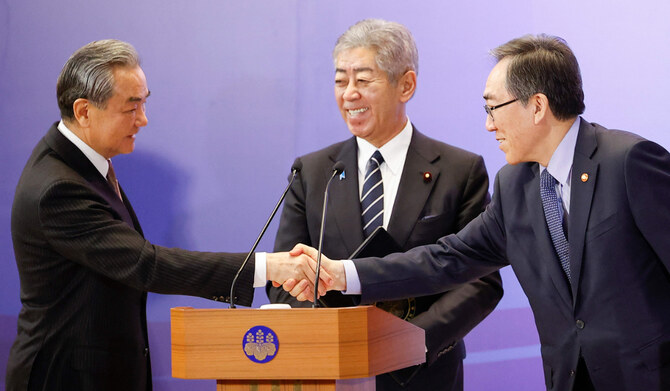
China's Foreign Minister Wang Yi (L) and South Korea's Foreign Minister Cho Tae-yul (R) shake hands as Japan's Foreign Minister Takeshi Iwaya looks on during a joint press conference after their meeting during the 11th Trilateral Foreign Minister's Meeting (Japan-China-ROK) in Tokyo on March 22, 2025. (AFP)
Short Url
Updated 23 March 2025
Follow

Japan, China, and South Korea agree to promote peace

  • Seoul and Tokyo typically take a stronger line against North Korea than China, which remains one of Pyongyang’s most important allies and economic benefactors

TOKYO: Japan, South Korea and China agreed Saturday that peace on the Korean Peninsula was a shared responsibility, Seoul’s foreign minister said, in a meeting of the three countries’ top diplomats in which they pledged to promote cooperation.
The talks in Tokyo followed a rare summit in May in Seoul where the three neighbors — riven by historical and territorial disputes — agreed to deepen trade ties and restated their goal of a denuclearised Korean peninsula.
But they come as US tariffs loom over the region, and as concerns mount over North Korea’s weapons tests and its deployment of troops to support Russia’s war against Ukraine.
“We reaffirmed that maintaining peace and stability on the Korean peninsula is a shared interest and responsibility of the three countries,” South Korea’s Cho Tae-yul told reporters after the trilateral meeting.
Seoul and Tokyo typically take a stronger line against North Korea than China, which remains one of Pyongyang’s most important allies and economic benefactors.
Japanese Foreign Minister Takeshi Iwaya said he, Cho, and China’s Wang Yi “had a frank exchange of views on trilateral cooperation and regional international affairs ... and confirmed that we will promote future-orientated cooperation.”
“The international situation has become increasingly severe, and it is no exaggeration to say that we are at a turning point in history,” Iwaya said at the start of Saturday’s meeting.
This makes it “more important than ever to make efforts to overcome division and confrontation,” he added.
Wang noted this year marks the 80th anniversary of the end of WWII, saying “only by sincerely reflecting on history can we better build the future.”
At two-way talks between Iwaya and Wang on Saturday, the Japanese minister said he had “frankly conveyed our country’s thoughts and concerns” on disputed islands, detained Japanese nationals and the situation in Taiwan and the South China Sea, among other contentious issues.
Ukraine was also on the agenda, with Iwaya warning “any attempt to unilaterally change the status quo by force will not be tolerated anywhere in the world.”
Climate change and aging populations were among the broad topics officials had said would be discussed, as well as working together on disaster relief and science and technology.
Iwaya said the trio had “agreed to accelerate coordination for the next summit” between the countries’ leaders.


Japan protests after a Chinese military aircraft locks its radar on Japanese jets

Updated 3 sec ago
Follow

Japan protests after a Chinese military aircraft locks its radar on Japanese jets

TOKYO: Japan said early Sunday that it has protested to China after a military jet that took off from the Chinese carrier Liaoning locked its radar on Japanese fighter jets near the southern island of Okinawa, the latest spat between the two countries whose ties have plunged recently over the Japanese leader’s Taiwan remarks.
Japan’s Defense Ministry said China’s military aircraft J-15 “intermittently” targeted its radar at Japanese F-15 fighter jets on two occasions Saturday — for about three minutes in the late afternoon and for about 30 minutes in the evening.
The radar lock by the Chinese aircraft was detected by different Japanese fighters that had scrambled against a possible airspace violation by China, according to the ministry. There was no breach of Japanese airspace, and no injury or damage was reported from the incident.
It was not known whether the radar lock incident involved the same Chinese J-15 both times.
Defense Minister Shinjiro Koizumi, briefing reporters in the early hours of Sunday, said Japan protested to China over the radar lock, calling it “a dangerous act that exceeded the scope necessary for safe aircraft operations.”
“The occurrence of such an incident is extremely regrettable,” Koizumi said. “We have lodged a strong protest with the Chinese side and demanded strict preventive measures.”
There was no immediate comment from the Chinese government or military. On Friday, Foreign Ministry spokesperson Lin Jian said the Chinese navy operates in accordance with international law and that others shouldn’t hype up its activities.
The latest incident comes as relations between the two countries have worsened in recent weeks.
China was angered by a statement by Japan’s Prime Minister Sanae Takaichi in early November that its military could get involved if China were to take action against Taiwan, the self-governing island that Beijing says must come under its rule.
The aircraft carrier Liaoning on Saturday passed between the main island of Okinawa and nearby Miyako island as it conducted aircraft takeoff and landing exercises in the Pacific.
Japanese F-15 fighter jets, scrambled in case of an airspace violation, were pursuing the Chinese aircraft at a safe distance and did not involve actions that could be interpreted as provocation, Kyodo News agency said, quoting defense officials.
Fighter jets can use radars for search, or as fire control ahead of a missile launch.
It is believed to be the first instance of a radar lock involving Japanese and Chinese military aircraft. In 2013, a Chinese warship targeted a radar on a Japanese destroyer, Kyodo said.
Elsewhere in the Pacific, the Philippine coast guard said China fired three flares toward a fisheries bureau plane on patrol in the South China Sea on Saturday. Chinese forces fire flares to warn planes to move away from what they consider their airspace over the disputed waters.