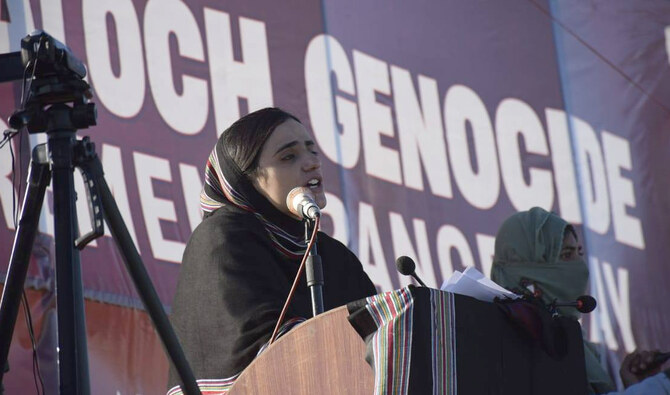
QUETTA: A leading Baloch ethnic rights group announced on Saturday its top leader was arrested along with several of her colleagues in southwestern Balochistan after police raided their protest camp at dawn in the provincial capital of Quetta.
Dr. Mahrang Baloch has long campaigned for the rights of the ethnic Baloch community, which claims to be subjected to extrajudicial harassment, arrests and killings by security forces in the province.
The Pakistani state, however, denies the allegation, saying its forces are combating separatist militants who target armed forces personnel and foreign nationals in the mineral-rich province that borders Iran and Afghanistan.
The Baloch Yakjehti Committee (BYC) said its leader’s arrest came amid a province-wide wheel-jam strike that followed an alleged police attack on a protest in Quetta that killed three people on Friday evening. BYC said its leader and other supporters began a sit-in with the bodies of the deceased when authorities intervened and detained them.
“At around 5:30 this morning, police and other state agencies attacked the protest sit-in, seized the bodies of the martyrs from the demonstrators, and arrested Baloch Yakjehti Committee’s central leader, Dr. Mahrang Baloch, along with her companions,” Sammi Deen Baloch, another BYC leader, said in a social media post.
“The bodies of the slain youth were also forcibly taken into custody,” she added. “In addition, a crackdown was carried out against women and children as well.”
Balochistan’s provincial authorities accused the BYC of getting into a confrontation with police after some of its members allegedly tried to snatch the bodies of deceased militants involved in the hijacking of a passenger train in the province from a mortuary last week.
The Baloch Liberation Army (BLA), a separatist group, had targeted the Peshawar-bound Jaffar Express in the mountainous Bolan region on March 11, taking hundreds of passengers captive.
The siege, which lasted for two days, ended after a military operation that killed 33 militants. The attack, which also claimed the lives of over 30 civilians and security personnel, was one of the deadliest train assaults in the country’s history.
A senior police official confirmed to Arab News on condition of anonymity that Baloch and seven other BYC activists had been arrested in this morning following the attempt to take militants’ bodies with them.
“Police have lodged an FIR [first information report] against Dr. Mahrang and other protesters who attempted to snatch militants’ bodies from the Civil Hospital on Wednesday to glorify the terrorists,” he said. “They also snatched two bodies yesterday from the families who wanted to bury their loved ones and didn’t want to be part of the police and BYC clash.”
A statement released by the office of the commissioner Quetta division during the day also maintained the BYC initiated a protest seeking the recovery of the bodies of militants who targeted the passenger train.
“The protest quickly turned violent as BYC protesters and their armed accomplices resorted to stone-pelting, indiscriminate firing and attacks on law enforcement personnel,” the statement continued. “During the unrest, three individuals lost their lives due to the firing by armed elements accompanying BYC leadership.”
The statement added civil authorities and police emphasized the deceased individuals’ bodies required examination to ascertain the actual circumstances of their deaths, but the BYC refused to hand them over.
“On the request of the deceased’s families, police successfully recovered the bodies from the unlawful custody of BYC supporters and ensured their respectful handover to the respective families,” the statement informed.
“Legal proceedings have been initiated against BYC leaders and their armed associates for inciting and abetting unlawful activities,” it added. “They have been booked under relevant laws for attacking the Civil Hospital, instigating violent protests and other serious offenses.”
Meanwhile, Sabiha Baloch, a senior BYC member, conducted a news conference in which she presented a list of demands to the government.
“The [Balochistan] chief minister, inspector general of police, commissioner and deputy commissioner of Quetta must be sacked for killing three unarmed protesters,” she said. “All detained members of BYC, including Dr. Mahrang Baloch, must be released immediately.”
The authorities restored the cellphone service in Quetta on Saturday evening after suspending it for 16 hours amid the BYC protests. However, the cellphone Internet service continues to remain suspended even after three days.


![]()

Baloch rights group says top leader arrested in police raid in southwestern Pakistan
Short Url
https://arab.news/5yzbc
Baloch rights group says top leader arrested in police raid in southwestern Pakistan
- Baloch Yakjehti Committee says Dr. Mahrang Baloch was arrested amid a province-wide wheel-jam strike
- Provincial authorities blame BYC activists for trying to snatch the bodies of militants who targeted Jaffar Express
Latest updates


© 2026 SAUDI RESEARCH & PUBLISHING COMPANY, All Rights Reserved And subject to Terms of Use Agreement.