At least 44 civilians killed in extremist attack in Niger, authorities say

The Interior Ministry says the attack took place on Friday afternoon in the village of Fambita. (AFP)
Short Url
Updated 22 March 2025
Follow

At least 44 civilians killed in extremist attack in Niger, authorities say

  • The Interior Ministry says the attack took place on Friday afternoon in the village of Fambita

DAKAR: An attack by a extremist group on a village in western Niger has killed 44 civilians, the country’s Interior Ministry said.
The attack took place on Friday afternoon in the village of Fambita in the rural commune of Kokorou, near the tri-state border with Mali and Burkina Faso, the ministry said in a statement. It blamed the attack on the Islamic State in the Great Sahara, or EIGS.
The Associated Press was not able to reach out to the EIGS for comment.
“Around 2 p.m., while Muslim worshippers were performing Friday prayers, these heavily armed terrorists surrounded the mosque to carry out their massacre of rare cruelty,” the statement read. The gunmen also set fire to a market and houses before retreating, it added.
The provisional death toll is at least 44 civilians, with 13 severely injured, the ministry said. It declared three days of national mourning
Niger, along with its neighbors Burkina Faso and Mali, has for over a decade battled an insurgency fought by extremist groups, including some allied with Al-Qaeda and the Daesh group.
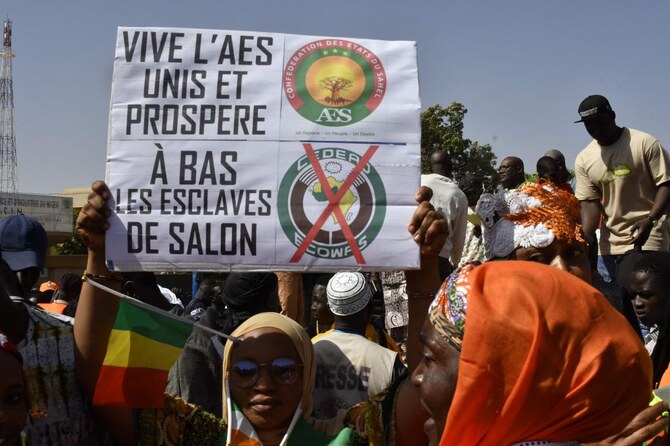
Following military coups in all three nations in recent years, the ruling juntas have expelled French forces and turned to Russia’s mercenary units for security assistance. The three countries have vowed to strengthen their cooperation by establishing a new security alliance, the Alliance of Sahel States.
But the security situation in the Sahel, a vast region on the fringes of the Sahara Desert, has significantly worsened since the juntas took power, analysts say, with a record number of attacks and civilians killed both by Islamic militants and government forces.


Pakistani fighter jet crashes in Jalalabad, pilot captured: Afghan military, police

Updated 42 min 34 sec ago
Follow

Pakistani fighter jet crashes in Jalalabad, pilot captured: Afghan military, police

  • Fighting between Pakistan and Afghanistan’s Taliban military entered its third day on Saturday
  • Pakistan’s strikes on Friday hit Taliban military installations and posts, including in Kabul and Kandahar

JALALABAD: A Pakistani jet has crashed in Jalalabad city and the pilot captured alive, the Afghan military and police said Saturday, with residents telling AFP the man parachuted from the plane before being detained.
"A Pakistani fighter jet was shot down in the sixth district of Jalalabad city, and its pilot was captured alive," police spokesman Tayeb Hammad said.
Wahidullah Mohammadi, spokesman for the military in eastern Afghanistan, confirmed the Pakistani jet was downed by Afghan forces "and the pilot was captured alive".

The AFP journalist heard a jet overhead before blasts from the direction of the airport in Jalalabad, the capital of Nangarhar province, which sits on the road between Kabul and the Pakistani border.

Fighting between Pakistan and Afghanistan’s Taliban military entered its third day on Saturday, following overnight clashes as the international community expressed increasing concern about the conflict and called for urgent talks.

Pakistan’s strikes on Friday hit Taliban military installations and posts, including in Kabul and Kandahar, in one of the deepest Pakistani incursions into its western neighbor in years, officials said.

Islamabad accuses the Taliban of harboring Tehreek-e-Taliban Pakistan (TTP) militants, who it claims are waging an insurgency inside Pakistan, a charge the Taliban denies.

Pakistan described its actions as a response to cross-border assaults, while Kabul denounced them as a breach of its sovereignty, saying it remained open to dialogue but warned any wider conflict would result in serious consequences.

The fighting has raised ‌the risk ‌of a protracted conflict along the rugged 2,600-kilometer frontier.

Diplomatic efforts gathered ‌pace ⁠late on Friday ⁠as Afghanistan said its foreign minister, Amir Khan Muttaqi, spoke by telephone with Saudi Arabia’s Prince Faisal bin Farhan about reducing tensions and keeping diplomatic channels open.

The European Union called for both sides to de-escalate and engage in dialogue, while the United Nations urged an immediate end to hostilities.

Russia urged both sides to halt the clashes and return to talks, while China said it was deeply concerned and ready to help ease tensions.

The United States supports Pakistan’s right to defend itself against attacks by ⁠the Taliban, a State Department spokesperson said.

Border fighting continues

Exchanges of fire continued along ‌the border overnight.

Pakistani security sources said an operation dubbed “Ghazab Lil Haq” was ongoing and that Pakistani forces had destroyed multiple Taliban posts and camps in several sectors. Reuters could not independently verify the claims.

Both sides have reported heavy losses with conflicting tolls that Reuters could not verify. Pakistan said 12 of its ‌soldiers and 274 Taliban were killed while the Taliban said 13 of its fighters and 55 Pakistani soldiers died.

Taliban deputy spokesman Hamdullah Fitrat ⁠said 19 civilians were ⁠killed and 26 wounded in Khost and Paktika. Reuters could not verify the claim.

Pakistan’s Defense Minister Khawaja Muhammad Asif said “our cup of patience has overflowed” and described the fighting as “open war,” warning that Pakistan would respond to further attacks.

Taliban Interior Minister Sirajuddin Haqqani said in a speech in Khost province that the conflict “will be very costly,” and that Afghan forces had not deployed broadly beyond those already engaged.

He said the Taliban had defeated “the world, not through technology, but through unity and solidarity,” and through “great patience and perseverance,” rather than superior military power.

Pakistan’s military capabilities far exceed those of Afghanistan, with a standing army of hundreds of thousands and a modern air force.

In stark contrast, the Taliban lacks a conventional air force and relies largely on light weaponry and ground forces.

However, the Islamist group is battle-hardened after two decades of insurgency against US-led forces before returning to power in 2021.