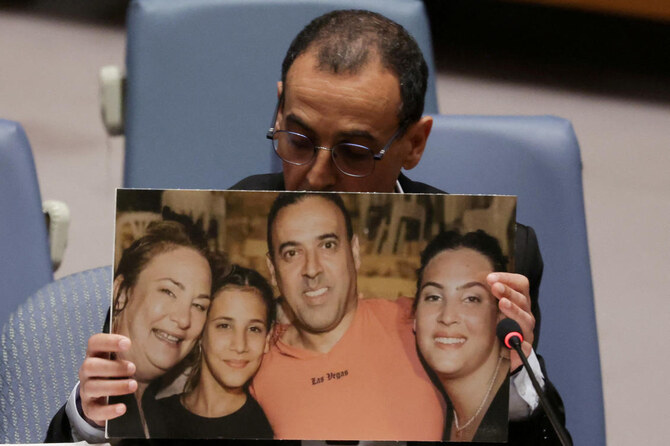
UNITED NATIONS: Freed Israeli hostage Eli Sharabi, who was beaten, chained and starved while held for 491 days by Hamas, expressed his anger during an appearance at the UN Security Council on Thursday for having to suffer for so long and worry every day about being killed.
“Where was the United Nations? Where was the Red Cross? Where was the world?” Sharabi asked.
He challenged the UN’s most powerful body: “If you stand for humanity prove it” by bringing home the 59 hostages still in Gaza, many of whom are believed to be dead.
The fate of the remaining hostages became more uncertain after Israel on Tuesday ended a six-week break in the fighting that had allowed for the return of some hostages in exchange for Palestinian prisoners.
Sharabi said the council talked about the need to get humanitarian aid to Palestinians in Gaza, but he saw Hamas militants eating stolen food from dozens of boxes marked with UN emblems while the hostages starved. They were given maybe a piece of pita and a sip of tea a day, and an occasional dry date, he said.
When he was released on Feb. 8, Sharabi said he weighed 44 kilos (about 97 pounds) — less than the weight of his youngest daughter, who was killed along with his wife and older daughter in Hamas’ surprise attack in southern Israel on Oct. 7, 2023, along with about 1,200 others. He was among 251 people taken hostage.
The United States in November vetoed a UN Security Council resolution demanding an immediate ceasefire in Gaza because it was not linked to an immediate release of the hostages.
The Palestinians and their supporters then went to the 193-member General Assembly, which adopted a resolution in December demanding a ceasefire and reiterating its demand for the release of the hostages. Unlike Security Council resolutions, though, those passed by the General Assembly are nonbinding.
The ceasefire that went into effect in January was shattered on Tuesday with surprise airstrikes on Gaza that killed more than 400 Palestinians, one of the highest death tolls in the nearly 18-month war. Gaza’s Health Ministry said most victims were women and children.
Sharabi’s appearance before the council, the second by a freed hostage, followed an Israeli request last week for a meeting on the plight of the hostages.
Britain’s deputy ambassador James Kariuki called Sharabi’s suffering “beyond the imagination” and said “Hamas must be held accountable for their despicable actions.”
But Kariuki also said the UK condemns Israeli Defense Minister Israel Katz’s “warning of the total destruction of Gaza.” Britain calls for the rapid resurgence of aid to Gaza, an investigation into allegations of sexual and gender-based violence against Palestinian detainees by Israeli forces, and an urgent return to the ceasefire deal, he said.
France’s new UN ambassador, Jérôme Bonnafont, expressed his country’s deepest condolences to Sharabi but also condemned the resumption of Israel’s bombing, saying it will not ensure the release of hostages, and demanded an end to Israel’s humanitarian blockade of Gaza.
Russia’s deputy UN ambassador Dmitry Polyansky told the council, “Our hearts were filled with sorrow as we listened to the tragic story of Mr. Eli Sharabi,” adding “such brutality can have no justification.”
Polyansky criticized Israel’s leaders for not moving to phase 2 of the ceasefire deal, which calls for the release of all hostages and a permanent end to the fighting. He said it’s difficult to discuss the future when Israel’s military and political leaders appear to have made the choice in favor of war.
Algeria’s UN Ambassador Amar Bendjama, representing the Arab world on the council, called Sharabi a “representative of civil society,” and said “no civilian, irrespective of their background, should endure suffering.”
He then accused Israel of “cherry-picking” international law. He pointed to Israel’s ban on humanitarian aid, fuel and electricity entering Gaza since March 2, its killing of civilians, and the cutoff of the International Committee of the Red Cross’ access to over 9,500 Palestinians detained in Israeli prisons since Oct. 7.
After all council members spoke, Riyad Mansour, the Palestinian UN ambassador, sent “our condolences” to Sharabi over the killing of his loved ones and his prolonged captivity. He said Palestinians “understand this pain because we live it.”
Sharabi made no mention of Israeli actions, except to say that on the morning of Oct. 7, when he heard that militants were inside Kibbutz Be’eri where he lived, he reassured his wife not to worry: “The army will come, they always come.” That morning, they never came.
He told the council he came to speak for 24-year-old Alon Ohel, a fellow hostage whom he left behind in the tunnel, and all others, including his older brother, Yossi, who was killed but whose body remains in Gaza.
“Bring them all home. Now!” Sharabi said.


![]()

Israeli hostage freed after 491 days asks: Where was the United Nations, the Red Cross, the world?
Short Url
https://arab.news/b4bat
Israeli hostage freed after 491 days asks: Where was the United Nations, the Red Cross, the world?
- He challenged the UN’s most powerful body: “If you stand for humanity prove it” by bringing home the 59 hostages still in Gaza
- Sharabi said the council talked about the need to get humanitarian aid to Palestinians in Gaza, but he saw Hamas militants eating stolen food from boxes marked with UN emblems


Latest updates





© 2026 SAUDI RESEARCH & PUBLISHING COMPANY, All Rights Reserved And subject to Terms of Use Agreement.