

What we know about Heathrow Airport

London’s Heathrow Airport is Europe’s busiest. (FILE/REUTERS)
Short Url
Updated 21 March 2025
Follow

What we know about Heathrow Airport

Britain’s Heathrow Airport, a major travel hub, said it would be closed all of Friday after a huge fire at a nearby electrical substation wiped out power, disrupting flight schedules around the world.

Here are some facts about one of the world’s busiest international airport:

HISTORY:

  • The airport is named after the village or hamlet of Heathrow, which used to be roughly where Terminal 3 now stands.
  • It began as a tented village in 1946 serving 18 destinations with a handful of airlines making 9,000 flights a year.
  • The first departure was on New Year’s Day 1946 to Buenos Aires via Lisbon, the first refueling stop on a long-haul flight to open up Britain’s first air link with South America.
  • Heathrow’s first terminal for short haul flights opened in 1955. Originally known as the Europa Building, it is now known as Terminal 2.
  • Terminal 1 was formally opened in 1969 by Queen Elizabeth and was closed in June 2015. Terminal 3 opened in 1961 and Terminal 4 in 1986.
  • Terminal 5 opened in 2008. The public inquiry into its construction was the longest in British planning history, lasting nearly four years.
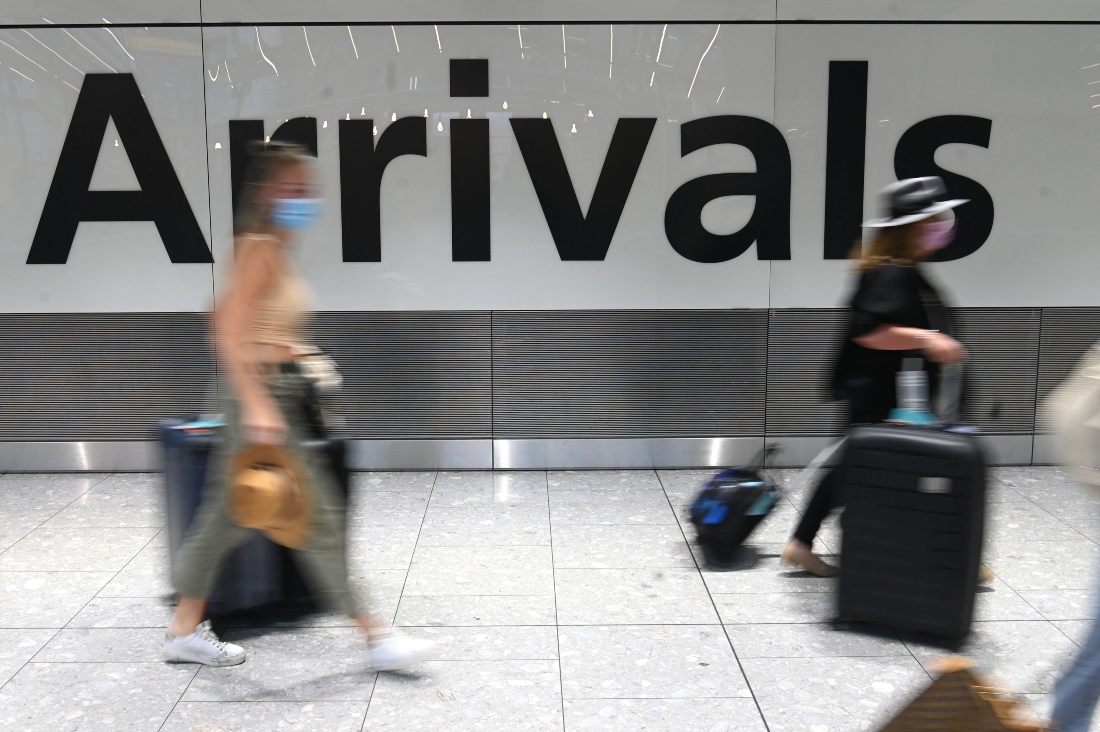


(FILE/AFP)


KEY NUMBERS:

  • Heathrow serves over 230 destinations in nearly 90 countries.
  • 90 airlines have made Heathrow their base, including British Airways, Virgin Atlantic and Lufthansa.
  • There are two main runways. The northern one is 3,902 meters long. The southern is 3,658 meters.
  • The airport will submit its proposal for a third runway this summer, weeks after the British government granted its support to the project citing its potential to boost trade and economic growth.
  • According to the group’s traffic summary, 5.7 million passengers traveled through Heathrow in February 2025, making it the busiest February on record. Passenger numbers amounted to 84.1 million from March 2024 to February 2025.
  • Heathrow is operating at 99 percent capacity and risks being overtaken by European rivals. Its two runways compare with four each at Paris’ Charles de Gaulle and Frankfurt Airport, and six at Amsterdam’s Schiphol.
  • There are around 475,000 total aircraft movements annually.
  • The most popular destination is New York.
  • Over 90,000 people work at the airport, the UK’s largest single-site employer.

UAE dethrone Algeria as Jordan edge Iraq to reach Arab Cup semi-finals

Updated 5 sec ago
Follow

UAE dethrone Algeria as Jordan edge Iraq to reach Arab Cup semi-finals

  • Jordan repeat Asian Cup triumph over Iraq with a 1-0 victory, Ali Olwan scoring from the spot for the 4th time in 4 consecutive matches
  • UAE end Algeria’s reign as Arab Cup champions with a 7-6 penalty-shootout win after the game ends 1-1

DOHA: The UAE and Jordan booked their places in the Arab Cup semi-finals on a dramatic day of quarter-final action in which the defending champions were eliminated and a regional rivalry was renewed.

Jordan repeated their Asian Cup triumph over Iraq with another narrow victory, as Ali Olwan extended his remarkable streak of scoring from the spot to four consecutive matches.

His first-half penalty was the only goal in a cagey encounter with few clear-cut chances for either side. Jordan dominated early on but were dealt a blow when star forward Yazan Al-Naimat was forced off with a knee injury.

Iraq improved after the break, with the talismanic Ali Jasim injecting a sense of urgency and twice drawing smart saves from Yazeed Abulaila, first with a fierce long-range strike and then a driven effort moments later.

Jordan nearly sealed the victory with a second goal late on when Mohannad Abu Taha, who scored with a spectacular long-range strike earlier in the tournament, hammered another powerful attempt just wide.

Nevertheless, the Jordanians held firm to set up a semi-final clash with Saudi Arabia on Monday.

The second quarter-final delivered even more drama, as the UAE ended Algeria’s reign as Arab Cup champions with a sudden-death, penalty-shootout win.

Algeria dominated the opening half and twice found the net, only for both goals to be ruled out. They finally made their pressure count just 50 seconds after the restart, when Adil Boulbina fired home after Yacine Brahimi’s strike was parried into his path.

The UAE had struggled to gain a foothold in the game but hit back through Bruno, who converted a pinpoint, inswinging cross from Yahya Al-Ghassani midway through the second half.

As Algeria pressed for a winner they were nearly punished at the end of regulation time when Lucas Pimenta’s fine header forced a sharp save from Farid Chaal.

Extra time offered chances for Brahimi and substitute Zakaria Draoui to put Algeria ahead again, but the breakthrough never came.

And so to the shootout, in which the UAE goalkeeper, Hamad Almeqbaali, denied Mohammed Khacef before Richard Akonnor coolly dispatched the decisive kick to make it 7-6 on penalties and set up a semi-final clash with Morocco, also on Monday.