

UK police chiefs warn of increased Islamophobia as British government defunds Tell Mama service

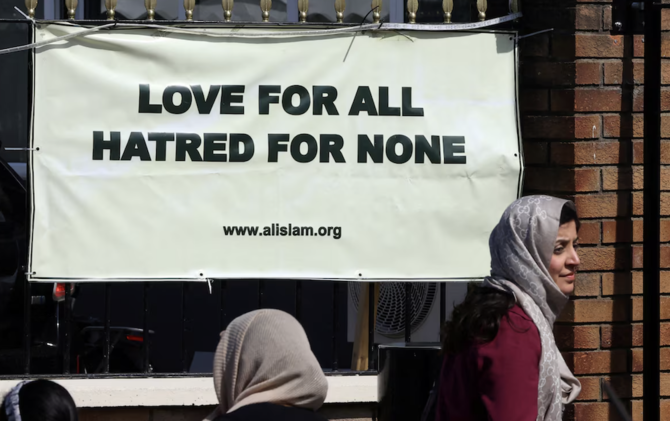
Senior police officials have issued a warning that the British government’s plans to cut funding for Tell Mama, the UK’s leading anti-Muslim hate-monitoring service, could severely impact efforts to tackle Islamophobia. (Reuters/File Photo)
Short Url
Updated 20 March 2025
Follow

UK police chiefs warn of increased Islamophobia as British government defunds Tell Mama service

  • Tell Mama, the UK’s leading anti-Muslim hate-monitoring service, faces imminent closure unless the decision is reversed

LONDON: Senior police officials have issued a warning that the British government’s plans to cut funding for Tell Mama, the UK’s leading anti-Muslim hate-monitoring service, could severely impact efforts to tackle Islamophobia.

The charity, which has been entirely funded by the Ministry of Housing, Communities and Local Government since its establishment in 2015, faces imminent closure unless the decision is reversed, The Times reported on Thursday.

Earlier this year, Tell Mama recorded the highest number of anti-Muslim hate incidents in its history.

The National Police Chiefs’ Council has urged the government to reconsider, stressing the charity’s “invaluable” role in providing police forces with critical data.

The NPCC, which has a data-sharing agreement with Tell Mama, says the organization’s work has been instrumental in preventing hate-fueled social disorder.

“This research lays bare the hostility and abuse faced by many in our Muslim communities,” said Mark Hobrough, NPCC lead for hate crime and chief constable of Gwent police.

“Our longstanding and trusted relationships with key partners like Tell Mama have been invaluable amidst these events, and I am confident that the strength of our partnerships will continue to help us reassure communities and bring hate crime offenders to justice.

“We all have a right to live our lives free from targeted abuse, and I would urge anyone who suffers anti-Muslim hate crime to report it to the police or to Tell Mama.”

Experts in policing and hate crime have echoed concerns about the consequences of defunding Tell Mama. Mike Ainsworth, chair of the National Independent Advisory Group on Hate Crime for Policing and Criminal Justice, warned against downplaying the seriousness of Islamophobia in Britain.

“Tell Mama have provided the clearest picture we have of the extent of anti-Muslim hate crime and prejudice in the country,” he said. “It’s an uncomfortable picture to look at, but it is essential that we do not look away.

“The figures are stark, but they help us understand the scale of the problem and what we must do to move forward. Tell Mama have provided the foundations that government departments and the legal justice system must build on to restore trust and confidence.”

Tell Mama’s founder, Fiyaz Mughal, expressed frustration over what he saw as a failure by British ministers to appreciate the organization’s vital role in tackling hate crime.

“Tell Mama has worked tirelessly with many police forces in the United Kingdom,” he said. “We have met with officers from every corner of the country and met committed, dedicated, and true professionals who have tried to get victims of anti-Muslim hate access to justice.

“They are the unsung heroes with the victims themselves, and some people, including a handful of politicians, reduce our work to numbers and figures and disrespect the whole picture of the range of activities, statutory agencies, and the good men and women in law enforcement in our country that we work with on a daily basis.”

Tell Mama has yet to receive £500,000 from last year’s government grant. While discussions about a potential six-month extension to its funding are ongoing, there is no guarantee the charity will be able to continue its operations.

Despite the widespread criticism, the government has maintained that it remains committed to tackling religious hatred.

An Ministry of Housing, Communities and Local Government spokesperson said: “Religious and racial hatred has absolutely no place in our society, and we will not tolerate Islamophobia in any form.

“That’s why we will tackle religiously motivated hate crime and provide a comprehensive service to monitor Anti-Muslim Hatred, so we can deliver on the government’s Plan for Change mission for safer streets.

“We will soon be opening a call for grant applications to ensure we can meet the challenges communities face today and continue to provide support for victims, with further detail to be set out in due course.”


Trump offers LatAm leaders US missile strikes to hit drug cartels

Updated 7 sec ago
Follow

Trump offers LatAm leaders US missile strikes to hit drug cartels

  • Cuban President Miguel Diaz-Canel posted on X that the “neocolonial” gathering of right-wing leaders “commits them to accepting the lethal use of US military force to solve internal problems”

DORAL, United States: US President Donald Trump on Saturday urged Latin American nations to use military power against the “cancer” of drug cartels, offering to support them with US missile strikes targeting narco kingpins.
Trump, currently waging a war with Iran, laid out a muscular position for advancing Washington’s interests in the Western hemisphere, pronouncing that communist-led Cuba was “in its last moments of life.”
He also advocated tough action by allies against organized crime blighting the region.
He formally launched a 17-nation “counter cartel” coalition that the White House described as a pledge from governments to use “hard power” against security threats.
“We’re working with you to do whatever we have to do. We’ll use missiles. You want us to use a missile? They’re extremely accurate,” Trump told a dozen right-wing leaders from Latin America and the Caribbean at his Doral golf club near Miami.
“’Piu,’ right into the living room,” he said, suggesting the sound of a missile in flight. “That’s the end of that cartel person. But we’ll do whatever you need.”
Trump has already staked bold claims in Latin America with the ouster of Venezuela’s authoritarian leader Nicolas Maduro and working with his replacement, Delcy Rodriguez, to claim Venezuelan oil reserves for America.
Among the leaders attending the “Shield of the Americas” summit were Argentina’s President Javier Milei, Ecuador’s Daniel Noboa and El Salvador’s Nayib Bukele, who has arrested tens of thousands of people in a crackdown on gangs.
All three leaders posted to social media photos of them standing beside Trump. Noboa wrote in Spanish: “For too long, organized crime believed that America was its territory. That they could cross borders, move drugs, weapons, and violence without consequences. That time is over for them.”
But Cuban President Miguel Diaz-Canel posted on X that the “neocolonial” gathering of right-wing leaders “commits them to accepting the lethal use of US military force to solve internal problems.”
Irene Mia, a Latin America expert at the International Institute for Strategic Studies, said drug cartel violence had hit countries in the region that until recently were considered fairly safe, such as Ecuador and Chile.
The strained security situation has contributed to the right wing’s recent string of electoral victories in Latin America and means the trend of US intervention has received less pushback than in the past, Mia told AFP.

- ‘They have no money’ -

Trump urged regional leaders to use military force to stamp out criminal organizations, which he likened to a cancer, saying “We don’t want it spreading.”
“The only way to defeat these enemies is by unleashing the power of our militaries. We have to use our military,” he said.
Trump also doubled down on his recent warnings toward Cuba, which he has implied could be “next” after taking out leaders in Venezuela and Iran.
“I’ll take care of Cuba,” Trump told the leaders.
“They have no money, they have no oil. They have a bad philosophy, they have a bad regime that’s been bad for a long time,” he said, adding, “Cuba’s in its last moments of life.”
That warning comes a week after Trump, with Israel, launched devastating strikes against Iran, sparking a regional conflict that has upended usually peaceful areas of the Gulf.
Also this week, the United States and Ecuador announced joint operations to combat drug trafficking and on Friday released video of a house exploding in a forested area of Ecuador, calling it a successful blow against “narcoterrorists.”
In addition to Milei, Bukele and Noboa, Trump hosted the leaders of Bolivia, Costa Rica, the Dominican Republic, Guyana, Honduras, Panama, Paraguay, and Trinidad and Tobago — as well as Jose Antonio Kast, the president-elect of Chile.
The analyst, Mia, pointed to some glaring absences: Mexico and Brazil, which are currently led by leftists Claudia Sheinbaum and Luiz Inacio Lula da Silva.
“Without Mexico and Brazil, it’s not going to be very successful in tackling those issues” of narcotrafficking and counterterrorism, she said, given that Mexican cartels play a key role in the trafficking supply chain and Brazil’s ports are critical narco-trafficking routes to Europe.