

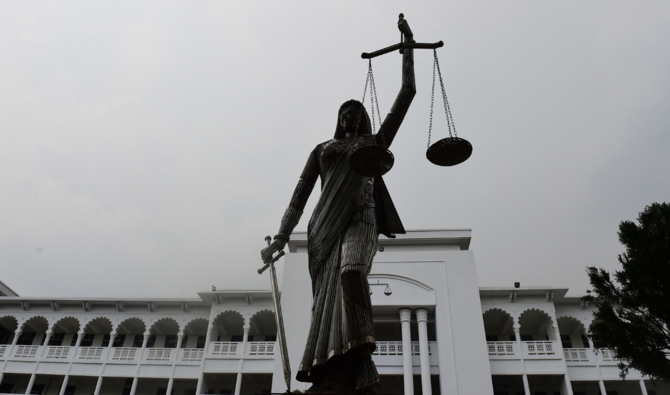

DHAKA: Bangladesh passed on Thursday a new law expediting the investigation and trial process in rape cases, following nationwide outrage after the rape of an eight-year-old girl who died of her injuries.
The girl from Magura was staying at the house of her elder sister’s in-laws, when the incident took place in early March. She was admitted to hospital in critical condition to the Combined Military Hospital in Dhaka, where she died after six days.
The news of her death last week set off protests across the country. As her body was taken for burial in Magura, thousands of people gathered in the city to participate in her funeral prayers.
An absentee funeral was also held for her at Dhaka University, followed by a protest march.
The incident resulted in mounting pressure on the government to reform laws related to rape, and women and children’s safety.
The first law to be amended was the Women and Children Repression Prevention Ordinance, which was passed by Bangladesh’s Advisory Council — the highest institution of its interim government led by Chief Adviser Prof. Muhammad Yunus.
“To ensure speedy trial and punishment of rape suspects, this reform was necessary. It will also help in ensuring proper investigation,” Azad Majumder, deputy press secretary of the chief adviser, told Arab News.
The new law reduces the investigation period of rape cases from 30 days to 15 days and the time for completing the trial from 180 days to 90 days.
Under the law, a special tribunal will be dedicated to handling child rape cases.
Judges will also be allowed to proceed with trials based on medical certificates and circumstantial evidence, without requiring DNA tests, which were previously mandatory for the trial to begin, even though samples were not always available, as it often takes time for victims or their families to register a case.
“Earlier, the trial process had to wait for the DNA profiling report of the accused. But now the trial can begin based on circumstantial evidence,” Majumder said.
The rape of minors is punishable by death in Bangladesh.
More than 5,600 reports of rape of girls aged below 18 were filed across the country in the past 10 years, according to data from Ain o Salish Kendra — a main women’s and children’s group in Bangladesh.
The numbers are unlikely to reflect the reality as many victims do not report the crime.
Part of the problem, according to advocate Elina Khan from the Bangladesh Human Rights Foundation, is the slow response of the police.
“The investigation process demands extra care and attention. Sometimes, our police stations don’t respond immediately to rape cases. If their responses were quick, evidence collection would be easier, and investigation would also take less time,” she told Arab News.
“Authorities should also improve logistical preparations in court, especially to protect the child from emotional distress and psychological harm during the hearing. The child should be brought to court with care, considering the psychological impact on the victim.”
She was also expecting more accountability from law enforces for the new law to have an actual effect.
“The ordinance doesn’t say anything about what will happen if an investigation officer fails to complete the investigation process within the guided timeframe. Investigators should be held accountable for failing to investigate within the time,” Khan said.
“We have the appropriate human resources in this regard. We just need to engage them all. If we can ensure the proper application of the law, monitoring from the authority and accountability of the responsible persons, justice can be swiftly delivered.”


