

2.5m Syrians in Saudi Arabia to benefit from Dammam-Damascus flights

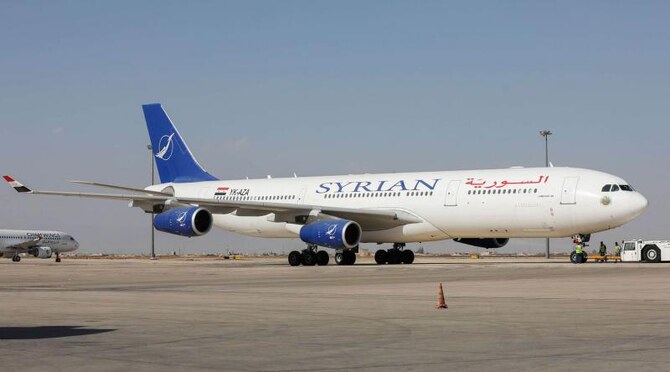
Routes between the two cities resumed on March 19 after a 13-year hiatus, with a Syrian Air plane departing King Fahd International Airport in Dammam for Damascus. File
Short Url
Updated 20 March 2025
Follow

2.5m Syrians in Saudi Arabia to benefit from Dammam-Damascus flights

JEDDAH: Over 2.5 million Syrian residents in Saudi Arabia will benefit from direct flights between Dammam and Damascus, reconnecting families and enhancing transport between the two countries.

Routes between the two cities resumed on March 19 after a 13-year hiatus, with a Syrian Air plane departing King Fahd International Airport in Dammam for Damascus.

The morning flight complements the direct service from the Kingdom’s three major cities to Syria after Syrian Air resumed operations at Saudi airports last year.

Passenger flights between the two countries were halted in 2012 when Riyadh severed ties with Damascus over Bashar Assad’s crackdown on anti-government protesters at the start of the country’s civil war.

Services between Syria and the Kingdom resumed temporarily in May for pilgrims participating in the annual Hajj pilgrimage. The first group of 270 Syrian travelers arrived in Jeddah on May 28, just a few days after Saudi Arabia appointed Faisal bin Saud Al-Mujfel as its ambassador to Syria.

Commercial flights between Saudi Arabia and Syria resumed in July following a 12-year freeze amid improving relations. A Syrian Air plane carrying 170 passengers from Damascus landed in Riyadh, marking the return of regular services. 

This was followed by the reinstatement of flights between Damascus and King Abdulaziz International Airport in Jeddah in November. 

Mohammed Ayman Soussan, Syria’s ambassador to the Kingdom, who took office in Riyadh in January 2024, said the two countries had agreed to operate one round-trip flight per week between the two capitals.

After the diplomatic gap, Saudi Arabia and Syria agreed to resume consular services in April 2023 and restored full relations in May 2023. 

Global flights resumed at Damascus International Airport in January for the first time since the ouster of President Bashar Assad last month.

Saudi Arabia has sent relief planes to Syria following the fall of the former president to assist with the ongoing crisis. These humanitarian efforts, organized by the King Salman Humanitarian Aid and Relief Center, also known as KSrelief, have delivered essential supplies, including food, shelter, and medical aid, to help the Syrian people cope with their challenging circumstances.

Additional flights to Syrian destinations are expected soon, following the reopening of Aleppo International Airport — the country’s second major airport — after nearly three months of closure.

The airport was closed in November during the offensive by rebel groups against the regime of Bashar Assad in early December.


School, hotel outlays keep Saudi POS weekly spending above $3bn: SAMA

Updated 13 sec ago
Follow

School, hotel outlays keep Saudi POS weekly spending above $3bn: SAMA

RIYADH: Spending on education in Saudi Arabia increased by 4.3 percent for the week ending Jan. 10, while hotel outlays saw a 0.9 percent increase, aiding the total weekly spending to stay above $3 billion.

According to the latest data from the Saudi Central Bank, the overall point-of-sale value dropped 16.6 percent to SR14.2 billion ($3.79 billion) with transactions representing a 7.3 percent week-on-week decrease to 236.7 million.

This week saw negative changes across all the remaining sectors.

Spending in the freight transport, postal, and courier services sector saw the biggest decrease at 35.9 percent to SR47.60 million, followed by telecommunications, which posted a 26.2 percent drop to SR188.42 million.

Expenditure on apparel and clothing saw a fall of 19.3 percent to SR1.3 billion, followed by an 18.3 percent decrease in spending on books and stationery. Jewelry outlays saw a 22.3 percent decrease to reach SR422.54 million.

Spending on car rentals in Saudi Arabia fell by 14.2 percent, while airlines saw a 6.3 percent decrease to SR48.04 million.

Expenditure on food and beverages saw a 23.6 percent decrease to SR2.07 billion, claiming the largest share of the POS. Restaurants and cafes retained the second position despite a 7.3 percent dip to SR1.76 billion.

The Kingdom’s key urban centers mirrored the national decline. Riyadh, which accounted for the largest share of total POS spending, saw a 13.6 percent dip to SR4.85 billion, down from SR5.61 billion the previous week.

The number of transactions in the capital settled at 74.78 million, down 6.1 percent week on week.

In Jeddah, transaction values decreased by 9.5 percent to SR2.02 billion, while Dammam reported a 15 percent decrease to SR707.12 million.

POS data, tracked weekly by SAMA, provides an indicator of consumer spending trends and the ongoing growth of digital payments in the Kingdom. 

The data also highlights the expanding reach of POS infrastructure, extending beyond major retail hubs to smaller cities and service sectors, supporting broader digital inclusion initiatives. 

The growth of digital payment technologies aligns with Saudi Arabia’s Vision 2030 objectives, promoting electronic transactions and contributing to the Kingdom’s broader digital economy.