

Meals in motion: Delivery rider races against time in Ramadan

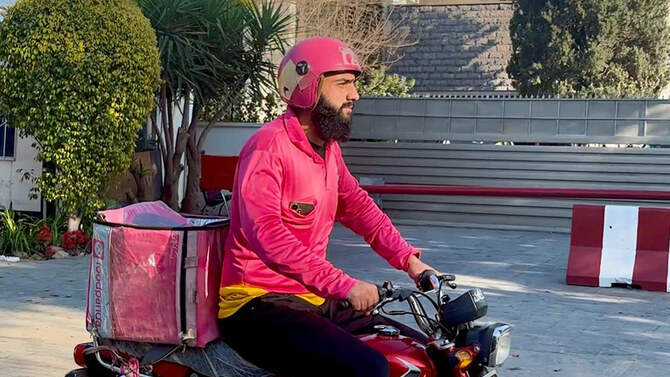
Haji Khan, a Foodpanda rider, rides his motorbike to deliver an order in Islamabad, Pakistan on March 14, 2025. (AN Photo)
Short Url
Updated 21 March 2025
Follow

Meals in motion: Delivery rider races against time in Ramadan

  • Hajji Khan navigates Islamabad’s busy streets on an empty stomach in Ramadan, ensuring he delivers suhoor, iftar meals on time
  • Khan works for online food and grocery delivery platform Foodpanda, making $178.61 in Ramadan delivering around 25 orders a day

ISLAMABAD: Wearing his signature pink Foodpanda uniform, Hajji Khan stood waiting outside the white gate of a house in the Pakistani capital an hour before sunset would usher in the iftar meal in the holy month of Ramadan earlier this week. 

Minutes later, the gate opened, and a customer received his order and paid Khan, who hurriedly hopped back onto his bike and sped off to complete the next delivery for Foodpanda, a prominent online food and grocery delivery platform in Pakistan. 

The going gets a bit tough for Khan and other Foodpanda riders during the holy month of Ramadan, when Muslims fast from dawn to dusk and often order food through restaurants or home chefs for the iftar and pre-dawn suhoor meals. Because the timing of the fasting meals are set, there is no room to be late, and riders like Khan, 25, often have to break their fast on the go with water and a fried snack bought from a nearby food stall, or by sitting down for a quick, free meal at a roadside charity ‘dastarkhwan.’

“We do our best to ensure timely deliveries before iftar so that customers can break their fast peacefully,” Khan said this week as Arab News accompanied him on pre-sunset delivery runs. 
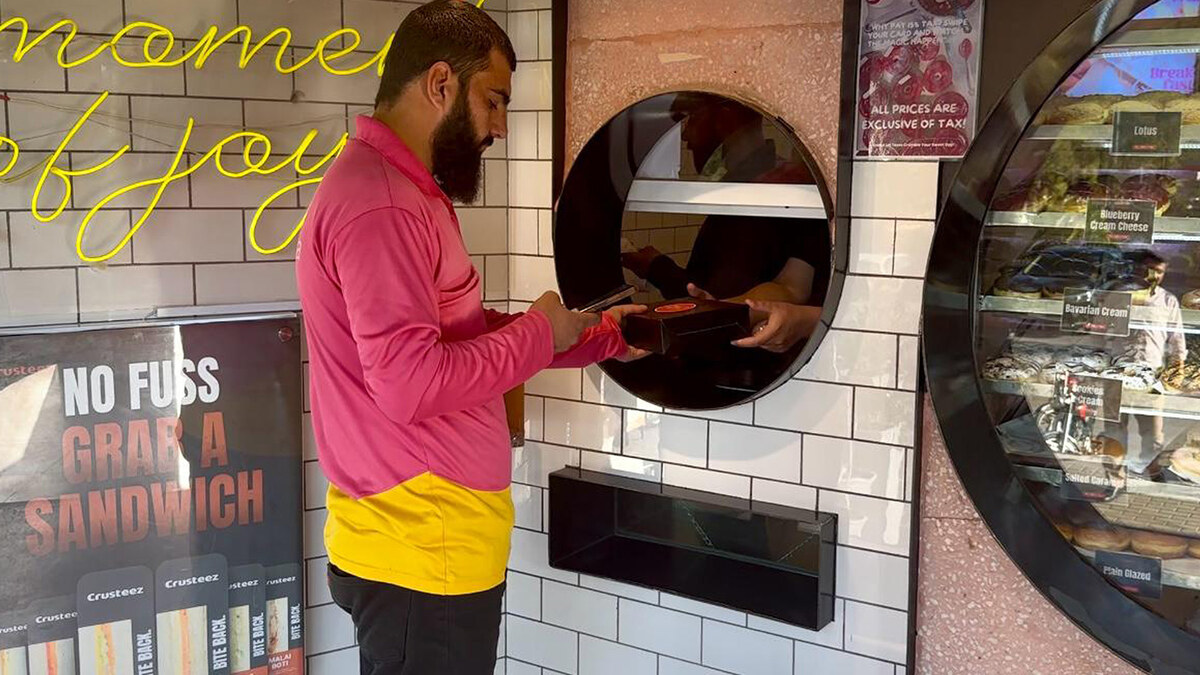


Haji Khan, a Foodpanda rider, picks up an order from a restaurant in Islamabad, Pakistan, on March 14, 2025. (AN Photo)

“We usually break our fast at free iftar dastarkhwans set up along the roadside. However, if I have many orders, then I break my fast while on the way to a delivery.”

The youngest of five brothers who left his home in the eastern Pakistani city of Sargodha four years ago to find work in Islamabad, Khan says he works in Ramadan from 2pm till the end of the suhoor meal at around 5am, making around Rs50,000 [$178.61] during the holy month, a modest income that barely covers basic expenses. 

GoNSave, a data company that serves leading gig platforms, said in a survey this month riders who worked during Ramadan and Eid cited personal financial needs, higher earnings from increased demand and incentives, and more job flexibility. At least 26.66 percent choose only to work during Ramadan.

‘SMALL ACTS OF KINDNESS’

While there are few orders during the morning and afternoon, Ramadan rush hour begins at around 4pm, around two hours before iftar. Then, it is no doubt a challenge to navigate the city’s busy and traffic-snarled roads on an empty stomach, the aroma of food wafting from the delivery box.

“Normally the day passes smoothly while fasting, but it becomes very challenging in the afternoon, when we start delivering food orders and the smell of food intensifies our hunger,” Khan said. 

“This is our peak time, and fasting feels particularly difficult but we push ourselves to take as many orders as possible and deliver them before iftar.”


Haji Khan, a Foodpanda rider, prays at a local mosque in Islamabad, Pakistan, on March 14, 2025. (AN Photo)

Khan, who delivers around 25 orders per day, says generous customers sometimes invite him in to break his fast if it is close to iftar time. 

These “small acts of kindness,” as Khan described them, made “all the difference” and pushed him to keep performing his duties despite the challenges. 

“Sometimes, a kind customer invites me to break my fast with them or they hand me an iftar parcel,” he said, as he stopped at a mosque for Asr, the third of five obligatory prayers in Islam.

“But if there’s nothing, I stop at a roadside dastarkhwan and share a meal with strangers who for a moment feel like family.”


Pakistan says over 100 militants killed in ‘retributive strikes’ against Afghanistan

Updated 9 sec ago
Follow

Pakistan says over 100 militants killed in ‘retributive strikes’ against Afghanistan

  • Islamabad determined to carry out similar strikes in future if cross-border attacks continue, warns Pakistan parliamentary affairs minister 
  • Pakistan says struck seven militant camps in Afghanistan’s three provinces Saturday night, while Taliban accuse Islamabad of killing civilians

ISLAMABAD: Minister for Parliamentary Affairs Tariq Fazal Chaudhry has said that over 100 militants were killed in the recent “retributive strikes” launched by Pakistan against Afghanistan, state media reported on Tuesday, vowing that Islamabad is determined to carry out similar actions in future if cross-border attacks persist. 

Pakistan said on Sunday it launched “intelligence-based selective targeting” of seven militant camps along the Afghan border in response to a mosque bombing in Islamabad and violence in the northwestern border districts of Bajaur and Bannu, among other attacks. Authorities say many of the assaults have been carried out by the Tehreek-e-Taliban Pakistan (TTP) and other allied militant groups that Islamabad alleges are operating from sanctuaries in Afghanistan, whose government denies this.

A Pakistani security official said the strikes were launched at militant camps in Afghanistan’s Nangarhar, Paktika and Khost provinces. Afghanistan denied Pakistan’s claims, saying Islamabad had killed dozens of civilians, including women and children. Afghanistan’s Defense

Ministry warned Pakistan of retaliation at a “suitable time.”

“The Senate was informed today that over one hundred Khawarij were killed in retributive strikes carried out by the Pakistan Air Force against Fitna Al-Khawarij in Afghanistan,” state broadcaster Radio Pakistan said. 

Pakistan’s military frequently uses the term “Fitna Al-Khawarij” to describe the TTP, which has carried out some of the deadliest attacks against Pakistani citizens and law enforcers since 2007. 

Chaudhry said Islamabad carried out the strikes after the Afghan administration failed to prevent “terrorists” from using its soil for attacks targeting Pakistan. He said Islamabad had repeatedly shared credible evidence of militants using Afghan territory to carry out attacks against

Pakistan, but Kabul remained unable to curb their actions. 

“He made it clear that Pakistan reserves the right to respond to terrorist activities in self-defense and is determined to carry out similar retributive actions in the future if such activities continue,” Radio Pakistan said. 

Afghanistan’s foreign ministry on Sunday summoned Pakistan’s charge d’affaires to Afghanistan Ubaid-ur-Rehman Nizamani and lodged a protest through a formal démarche in response to the Pakistani military strikes.

Tensions between Islamabad and Kabul have escalated since the Afghan Taliban returned to power in 2021. Pakistan says cross-border militant attacks have increased since then and has accused the Taliban of failing to honor commitments under the 2020 Doha Agreement to prevent Afghan soil from being used for attacks against other countries.

The Taliban deny allowing such activity and have previously rejected similar accusations. Pakistan also blames India for supporting militant attacks in Pakistan by the TTP and separatist groups in southwestern Pakistan, charges India denies.