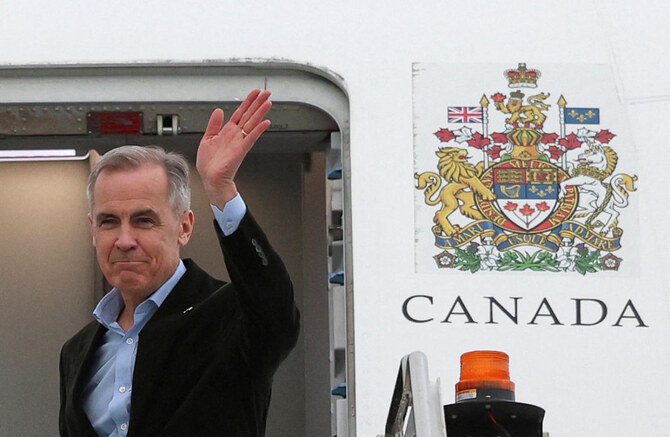
MONTEAL: With Canada’s economy and even sovereignty under unprecedented threat from its southern neighbor the United States, its new leader has embarked on a trans-Atlantic trip to strengthen ties with traditional friends France and Britain.
Just days into his mandate, Prime Minister Mark Carney faces threats on three fronts: A trade war with the Washington, US President Donald Trump’s threats to annex his country, and looming domestic elections.
But, despite the tension at home, he is expecting warm welcomes on three days of visits to Paris, London and Iqaluit in Canada’s northernmost territory, Nunavut.
“Canada was built upon a union of peoples – indigenous, French, and British,” Carney said, in a statement released before he set off from Ottawa on Sunday, two days after he was sworn in, replacing 10-year veteran prime minister Justin Trudeau as leader of the G7, NATO and Commonwealth power.
“My visit to France and the United Kingdom will strengthen trade, commercial, and defense ties with two of our strongest and most reliable partners, and my visit to Nunavut will be an opportunity to bolster Canada’s Arctic sovereignty and security, and our plan to unlock the North’s full economic potential.”
Carney did not say why Canada might be in need of “reliable partners,” but he didn’t need to – Trump’s imposition of an escalating raft of import tariffs on Canadian goods has threatened to trigger a recession, and his scorn for Canadian sovereignty sent jitters through the former ally.
Opinion polls show a large majority of Canadian voters reject Trump’s argument that their country would be better off as the “51st state of the United States,” but the trade war is a threat to the economy of the vast country of 41 million people, which has long enjoyed a close US partnership.
On Monday, 60-year-old Carney will be in Paris for a working dinner with French President Emmanuel Macron and discuss how to, according to the Canadian leader’s office, “build stronger economic, commercial, and defense ties.”
According to the Elysee, the two leaders “will discuss Russia’s war of aggression against Ukraine, international crises, and projects at the heart” of the “strategic partnership” between Paris and Ottawa.
Canada, France and Britain are among the NATO members that have maintained strong support for Ukraine’s beleaguered government and military since Russia’s all-out invasion in February 2022, even as Trump’s US administration has bullied Kyiv to make concessions to Moscow.
London and Paris are putting together plans for a coalition security force in Ukraine and looking for allies.
France is Canada’s 11th-largest trading partner and Britain its third at a time when Trump’s tariffs and Canadian retaliatory measures are threatening trade with its huge southern neighbor – destination of three-quarters of Canada’s exports.
But Canada also has a “Comprehensive Economic and Trade Agreement” with the European Union, which includes France, and is a member of the Comprehensive and Progressive Trans-Pacific Partnership (CPTPP), which now also includes Britain.
After Paris, Carney heads for London, where he once worked as governor of the Bank Of England, for talks with Prime Minister Keir Starmer and King Charles III, the monarch who is head of state in both Britain and Canada.
In his first speech as prime minister, Carney said: “Security is a priority for this government, reinforcing our security, as is diversifying our trading and commercial relationships, of course, with both Europe and the United Kingdom.”
On his return leg, Carney will touch down in Iqaluit, in Nunavut, the Canadian territory closest to the Danish autonomous country of Greenland – another Trump target for annexation – to “reaffirm Canada’s Arctic security and sovereignty.”

Threatened by US, Canada hugs France and Britain close
https://arab.news/vqcfq
Threatened by US, Canada hugs France and Britain close
- Prime Minister Mark Carney expecting warm welcomes on three days of visits to Paris, London and Iqaluit in Canada’s northernmost territory, Nunavut
Trump says US could run Venezuela and its oil for years
- US president made the comments less than a week after Washington seized Maduro in a raid on Caracus
- Oil has emerged as the key to US control over Venezuela, which has the world’s largest proven reserves
WASHINGTON: The United States could run Venezuela and tap into its oil reserves for years, President Donald Trump said in an interview published Thursday, less than a week after toppling its leader Nicolas Maduro.
“Only time will tell” how long Washington would demand direct oversight of the South American country, Trump told The New York Times.
But when asked whether that meant three months, six months or a year, he replied: “I would say much longer.”
The 79-year-old US leader also said he wanted to travel to Venezuela eventually. “I think at some point it’ll be safe,” he said.
US special forces snatched president Maduro and his wife in a lightning raid on Saturday and whisked them to New York to face trial on drug and weapons charges, underscoring what Trump has called the “Donroe Doctrine” of US hegemony over its backyard.
Since then Trump has repeatedly asserted that the United States will “run” Venezuela, despite the fact that it has no boots on the ground.
Venezuela’s interim leader Delcy Rodriguez insisted that no foreign power was governing her country. “There is a stain on our relations such as had never occurred in our history,” Rodriguez said of the US attack.
But she added it was “not unusual or irregular” to trade with the United States now, following an announcement by state oil firm PDVSA that it was in negotiations to sell crude to the United States.
‘Tangled mess’
Oil has in fact emerged as the key to US control over Venezuela, which has the world’s largest proven reserves.
Trump announced a plan earlier this week for the United States to sell between 30 million and 50 million barrels of Venezuelan crude, with Caracas then using the money to buy US-made products.
On the streets of Caracas, opinions remain mixed about the oil plan.
“I feel we’ll have more opportunities if the oil is in the hands of the United States than in the hands of the government,” said Jose Antonio Blanco, 26. “The decisions they’ll make are better.”
Teresa Gonzalez, 52, said she didn’t know if the oil sales plan was good or bad.
“It’s a tangled mess. What we do is try to survive, if we don’t work, we don’t eat,” she added.
Trump, who will meet oil executives on Friday, is also considering a plan for the US to exert some control over Venezuela’s PDVSA, the Wall Street Journal reported.
The US would then have a hand in controlling most of the oil reserves in the Western Hemisphere, as Trump aims to drive oil prices down to $50 a barrel, the paper reported.
Vice President JD Vance underscored that “the way that we control Venezuela is we control the purse strings.”
“We tell the regime, ‘you’re allowed to sell the oil so long as you serve America’s national interest,’” he told Fox News host Jesse Watters in an interview broadcast late Wednesday.
‘Go like Maduro’
Vance, an Iraq veteran who is himself a skeptic of US military adventures, also addressed concerns from Trump’s “Make America Great Again,” saying the plan would exert pressure “without wasting a single American life.”
The US Senate is voting Thursday on a “war powers” resolution to require congressional authorization for military force against Venezuela, a test of Republican support for Trump’s actions.
Caracas announced on Wednesday that at least 100 people had been killed in the US attack and a similar number wounded. Havana says 32 Cuban soldiers were among them.
Trump’s administration has so far indicated it intends to stick with Rodriguez and sideline opposition figures, including Nobel Peace Prize winner Maria Corina Machado.
But Rodriguez’s leadership faces internal pressures, analysts have told AFP, notably from her powerful Interior Minister Diosdado Cabello and Defense Minister Vladimir Padrino Lopez.
“Her power comes from Washington, not from the internal structure. If Trump decides she’s no longer useful, she’ll go like Maduro,” Venezuela’s former information minister Andres Izarra told AFP in an email.
The US operation in Venezuela — and Trump’s hints that other countries could be next — spread shockwaves through the Americas, but but he has since dialed down tensions with Colombia.
A day after Colombia’s leftist President Gustavo Petro spoke with Trump on Wednedsday, Bogota said Thursday it had agreed to take “joint action” against cocaine-smuggling guerrillas on the border with Venezuela.