

Pakistan keeps fuel prices unchanged, plans power tariff cuts for public relief

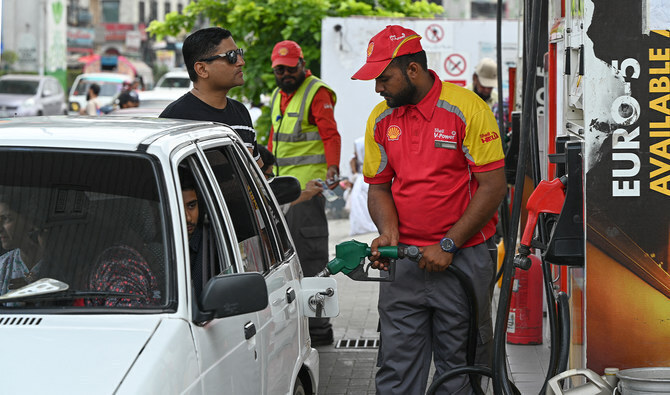
A worker pumps petrol in a car at a fuel station in Rawalpindi, Pakistan, on July 16, 2023. (AFP/File)
Short Url
Updated 16 March 2025
Follow

Pakistan keeps fuel prices unchanged, plans power tariff cuts for public relief

  • Shehbaz Sharif says a comprehensive strategy is being finalized to reduce electricity charges
  • Fuel prices and electricity tariffs are sensitive issues after high inflation rates recorded in 2023

ISLAMABAD: Prime Minister Shehbaz Sharif announced on Saturday the government will maintain current petroleum product prices for the another fortnight and utilize the resulting fiscal space to implement a reduction in electricity tariffs, aiming to provide relief to consumers.

Fuel prices in Pakistan are adjusted fortnightly, reflecting global energy market fluctuations and the rupee-dollar exchange rate, to pass on the net effect to consumers.

Since fuel is a key input for thermal power generation, keeping petroleum prices unchanged can create fiscal space for the government to lower electricity tariffs and making it more affordable for consumers.

“We have decided to maintain petroleum prices at their previous levels and transfer the entire financial advantage to the public through reduced electricity tariffs,” the prime minister said in a statement released by his office.

“This measure, among many others, will lead to a meaningful decrease in electricity rates.”

Sharif also said that a comprehensive and effective strategy was being finalized to reduce electricity charges, with details to be announced in the coming weeks.

“Since assuming office, we pledged to prioritize public relief,” he said. “This relief will not only lower electricity prices but also have an overall impact on inflation, leading to a further decline.”

Both fuel prices and electricity tariffs are sensitive issues in Pakistan, which experienced an inflation rate hitting about 38 percent in 2023.

Subsequent stringent monetary policies have significantly reduced inflation, with the latest figures indicating a drop to 1.5 percent in February, marking a nine-year low.


PIF Private Sector Forum sees multiple deals across key sectors

Updated 14 sec ago
Follow

PIF Private Sector Forum sees multiple deals across key sectors

RIYADH: The first day of the PIF Private Sector Forum marked the signing of several agreements spanning travel, entertainment, advanced manufacturing, innovation, urban development, and industrial sectors.

In the tourism, travel, and entertainment sector, a memorandum of understanding was signed between the Public Investment Fund’s Dan Co. and Fresh on Table to expand the latter’s platform in Saudi Arabia, enhance cooperation, and establish consolidation centers in Dan Co.’s facilities across targeted cities.

Dan Co. also signed an MoU with DRB Arabia to collaborate on the development of the Tuaja Resort Community Center in Al-Ahsa, establishing a framework for cooperation between the two parties.

King Abdullah Economic City and Almosafer Travel and Tourism Co. agreed to a joint venture to support tourism promotion and destination marketing.

Cruise Saudi and FlyAkeed signed an MoU to strengthen initiatives in travel optimization and digital innovation, while FlyAkeed also partnered with Al-Ula Club to explore opportunities in automation and digital transformation. Additionally, the PIF and FlyAkeed signed an MoU to advance digital travel solutions and enhance service delivery leveraging FlyAkeed’s capabilities.

In urban development and livability, the PIF signed an MoU with ABB Academy to develop the Saudi workforce through targeted training programs. Another agreement with Saudi Tabreed will explore expanding high-quality district cooling solutions for large-scale developments, aligning with national sustainability goals. Fraunhofer IAO will collaborate with the PIF on waste management and innovative construction methods to support smart city development.

The industrial and logistics sector also saw multiple agreements. Nupco signed an MoU with Saudi Awwal Bank to strengthen healthcare supply chains, while Saudi Arabia Railways partnered with Siemens Mobility to localize manufacturing, develop the Kingdom’s rail infrastructure, and advance industrial capabilities. The Royal Commission of AlUla signed a deal with TASAMA to support its operational and strategic objectives.

In advanced manufacturing and innovation, Tasaru Mobility Investments signed multiple agreements with Masarat Mobility Park, Shin Young, JVIS, Benteler, Lear Corp., and Fangxin. Electric vehicle maker Lucid also inked deals with Benteler, JVIS, Shin Young, and Lear Corp.

Saudi Arabia’s first homegrown EV brand, Ceer, signed agreements with Mino, Natpet Schulman Specialty Plastic Compounds, Xinyi Glass, MK Tron, Sika, Saudi Controls, AVL, FEV, Zamil Trade and Services, Zamil Plastics, and Arabian Plastic Industrial Co. CEO James DeLuca highlighted that Ceer is set to sign 16 agreements valued at SR3.7 billion ($990 million) at the forum, noting that 90% of these are commercial contracts rather than MoUs.