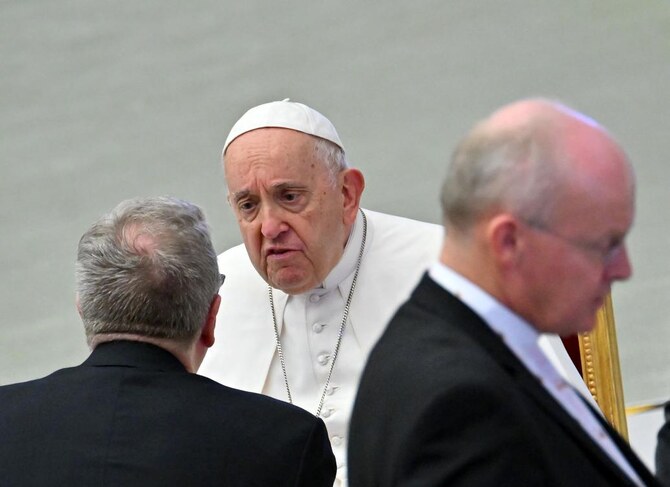
Pope Francis, showing plans to stay on, starts new Catholic reform process

Pope Francis approved a new three-year process to consider reforms for the global Catholic Church, the Vatican said on Saturday, in a sign the 88-year-old pontiff plans to continue on as pope despite his ongoing battle with double pneumonia. (AFP)
Short Url
Updated 15 March 2025
Follow

Pope Francis, showing plans to stay on, starts new Catholic reform process

  • Francis approved the new process for reforms on Tuesday from Rome’s Gemelli hospital
  • His friends and biographers have insisted, however, that he has no plans to step down

VATICAN CITY: Pope Francis approved a new three-year process to consider reforms for the global Catholic Church, the Vatican said on Saturday, in a sign the 88-year-old pontiff plans to continue on as pope despite his ongoing battle with double pneumonia.
Francis has extended the work of the Synod of Bishops, a signature initiative of his 12-year papacy, which has discussed reforms such as the possibility of women serving as Catholic deacons and better inclusion of LGBTQ people in the Church.
The synod, which held an inconclusive Vatican summit of bishops on the future of the Church last October, will now hold consultations with Catholics across the world for the next three years, before hosting a new summit in 2028.
Francis approved the new process for reforms on Tuesday from Rome’s Gemelli hospital, where he is being treated, the Vatican said on Saturday.
The pope has been in hospital for more than a month and his prolonged public absence has stoked speculation that he could choose to follow his predecessor Benedict XVI and resign from the papacy.
His friends and biographers have insisted, however, that he has no plans to step down. The approval of a new three-year process indicated he wants to continue on, despite his age and the possibility he might face a long, fraught road to recovery from pneumonia, given his age and other medical conditions.
“The Holy Father ... is helping push the renewal of the Church toward a new missionary impulse,” Cardinal Mario Grech, the official leading the reform process, told the Vatican’s media outlet. “This is truly a sign of hope.”

BRINGING CHURCH ‘UP TO DATE’
Francis, who has been pope since 2013, is widely seen as trying to open up the staid global Church to the modern world.
However, the pope’s reform agenda has upset some Catholics, including a few senior cardinals. They have accused him of watering down the Church’s teachings on issues such as same-sex marriage, and divorce and remarriage.
Massimo Faggioli, a US academic who has followed the papacy closely, said the new reform process is a way for the pope to signal that he is still the leader of the world’s 1.4 billion Catholics.
“Francis’ pontificate is not over, and this decision he just made for what happens between now and 2028 will have an effect on the rest of (it),” said Faggioli, a professor at Villanova University.
After last October’s inconclusive Vatican summit, which yielded no concrete action on possible reforms, Francis had faced questions of whether his papacy was running out of steam.
Vatican officials had said at the time that Francis was still considering future changes, and was waiting to receive a series of 10 expected reports about possible reforms this June.
The latest medical bulletins from the Vatican on the pope’s condition in hospital have said he is improving and is no longer in immediate danger of death.
They have not said when he will be discharged from hospital.
Well-wishers have been gathering to offer support for Francis outside the hospital each day during the pope’s recovery.
Stefania Gianni, an Italian being treated for cancer at the facility, said on Saturday that Francis “has taken great steps to bring the Church up to date with the times.”
“He is a great man and a great pope, and the Church still needs him,” she said.


Malawi suffers as US aid cuts cripple health care

Updated 6 sec ago
Follow

Malawi suffers as US aid cuts cripple health care

LILONGWE: A catastrophic collapse of health care services in Malawi a year after US funding cuts is undoing a decade of progress against HIV/AIDS, providers warn, leaving some of the most vulnerable feeling like “living dead.”
In the impoverished southern Africa country, the US government’s decision to slash foreign aid in January 2025 has led to significant cuts in HIV treatments, a spike in pregnancies and a return to discrimination.
Chisomo Nkwanga, an HIV-positive man who lives in the northern town of Mzuzu, told AFP that the end of US-funded specialized care was like a death sentence.
After his normal provider of life-saving antiretroviral therapy (ART) vanished due to budget cuts, he turned to a public hospital.
“The health care worker shouted at me in front of others,” Nkwanga recalled. “They said, ‘You gay, you are now starting to patronize our hospitals because the whites who supported your evil behavior have stopped?’“
“I gave up,” he said, trembling. “I am a living dead.”
More than one million of aid-dependent Malawi’s roughly 22 million people live with HIV and the United States previously provided 60 percent of its HIV treatment budget.
Globally, researchers estimate that hundreds of thousands of preventable deaths have been caused by the Trump administration’s dismantling of US foreign aid, which has upended humanitarian efforts to fight HIV, malaria and tuberculosis in some of the world’s poorest regions.

- Lay offs, panic -

In Malawi, the drying up of support from USAID and the flagship US anti-HIV program, PEPFAR, has left a “system in panic,” said Gift Trapence, executive director of the Center for the Development of People (CEDEP).
“The funding cut came on such short notice that we couldn’t prepare or engage existing service providers,” Trapence told AFP.
“We had to lay off staff... we closed two drop-in centers and maintained two on skeleton staff,” he said.
“We did this because we knew that if we closed completely, we would be closing everything for the LGBTI community.”
The Family Planning Association of Malawi (FPAM) non-government organization, a cornerstone of rural health care, has been forced to ground the mobile clinics that served as the only medical link for remote villages.
“We had two big grants that were supporting our work, particularly in areas where there were no other service providers,” said executive director Donald Makwakwa.
“We are likely to lose out on all the successes that we have registered over the years,” he said.
A resident of a village once served by FPAM told AFP there had been an explosion in unplanned pregnancies when the family planning provider stopped work.
“I know of nearly 25 girls in my village who got pregnant when FPAM suspended its services here last year,” said Maureen Maseko at a clinic on the brink of collapse.

- Progress undone -

For over a decade, Malawi’s fight against AIDS relied on “peer navigators” and drop-in centers that supported people with HIV and ensured they followed treatment.
With the funding for these services gone, the default rate for people taking the HIV preventative drug PrEP hit 80 percent in districts like Blantyre, according to a report by the CEDEP.
“This is a crisis waiting to happen,” the report quoted former district health care coordinator Fyness Jere as saying.
“When people stop taking PrEP, we increase the chances of new HIV infections... we are undoing a decade of progress in months,” she said.
Trapence noted that without specialized support, thousands of patients had simply disappeared from the medical grid.
“We lost everything, including the structures that were supporting access... treatment and care,” he said.