

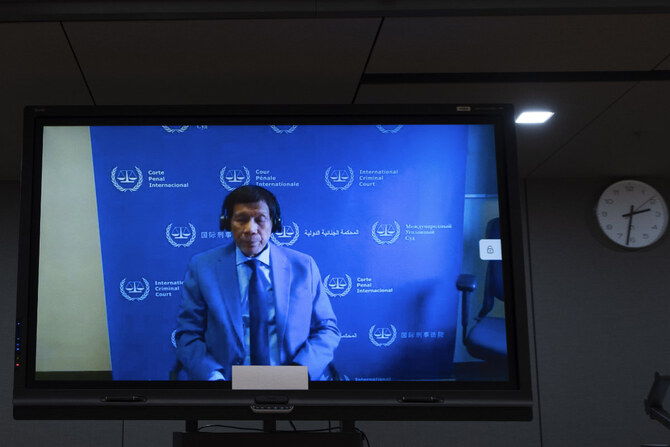

THE HAGUE: Former Philippine president Rodrigo Duterte failed to attend in person an initial hearing at the International Criminal Court on Friday, as he faces crimes against humanity charges over his deadly crackdown on narcotics.
The 79-year-old, the first ex-Asian head of state charged by the ICC, followed by videolink during a short hearing to inform him of the crimes he is alleged to have committed, as well as his rights as a defendant.
Sounding frail and wearing a blue suit and tie, he spoke briefly to confirm his name and date of birth. Presiding Judge Iulia Motoc allowed him to follow proceedings in absentia due to his long flight to The Hague.
His lawyer Salvador Medialdea told the court that his client had been “abducted from his country.”
“He was summarily transported to The Hague. To lawyers it’s extrajudicial rendition. For less legal minds, it’s pure and simple kidnapping,” said Medialdea.
The lawyer also said that Duterte was suffering “debilitating medical issue,” adding: “Other than to identify himself, he is not able to contribute to this hearing.”
Duterte appeared sleepy during the proceedings, closing his eyes frequently for long periods.
But Motoc told Duterte: “The court doctor was of the opinion that you were fully mentally aware and fit.”
She set a date of September 23 for the next stage of the process: a hearing to confirm the charges.
Duterte stands accused of the crime against humanity of murder over his years-long campaign against drug users and dealers that rights groups said killed thousands.
In the prosecutor’s application for his arrest, he said Duterte’s alleged crimes were “part of a widespread and systematic attack directed against the civilian population in the Philippines.”
“Potentially tens of thousands of killings were perpetrated,” the prosecutor alleged of the campaign that targeted mostly poor men, often without proof they were linked to drugs.
Victims’ families have welcomed the trial as a chance for justice, while Duterte supporters believe he was “kidnapped” and sent to The Hague amid a spectacular fall-out with the ruling Marcos family.
In Manila, Jane Lee, whose husband was killed in the drug war, said she was barely able to contain her rage at the sight of the former president.
“When I saw him, I was so angry I could barely control myself,” the 42-year-old said at a public viewing of the ICC proceedings.
According to international law experts, his whirlwind arrest and surrender offers a welcome boon to the embattled ICC, which is being attacked from all sides and sanctioned by the United States.
“I see the arrest and handing over of Duterte as a gift at an important moment in time,” Willem van Genugten, Professor of International Law at Tilburg University in The Netherlands, told AFP.
Earlier on Friday, the former leader’s daughter Sara Duterte, vice president of the Philippines, told AFP she had submitted a last-minute bid to have the hearing moved.
She later revealed that she had visited her father for an hour in the detention center and that he was “in good spirits, well looked-after” and “well rested,” his main complaint being about the food.
“He told me that all he does is sleep and watch TV... (he said that) my only complaint is that I really miss Philippine food,” Sara Duterte told reporters at a chaotic press conference surrounded by dozens of baying supporters.
Duterte backers had gathered outside the hulking glass building in the Hague shouting “bring him home.”
But Ecel Sandalo, an anti-Duterte demonstrator, told AFP the fact that the former president was on trial had given him “hope that despite all the injustices in the world, there are still small victories that we can celebrate.”
As he landed in The Hague, the former leader appeared to accept responsibility for his actions, saying in a Facebook video: “I have been telling the police, the military, that it was my job and I am responsible.”
In his application for arrest, the prosecutor quoted from some of Duterte’s pronouncements when he was running for president.
He is cited as saying the number of criminal suspects killed “will become 100,000... I will kill all of you” and the fish in Manila Bay “will become fat because that’s where I will throw you.”
At the confirming of charges hearing, a suspect can challenge the prosecutor’s evidence.
Only after that will the court decide whether to press ahead with a trial, a process that could take several months or even years.


