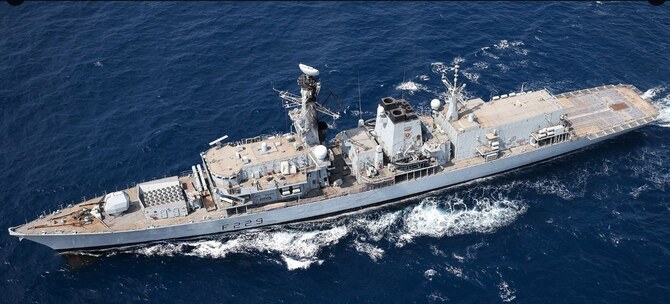
UK Royal Navy busts drug smuggling using drones for first time

The UK’s Royal Navy has used drones to foil drug smuggling for the first time as part of an operation in the northern Arabian Sea. (X/@NavyLookout)
Short Url
Updated 14 March 2025
Follow

UK Royal Navy busts drug smuggling using drones for first time

  • Arabian Sea operation intercepts $6.9m worth of drugs
  • HMS Lancaster operates out of Bahrain

LONDON: The UK’s Royal Navy has used drones to foil drug smuggling for the first time as part of an operation in the northern Arabian Sea.
The crew of HMS Lancaster spotted suspicious boats using new Peregrine miniature helicopters that are controlled remotely, the Daily Telegraph reported on Friday.
Operators of the drones detected the two boats side by side at night, and a Wildcat helicopter was dispatched to inspect the vessels at a closer distance.
The crew on the helicopter saw a small fast boat and a dhow, with packages being transferred onto the latter.
After HMS Lancaster arrived to intercept the vessels, $6.9 million worth of drugs were discovered despite the crew of the small boats attempting to dump the packages.
The Peregrine is 3 meters long and has a flight time of up to five hours. It is the first remote-controlled helicopter operated by the Royal Navy and can transfer data, radar information and imagery back to warship control rooms.
It has radically improved the navy’s ability to carry out drug busts, a source told the Telegraph.
HMS Lancaster, which has operated out of Bahrain for more than two years, was in the region as part of the international Combined Task Force 150. The coalition aims to clamp down on illegal activity in the Middle East.


UN votes to end mission in Yemeni city of Hodeida

Updated 5 sec ago
Follow

UN votes to end mission in Yemeni city of Hodeida

  • The resolution approved Tuesday, which was sponsored by Britain, stipulates that the UN mission in Hodeida — known as UNMHA — must close as of March 31

UNITED NATIONS, United States: The UN Security Council voted Tuesday to terminate a mission that tried to enforce a ceasefire in war-torn Yemen’s port city of Hodeida.
“Houthi obstructionism has left the mission without a purpose, and it has to close,” said Tammy Bruce of the US delegation, one of 13 on the 15 member council to support ending the mission’s mandate.
The UN mission is now scheduled to conclude in two months.
Yemen’s internationally recognized government is a patchwork of groups held together by their opposition to the Iran-backed Houthis, who ousted them from the capital Sanaa in 2014 and now rule much of the country’s north. They also hold Hodeida.
The Houthis have been at war with the government, backed by a Saudi-led coalition since 2015, in a conflict that has killed hundreds of thousands of Yemenis and triggered a major humanitarian crisis.
Since 2021 the Houthis have periodically detained UN staffers and still hold some of them.
The resolution approved Tuesday, which was sponsored by Britain, stipulates that the UN mission in Hodeida — known as UNMHA — must close as of March 31. It has been there since 2019.
Russia and China abstained from the vote.
“For six years, UNMHA has served as a critical stabilizing presence” in the region and “actively deterred and prevented a return to full scale conflict,” said Danish representative Christina Markus Lassen.
“The dynamics of the conflict have evolved, and the operating environment has significantly narrowed as UN personnel have become the target of the Houthis’ arbitrary detentions,” Lassen said.
The war in the poorest country in the Arabian peninsula has triggered the worst humanitarian crisis anywhere in the world, the United Nations says.
It expects things to get worse in 2026 as hungry Yemenis find it even harder to get food and international aid drops off.