

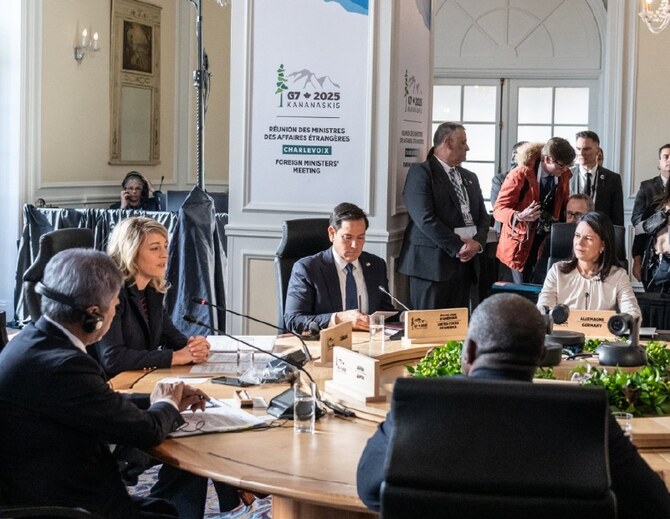
‘Strong G7 unity’ on Ukraine in talks: host Canada

Group of Seven foreign ministers reached a unified statement backing US-led calls for a ceasefire between Ukraine and Russia, host Canada said Friday, despite friction with President Donald Trump. (X/@G7)
Short Url
Updated 14 March 2025
Follow

‘Strong G7 unity’ on Ukraine in talks: host Canada

  • “We were able to find strong G7 unity on a variety of issues … in particular is the one linked to Ukraine,” Joly said

CHARLEVOIX, Canada: Group of Seven foreign ministers reached a unified statement backing US-led calls for a ceasefire between Ukraine and Russia, host Canada said Friday, despite friction with President Donald Trump.

“I can say that through our long conversations, we were able to find strong G7 unity on a variety of issues that were discussed and one that I would like to highlight in particular is the one linked to Ukraine,” Canadian Foreign Minister Melanie Joly told reporters on the last day of the talks in Quebec.


Trump administration’s capture of Maduro raises unease about the international legal framework

Updated 8 sec ago
Follow

Trump administration’s capture of Maduro raises unease about the international legal framework

THE HAGUE, Netherlands: From the smoldering wreckage of two catastrophic world wars in the last century, nations came together to build an edifice of international rules and laws. The goal was to prevent such sprawling conflicts in the future.
Now that world order — centered at the United Nations headquarters in New York, near the courtroom where Nicolás Maduro was arraigned Monday after his removal from power in Venezuela — appears in danger of crumbling as the doctrine of “might makes right” muscles its way back onto the global stage.
UN Undersecretary-General Rosemary A. DiCarlo told the body’s Security Council on Monday that the “maintenance of international peace and security depends on the continued commitment of all member states to adhere to all the provisions of the (UN) Charter.”
US President Donald Trump insists capturing Maduro was legal. His administration has declared the drug cartels operating from Venezuela to be unlawful combatants and said the US is now in an “armed conflict” with them, according to an administration memo obtained in October by The Associated Press.
The mission to snatch Maduro and his wife Cilia Flores from their home on a military base in the capital Caracas means they face charges of participating in a narco-terrorism conspiracy. The US ambassador to the United Nations, Mike Waltz, defended the military action as a justified “surgical law enforcement operation.”
The move fits into the Trump administration’s National Security Strategy, published last month, that lays out restoring “American preeminence in the Western Hemisphere” as a key goal of the US president’s second term in the White House.
But could it also serve as a blueprint for further action?
Worry rises about future action
On Sunday evening, Trump also put Venezuela’s neighbor, Colombia, and its leftist president, Gustavo Petro, on notice.
In a back-and-forth with reporters, Trump said Colombia is “run by a sick man who likes making cocaine and selling it to the United States.” The Trump administration imposed sanctions in October on Petro, his family and a member of his government over accusations of involvement in the global drug trade. Colombia is considered the epicenter of the world’s cocaine trade.
Analysts and some world leaders — from China to Mexico — have condemned the Venezuela mission. Some voiced fears that Maduro’s ouster could pave the way for more military interventions and a further erosion of the global legal order.
French Foreign Minister Jean-Noël Barrot said the capture of Maduro “runs counter to the principle of the non-use of force, which forms the basis of international law.”
He warned the “increasing number of violations of this principle by nations vested with the important responsibility of permanent membership on the United Nations Security Council will have serious consequences for global security and will spare no one.”
Here are some global situations that could be affected by changing attitudes on such issues.
Ukraine
For nearly four years, Europe has been dealing with Russia’s war of aggression in neighboring Ukraine, a conflict that grates against the eastern flank of the continent and the transatlantic NATO alliance and has widely been labeled a grave breach of international law.
The European Union relies deeply on US support to keep Ukraine afloat, particularly after the administration warned that Europe must look after its own security in the future.
Vasily Nebenzya, the Russian ambassador to the UN, said the mission to extract Maduro amounted to “a turn back to the era of lawlessness” by the United States. During the UN Security Council’s emergency meeting, he called on the 15-member panel to “unite and to definitively reject the methods and tools of US military foreign policy.”
Volodymyr Fesenko, chairman of the board of the Penta think tank in Kyiv, Ukraine, said Russian President Vladimir Putin has long undermined the global order and weakened international law.
“Unfortunately,” he said, “Trump’s actions have continued this trend.”
Greenland
Trump fanned another growing concern for Europe when he openly speculated about the future of the Danish territory of Greenland.
“It’s so strategic right now. Greenland is covered with Russian and Chinese ships all over the place,” Trump told reporters Sunday as he flew back to Washington from his home in Florida. “We need Greenland from the standpoint of national security, and Denmark is not going to be able to do it.”
Danish Prime Minister Mette Frederiksen said in a statement that Trump has “no right to annex” the territory. She also reminded Trump that Denmark already provides the US, a fellow NATO member, broad access to Greenland through existing security agreements.
Taiwan
The mission to capture Maduro has ignited speculation about a similar move China could make against the leader of Taiwan, Lai Ching-te. Just last week, in response to a US plan to sell a massive military arms package to Taipei, China conducted two days of military drills around the island democracy that Beijing claims as its own territory.
Beijing, however, is unlikely to replicate Trump’s action in Venezuela, which could prove destabilizing and risky.
Chinese strategy has been to gradually increase pressure on Taiwan through military harassment, propaganda campaigns and political influence rather than to single out Lai as a target. China looks to squeeze Taiwan into eventually accepting a status similar to Hong Kong and Macau, which are governed semi-autonomously on paper but have come under increasing central control.
For China, Maduro’s capture also brings a layer of uncertainty about the Trump administration’s ability to move fast, unpredictably and audaciously against other governments. Beijing has criticized Maduro’s capture, calling it a “blatant use of force against a sovereign state” and saying Washington is acting as the “world’s judge.”
The Mideast
Israel’s grinding attack on Gaza in the aftermath of the Oct. 7, 2023, attacks by Hamas underscored the international community’s inability to stop a devastating conflict. The United States, Israel’s staunchest ally, vetoed Security Council resolutions calling for ceasefires in Gaza.
Trump already has demonstrated his willingness to take on Israel’s neighbor and longtime US adversary Iran over its nuclear program with military strikes on sites in Iran in June 2025.
On Friday, Trump warned Iran that if Tehran “violently kills peaceful protesters,” the US “will come to their rescue.” Violence sparked by Iran’s ailing economy has killed at least 35 people, activists said Tuesday.
Iran’s Foreign Ministry condemned the “illegal US attack against Venezuela.”
Europe and Trump
The 27-nation European Union, another post-World War II institution intended to foster peace and prosperity, is grappling with how to respond to its traditional ally under the Trump administration. In a clear indication of the increasingly fragile nature of the transatlantic relationship, Trump’s national security strategy painted the bloc as weak.
While insisting Maduro has no political legitimacy, the EU said in a statement on the mission to capture him that “the principles of international law and the UN Charter must be upheld,” adding that members of the UN Security Council “have a particular responsibility to uphold those principles.”
But outspoken Hungarian Prime Minister Viktor Orbán, a close Trump ally, spoke disparagingly about the role international law plays in regulating the behavior of countries.
International rules, he said, “do not govern the decisions of many great powers. This is completely obvious.”