

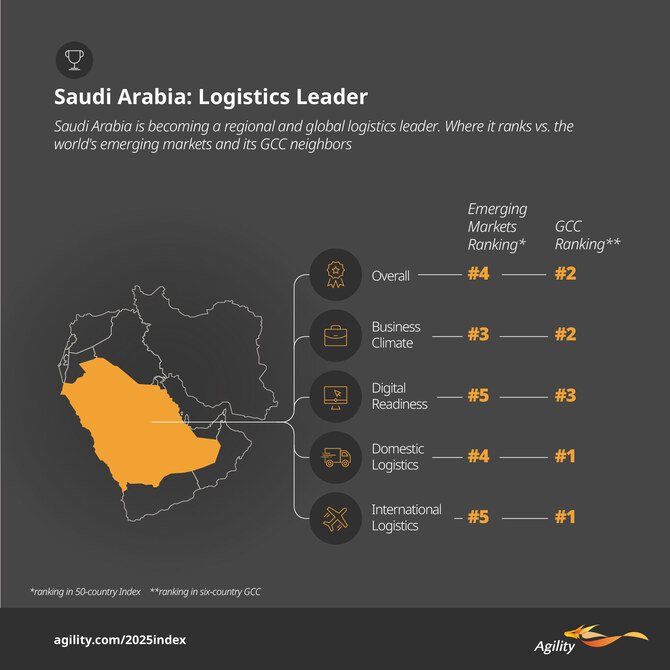

Saudi Arabia’s massive logistics investment, sweeping digitization of trade, and sharp focus on quality-of-life improvements has pushed the country higher in the annual Agility Emerging Markets Logistics Index.
For 16 years, the index has been a benchmark of competitiveness for the world’s 50 leading emerging markets countries, ranking them by factors important to logistics providers, freight forwarders, air and ocean carriers, distributors and investors.
In the 2025 index, Saudi Arabia improves its performance relative to other countries in all four Index categories: international and domestic logistics opportunities, business climate, and digital readiness.
The Kingdom ranks with China, India and United Arab Emirates at the top of the 2025 rankings. It finishes among the top five in all four Index categories.
“Saudi Arabia’s desire to establish itself as a major global trade hub and innovation center are rapidly becoming a reality.
“The ambitious aims laid out in the Kingdom’s Vision 2030 strategy have been matched by focused, effective policies and actions that are yielding change and progress across the economy, business and society,” says Agility vice chairman Tarek Sultan.
The 2025 index singles out Saudi Arabia for efforts to strengthen supply chain networks, improve port connectivity, manage inflation, reduce corruption, improve digital skills, and develop a high-value manufacturing sector.
In addition to the rankings, the index features a survey of 567 logistics industry professionals.
More than 62 percent of those surveyed say they’ve overhauled their supply chains to safeguard against inflation, looming trade tariffs, the possibility of a global economic downturn and other major risks.
The survey shows the logistics industry entering 2025 looking to protect itself from rising costs and a potential trade war ignited by expected US tariff hikes and a flood of exports from China.
“There is wariness and uncertainty among shippers, carriers, forwarders and others when it comes to the geopolitical factors that drive up costs, affect trade volumes, and alter supply chains,” Sultan said.
“Companies doing business internationally continue to shift production as they re-evaluate investment plans and search for durable paths to growth. Saudi Arabia, Vietnam, Mexico and a handful of others are emerging as super-connectors for global trade.”
The 2025 Index features an in-depth analysis of Saudi Arabia and its Gulf neighbors. Individually and as a group, the six GCC countries are positioning themselves as global trade centers, investing heavily in infrastructure, AI, energy transition, and workforce development.
Despite increasing risk to global supply chains, the UAE, Saudi Arabia and other Gulf countries have become “beacons of stability” and resilience, the Index concludes.
Stability at the top of the 50-country rankings was accompanied by volatility and movement further down in the Index. China, India, UAE, Saudi Arabia, Malaysia, Indonesia, Mexico, Qatar, Thailand and Vietnam rank 1 through 10. Colombia (No. 21) leaped up the rankings; as Nigeria (43), Bangladesh (39) and Ukraine (40) tumbled.
The six Gulf countries all are among the top 11 for business conditions: UAE again tops the rankings for best business climate; Saudi Arabia is third and Qatar fifth. The countries most digitally ready are China, UAE, Malaysia, Qatar and Saudi Arabia.
In international logistics opportunities, China, India, Mexico, Indonesia and Saudi Arabia rank highest. In domestic logistics, the leaders are China, India, Indonesia, Saudi Arabia and UAE.
2025 Index Highlights
SURVEY
- Recession -- Nearly 55 percent of respondents see a global recession as likely or certain.
- Protectionism -- Almost 82 percent say tariffs and other trade protectionism are having a significant impact on their supply chains.
- Emerging markets – 72 percent say risks in emerging markets have increased over the past year.
- China – 54 percent intend to move production or sourcing out of China in the next five years with US-China trade friction, labor costs and increasing domestic regulation being the biggest factors.
- Africa – Despite seeing heightened risks in emerging markets, 35 percent plan to boost investment in Africa in 2025 vs only 8 percent planning to cut back there.
- Net-Zero – Nearly 65 percent say their companies are on track to meet net-zero goals.
COUNTRY RANKINGS
- In the Middle East and North Africa, overall rankings are: UAE (3); Saudi Arabia (4); Qatar (8); Turkey (11); Oman (14); Bahrain (16); Jordan (17); Kuwait (18); Egypt (24); Morocco (26); Iran (32); Tunisia (36); Algeria (38); Lebanon (42); Libya (46).
- Rankings in Sub-Saharan Africa: South Africa (20); Kenya (22); Ghana (31); Tanzania (37); Uganda (41); Nigeria (43); Ethiopia (45); Angola (47); Mozambique (48).
- Rankings in Asia: China (1); India (2); Malaysia (5); Indonesia (6); Thailand (9); Vietnam (10); Philippines (23); Kazakhstan (25); Sri Lanka (27); Cambodia (30); Pakistan (33); Bangladesh (39); Myanmar (49).
- Rankings for Latin America: Mexico (7); Chile (11); Brazil (13); Uruguay (19); Colombia (21); Peru (28); Argentina (29); Ecuador (34); Paraguay (35); Bolivia (44); Venezuela (50).
- In Europe: Ukraine (40).
Transport Intelligence, a leading analysis and research firm for the logistics industry, has compiled the Index since it was launched in 2009.
John Manners-Bell, chief executive of Ti, said: “Despite global economic headwinds and disruption to shipping lanes over the last year, the Gulf economies have proved exceptionally resilient. Diversification and their focus on investment in transport, the green energy transition, and other major infrastructure projects has laid the foundations for future growth. The improving security situation across the region will only act to accelerate their development as a bridge between emerging superpowers and the West.”


