At UNSC, Pakistan calls for ceasefire, technocratic government in Sudan

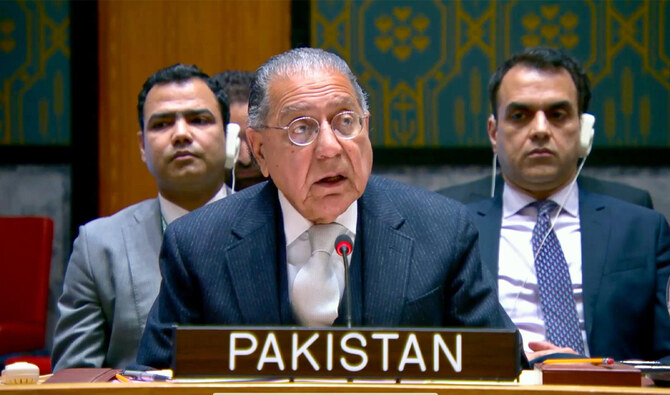
Pakistan’s Permanent Representative to the United Nations (UN) Ambassador Munir Akram speaks at the UN security council session in New York, on March 13, 2025. (X/@PakistanUN_NY)
Short Url
Updated 14 March 2025
Follow

At UNSC, Pakistan calls for ceasefire, technocratic government in Sudan

  • The war between Sudan’s army and Rapid Support Forces has displaced around 12 million people since 2023
  • Pakistan’s envoy says any scheme that undermines UN Charter principles will further complicate the conflict

ISLAMABAD: Pakistan’s Permanent Representative to the United Nations (UN) Ambassador Munir Akram has called for the establishment of an independent technocratic government in Sudan to manage the transitional period and urged warring parties to declare a ceasefire, Pakistani state media reported on Friday.
The war between Sudan’s army and the paramilitary Rapid Support Forces (RSF), which erupted in April 2023 over disputes regarding the integration of the two forces, has killed tens of thousands of people, displaced millions and left half of the Sudanese population facing hunger.
The conflict has also triggered waves of ethnically driven violence, largely blamed on the RSF, leading to a severe humanitarian crisis. The UN says that nearly two-thirds of Sudan’s population, or more than 30 million people, will need aid this year.
“The appointment of an independent prime minister and formation of an independent national technocratic government to oversee the transitional period could be steps in a positive direction,” the Associated Press of Pakistan (APP) news agency quoted Akram as saying at a meeting of the UN Security Council (UNSC) to discuss the Sudan situation.
“The conflict will not be resolved on the battlefield [and] war will only bring more death and destruction to the Sudanese people.”
Akram condemned the signing of a charter by the RSF and its allies for a parallel governing authority in Sudan.
“Any such external intervention and any scheme that undermines the UN Charter principles will further complicate the conflict, prevent an early solution and further undermine regional and international peace and security,” he said.
The Pakistan envoy urged warring parties in Sudan to abide by the international humanitarian law and facilitate humanitarian assistance in the affected areas.
United Nations Children’s Fund (UNICEF) Executive Director Catherine Russell said the Sudanese children were enduring “unimaginable suffering and horrific violence,” calling for an immediate end to the conflict.
“This is not just a crisis, it is a poly-crisis affecting every sector, from health and nutrition to water, education and protection,” she said.
“I met with families and children who are living through this nightmare. Their stories are heartbreaking – and demand immediate action.”


EU, Pakistan sign €60 million loan agreement for clean drinking water in Karachi

Updated 17 December 2025
Follow

EU, Pakistan sign €60 million loan agreement for clean drinking water in Karachi

  • Project will finance rehabilitation, construction of water treatment facilities in Karachi city, says European Investment Bank
  • As per a report in 2023, 90 percent of water samples collected from various places in city was deemed unfit for drinking

ISLAMABAD: The European Investment Bank (EIB) and Pakistan’s government on Wednesday signed a €60 million loan agreement, the first between the two sides in a decade, to support the delivery of clean drinking water in Karachi, the EU said in a statement. 

The Karachi Water Infrastructure Framework, approved in August this year by the EIB, will finance the rehabilitation and construction of water treatment facilities in Pakistan’s most populous city of Karachi to increase safe water supply and improve water security. 

The agreement was signed between the two sides at the sidelines of the 15th Pak-EU Joint Commission in Brussels, state broadcaster Radio Pakistan reported. 

“Today, the @EIB signed its first loan agreement with Pakistan in a decade: a €60 million loan supporting the delivery of clean drinking water for #Karachi,” the EU said on social media platform X. 

Radio Pakistan said the agreement reflects Pakistan’s commitment to modernize essential urban services and promote climate-resilient infrastructure.

“The declaration demonstrates the continued momentum in Pakistan-EU cooperation and highlights shared priorities in sustainable development, public service delivery, and climate and environmental resilience,” it said. 

Karachi has a chronic clean drinking water problem. As per a Karachi Water and Sewerage Corporation (KWSC) study conducted in 2023, 90 percent of water from samples collected from various places in the city was deemed unsafe for drinking purposes, contaminated with E. coli, coliform bacteria, and other harmful pathogens. 

The problem has forced most residents of the city to get their water through drilled motor-operated wells (known as ‘bores’), even as groundwater in the coastal city tends to be salty and unfit for human consumption.

Other options for residents include either buying unfiltered water from private water tanker operators, who fill up at a network of legal and illegal water hydrants across the city, or buying it from reverse osmosis plants that they visit to fill up bottles or have delivered to their homes.

The EU provides Pakistan about €100 million annually in grants for development and cooperation. This includes efforts to achieve green inclusive growth, increase education and employment skills, promote good governance, human rights, rule of law and ensure sustainable management of natural resources.