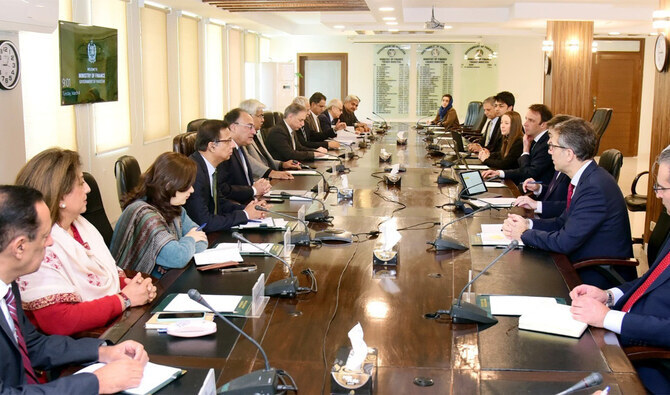
KARACHI: Stock investors have been trading cautiously since last week when an International Monetary Fund (IMF) mission arrived in Pakistan to review the country’s economic performance under its reforms-oriented, $7 billion loan program, analysts said on Thursday.
Pakistan’s stocks turned green on Thursday after losing more than 300 points in the last three sessions, with the benchmark KSE-100 index gaining 0.9 percent to close at 115,094.23 points. The stocks, which have gained about 3 percent since March 3 when the IMF experts landed in the country, have been fluctuating and witnessed four bull-runs and as many bearish sessions.
While the IMF and the government remain tightlipped about what they are discussing behind the closed doors, local media reports claim that the two sides are not on the same page over issues relating to Pakistan’s revenue shortfall, debt sustainability, and the resolution of the country’s power sector debt. The central bank unexpectedly maintaining the interest rate at 12 percent this week is being seen as another negative for stocks investors.
“The stock market is jittery because of the IMF review along with other factors,” Sana Tawfik, head of research at Karachi-based Arif Habib Ltd., told Arab News.
She said the market was mainly reacting to news reports about the IMF expressing concern over Pakistan’s tax shortfall of around Rs600 billion ($2.1 billion) and rejecting the government’s plans to resolve the lingering circular debt that was expected to increase to as much as Rs1 trillion by June.
The IMF wants Pakistan to increase its tax-to-GDP ratio, which is the lowest in the region, to 13 percent by taxing incomes from agriculture, real estate and retail sectors. Pakistan, however, fell short of the IMF-backed tax collection target this year.
“There is a concern in the market that this tax shortfall may upset the review,” Tawfik said, adding that the selling pressure and a lack of a proper trigger were other drags on the stock index.
Ahsan Mehanti, chief executive officer at Arif Habib Commodities Ltd., said the issues being discussed with the IMF would have a “direct impact” on stocks, including energy, cement and even the cost of borrowing that is directly related to economic growth.
“Generally higher interest rates are negative for the stocks and we believe the IMF certainly does play a role in the central bank’s decisions,” Mehanti told Arab News.
Pakistan’s policymakers avoid squeezing the interest rate much at a time when the IMF is reviewing the release of its first tranche under the $7 billion program.
“The market expects IMF’s proposal may be growth negative owing to higher interest rates to check inflation risks, thin LSM (large-scale manufacturing) growth in case of a cut in the PSDP (public sector development program) or refusals of circular debt plans,” the commodity analyst said.
But Amjad Waheed, chief executive officer at the NBP Fund Management Ltd., held a different view and said the recent fluctuation looked more like a case of profit-taking as investors booked handsome profits during the last couple of years, when the stock market rose as much as 84 percent.
“The IMF talks are ongoing stable and as per routine. I haven’t heard of any tough conditions that the IMF is going to set,” said Waheed, who manages billions of rupees of investor savings.
“People have earned enough and some people now booking profit is normal. The market corrects a bit because of profit-taking.”
The fund manager said some investors might be selling their stocks as their expectation for a rate cut of as much as 1,500 basis points could not materialize because of Monday’s decision by the central bank.
“As an investor I am very conscious at the moment. I am holding on to my stocks. I am holding on to my investments. I am very careful with that,” Isra Ghous Rasool, a 22-year-old stock investor from Karachi, told Arab News in a recent interview.


![]()

IMF review talks keep stock investors jittery in Pakistan
Short Url
https://arab.news/95y5d
IMF review talks keep stock investors jittery in Pakistan
- Pakistan stock market has seen four bullish runs and as many bearish sessions since an IMF team arrived in Pakistan this month
- Analysts says the talks with the IMF will have a ‘direct impact’ on stocks such as energy, cement and even the cost of borrowing
Latest updates


Recommended


© 2026 SAUDI RESEARCH & PUBLISHING COMPANY, All Rights Reserved And subject to Terms of Use Agreement.