ISTANBUL: Several independent media outlets in Turkiye face a potential risk of closure after algorithm changes made by Google led to a significant reduction in reader traffic, a joint statement from the outlets said on Thursday.
They said Google’s algorithm changes since the end of January had wiped out the vast majority of reader traffic to their websites, previously directed through Google’s “Discover” and “News” tools, and had harmed their finances.
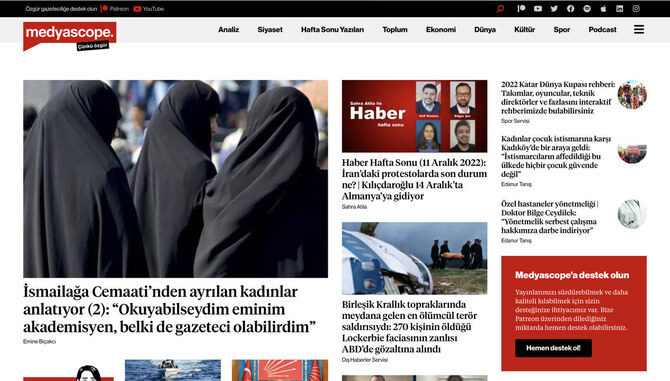
Independent news websites including T24, Medyascope, Diken, and Birgun said that Google’s changes also blocked the public’s access to news, adding that they would take legal action.
“As independent media organizations operating in Turkiye, we announce that we will stand up for our corporate rights, our employees’ work and the support of our readers, which have been stolen by Google’s actions, on every platform,” they said.
They said they would apply to local and international legal bodies, notably Turkiye’s Competition Authority.
A Google spokesperson, requesting anonymity, said its changes do not target individual websites and that they are designed to improve its search facility overall.
“We don’t and would never manipulate search results, modify our products, or enforce our policies to promote or disadvantage any particular viewpoint,” the spokesperson said.
In 2024, Turkiye ranked 158th out of 180 countries in the press freedom index of the free speech advocacy group Reporters Without Borders. Its report said that with some 90 percent of Turkiye’s media under government influence, Turks recently turned to critical or independent media outlets for domestic news.
Independent media outlets in Turkiye are highly dependent on Google revenues as private companies are reluctant to advertise on independent websites.
On Wednesday, independent news outlet Gazete Duvar announced its closure, citing revenue losses triggered by Google’s algorithm changes alongside inflationary economic conditions.


Turkiye’s independent news websites face closure risk after Google changes
https://arab.news/5ykq9
Turkiye’s independent news websites face closure risk after Google changes

- Google implemented algorithm changes that led to reduction in reader traffic, outlets say
- Spokesperson for the tech giant argues that the changes do not target individual websites and that they are designed to improve its search facility overall

Israel arrests 2 Turkish CNN journalists over live broadcast outside IDF HQ
- Police said reporter Emrah Cakmak and cameraman Halil Kahraman were detained on suspicion of filming a sensitive security facility
- Since the Gaza war began, restrictions have expanded significantly, including tighter limits on filming soldiers on duty and sensitive or strategic sites
LONDON: Israeli police have arrested two Turkish CNN journalists who were broadcasting live outside the Israel Defense Forces’ headquarters in Tel Aviv.
Police said the pair were detained on suspicion of filming a sensitive security facility, according to the Israel Police Spokesperson’s Unit.
Reporter Emrah Cakmak and cameraman Halil Kahraman, from the network’s Turkish-language channel, had been reporting near the IDF’s Kirya military headquarters on Tuesday after Iran launched another missile barrage at Tel Aviv and other parts of central Israel.
During the live broadcast, two men believed to be soldiers approached the crew and seized the reporter’s phone, according to initial reports and a video circulating online that could not be independently verified.
Police said officers were dispatched after receiving reports of two people carrying cameras and allegedly broadcasting in real time for a foreign outlet.
עיתונאים של CNN טורקיה נעצרו לאחר שצילמו את בסיס הקרייה@NoamIhmels pic.twitter.com/t8a5P9yXfw
— גלצ (@GLZRadio) March 3, 2026
Israel’s long-standing military censorship system, overseen by the IDF Military Censor, has long barred journalists and civilians from publishing material deemed harmful to national security.
Since the Gaza war began, restrictions have expanded significantly, including tighter limits on filming soldiers on duty and sensitive or strategic sites.
After a series of similar incidents involving foreign media — most of them Palestinian citizens of Israel working for Arab-language and international media, along with foreign journalists — during the 12-Day War, Israeli police halted live international broadcasts from missile impact sites, citing concerns that exact locations were being revealed.
The Government Press Office later imposed a blanket ban on live coverage from crash and impact areas.
Communications Minister Shlomo Karhi and National Security Minister Itamar Ben-Gvir subsequently ordered that all foreign journalists obtain prior written approval from the military censor before broadcasting — live or recorded — from combat zones or missile strike locations.
Police said that when officers asked the CNN Turk crew to identify themselves, they presented expired press cards and were taken in for questioning.
Burhanettin Duran, head of Turkiye’s Directorate of Communications, condemned the arrests as an attack on the press and said Ankara is working to secure the journalists’ release.


