

Pakistan PM calls for national unity to address Balochistan crisis after train hijacking

1 / 2
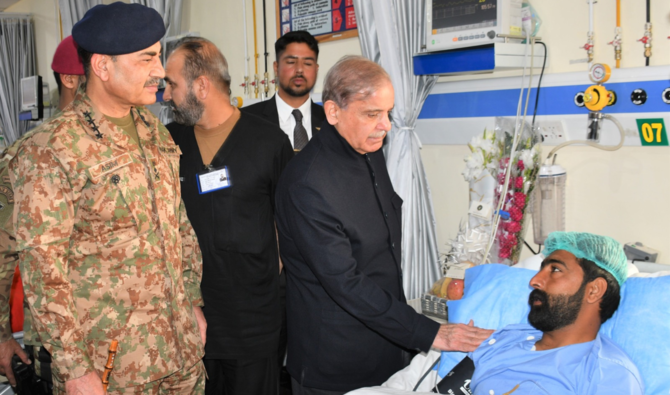
Prime Minister Muhammad Shehbaz Sharif (center) and Chief of Army Staff (COAS) General Syed Asim Munir (left) visit the rescued hostages of the Balochistan train hijack at the Combined Military Hospital (CMH) Quetta, on March 13, 2025. (PMO)
2 / 2
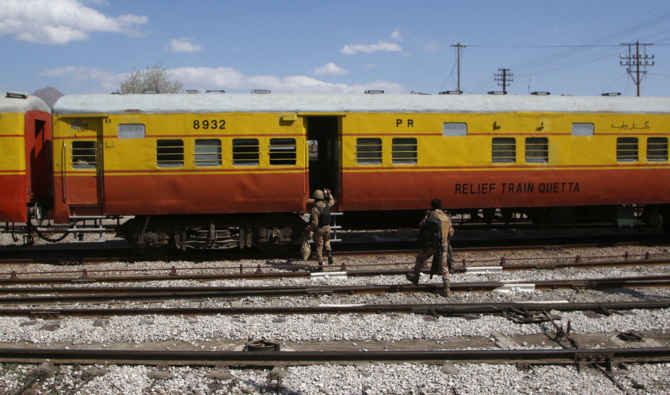
Soldiers board a relief train headed to Bolan, where a passenger train was attacked by separatist militants, at a railway station in Mach, Balochistan, Pakistan, March 13, 2025. (REUTERS)
Short Url
Updated 13 March 2025
Follow

Pakistan PM calls for national unity to address Balochistan crisis after train hijacking

  • PM Shehbaz Sharif chairs high-level meeting to review security situation in Balochistan 
  • Separatist BLA outfit stormed train in southwest Pakistan on Tuesday, held over 400 hostages 

ISLAMABAD: Pakistan’s Prime Minister Shehbaz Sharif on Thursday called on political parties to forge unity to combat surging militancy in southwestern Balochistan province, a day after the military announced it had conducted a successful operation against separatists who hijacked a passenger train with over 400 people on board, rescuing hostages and killing 33 militants.

The separatist Baloch Liberation Army (BLA) had bombed part of a railway track and stormed the train on Tuesday afternoon in Mushkaaf, a rugged area in the mountainous Bolan range of Balochistan.

Security forces had killed militant suicide bombers sitting among the hostages before swiftly executing the rescue operation and securing the Quetta-Peshawar-bound Jaffar Express on Wednesday night, the military said, adding that 21 hostages had been killed in the episode. 

Sharif chaired a high-level meeting in Balochistan’s provincial capital Quetta on Thursday to review the security situation in the province, with senior officials including Chief Minister Sarfraz Ahmed Bugti in attendance. 

“If there ever was a need for something more than before, it is national unity and national alliance,” Sharif told participants of the meeting in a televised address. 

“We will keep on doing our politics and keep on saying what we want to say but on this one issue, that we must save this country from these khawarij, this trial, this terrorism, we must become united,” he added. 

The prime minister said his government would “soon” convene a meeting to discuss the Balochistan crisis. He called for Pakistan’s political leadership to sit with the military to discuss the challenges that the country was facing.

Sharf said Pakistan can’t prosper until the pace of development in Balochistan catches up to that of other provinces. 

“Peace can’t be established in Pakistan until terrorism is completely eliminated in Khyber Pakhtunkhwa and Balochistan,” he said. 

Balochistan, Pakistan’s biggest in terms of landmass, has long been the site of a low-level insurgency, with separatist groups accusing the government of exploiting the province’s natural resources while leaving its people in poverty. 

Government officials deny the allegation and say they are developing the province through multibillion-dollar projects, including those backed by China.


Anti-minority hate speech in India rose by 13 percent in 2025, US research group says

Updated 6 sec ago
Follow

Anti-minority hate speech in India rose by 13 percent in 2025, US research group says

  • India Hate Lab documented 1,318 instances in 2025
  • The Indian government calls such reports biased

WASHINGTON: Hate speech against minorities, ​including Muslims and Christians, in India rose by 13 percent in 2025, with most incidents occurring in states governed by Prime Minister Narendra Modi’s Hindu nationalist Bharatiya Janata Party, a Washington-based research group said on Tuesday.

India Hate Lab documented 1,318 instances of what it called hate speech in 2025, up from 1,165 in 2024 and 668 in ‌2023, at ‌events such as political rallies, religious ‌processions, ⁠protest marches ​and cultural ‌gatherings.

Of that number, 1,164 incidents occurred in states and union territories governed by the BJP, either directly or with coalition political parties, the group said. The Indian embassy in Washington did not respond immediately to a request for comment.

Modi and his party deny being discriminatory and say their policies, including ⁠food subsidy programs and electrification drives, benefit all communities.

April recorded the highest ‌monthly spike, 158 events, with nearly 100 ‍occurring between April 22, ‍after a deadly militant attack in India-administered Kashmir, ‍and May 7, when four days of deadly fighting broke out between India and Pakistan.

Rights groups including Amnesty International and Human Rights Watch say abuse of minorities has risen in India since Modi ​took office in 2014, pointing to a religion-based citizenship law the UN calls “fundamentally discriminatory,” anti-conversion legislation that challenges ⁠freedom of belief, the 2019 removal of Muslim-majority Kashmir’s special status, and the demolition of Muslim-owned properties.

India Hate Lab, founded by US-based Kashmiri journalist Raqib Hameed Naik, is a project of the Center for the Study of Organized Hate, a nonprofit Washington-based think tank. The BJP has previously said India Hate Lab presents a biased picture of India.

India Hate Lab says it uses the UN’s definition of hate speech, which defines it as prejudiced or discriminatory language toward an individual ‌or group based on attributes including religion, ethnicity, nationality, race or gender.