

Pakistan denounces five-year ban on two Kashmiri organizations

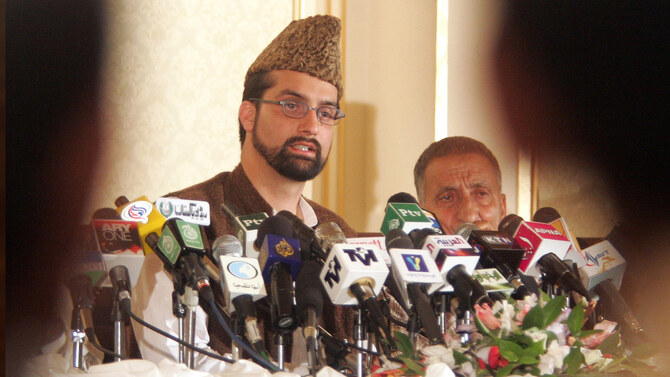
Chairman of All Parties Hurriyat Conference Mirwaz Umar Farooq speaks during a news conference in Islamabad on June 8, 2005. (Reuters/File)
Short Url
Updated 12 March 2025
Follow

Pakistan denounces five-year ban on two Kashmiri organizations

  • India declares Awami Action Committee and Jammu and Kashmir Ittihad-ul-Muslimeen ‘unlawful associations’
  • Pakistan says move an attempt to suppress political activities and stifle dissent, shows disregard of democratic norms

ISLAMABAD: Pakistan on Wednesday denounced a five-year ban on the Awami Action Committee and Jammu and Kashmir Ittihad-ul-Muslimeen organizations in Indian-administered Kashmir, calling it an attempt to “suppress political activities and stifle dissent.”

In a notification on Tuesday, the Indian Union Ministry of Home Affairs said both organizations were “unlawful” associations engaged in activities that were prejudicial to the integrity, sovereignty and security of the country.

The Awami Action Committee is led by political and religious leader Mirwaiz Umar Farooq, the chairman of the moderate faction of Kashmir’s main separatist political alliance. The Jammu and Kashmir Ittihad-ul-Muslimeen is led by Shia leader Masroor Abbas Ansari, who is also a senior leader of Farooq’s All Parties Hurriyat Conference.

Farooq’s family and aides are part of more than three decades of separatist activity by some Muslim politicians who have long resented what they see as heavy-handed New Delhi rule. Some want to join Pakistan, while others have called for complete independence for Kashmir.

“The recent decision increases the total number of outlawed Kashmiri political parties and organizations to 16,” the foreign office said, calling it a manifestation of India’s “iron-fisted” approach toward Kashmir. 

“It reflects a desire to suppress the political activities and stifle dissent. It also shows sheer disregard of democratic norms and international human rights law.”

The FO urged the government of India to remove the curbs on Kashmiri political parties, release all political prisoners and implement UN Security Council resolutions.

The Himalayan region of Jammu and Kashmir has long been a flashpoint between nuclear-armed neighbors India and Pakistan, with both claiming Kashmir in full but ruling it in part. UN peacekeepers have been deployed since 1949 to observe a ceasefire between India and Pakistan in Jammu and Kashmir.

The UN Security Council adopted several resolutions in 1948 and in the 1950s on the dispute between India and Pakistan over the region, including one which says a plebiscite should be held to determine the future of the mostly Muslim Kashmir.

Another resolution also calls upon both sides to “refrain from making any statements and from doing or causing to be done or permitting any acts which might aggravate the situation.”


Pakistan vaccinates over 43 million children as last polio drive of 2025 enters 6th day

Updated 8 sec ago
Follow

Pakistan vaccinates over 43 million children as last polio drive of 2025 enters 6th day

  • Campaign running simultaneously in Pakistan and Afghanistan, last two polio-endemic countries
  • Health authorities urge parents and communities to fully cooperate with anti-polio vaccinators

ISLAMABAD: Pakistan has vaccinated more than 43.8 million children in five days of its last nationwide polio campaign of 2025, health authorities said on Saturday, as the drive entered its sixth day amid renewed efforts to curb the virus.

The campaign, running from Dec. 15 to 21, targets children under the age of five and is being conducted simultaneously in Pakistan and Afghanistan, according to Pakistan’s National Emergency Operations Center (NEOC) which oversees eradication efforts.

Pakistan and neighboring Afghanistan are the only two countries where wild poliovirus transmission has never been interrupted, keeping global eradication efforts at risk. The virus, which can cause irreversible paralysis, has no cure and can only be prevented through repeated oral vaccination.

“The last nationwide polio campaign of 2025 continues in full swing on the sixth day,” the NEOC said in a statement. “Over 43.8 million children have been vaccinated in five days so far.”

Provincial data released by the National EOC showed that around 22.7 million children had been vaccinated in Punjab province, more than 10.2 million in Sindh, approximately 6.9 million in Khyber Pakhtunkhwa and about 2.5 million in Balochistan. In Islamabad, over 450,000 children received polio drops, while more than 274,000 were vaccinated in Gilgit-Baltistan and over 714,000 in Azad Jammu and Kashmir.

“The polio campaign is being conducted simultaneously in Pakistan and Afghanistan,” the NEOC said. “More than 400,000 polio workers are going door to door across the country to administer vaccines.”

Pakistan has logged 30 polio cases so far in 2025, underscoring the fragility of progress against the virus. The country recorded 74 cases in 2024, a sharp rise from six cases in 2023, reflecting setbacks caused by vaccine hesitancy, misinformation and access challenges in high-risk areas.

Health officials say insecurity remains a major obstacle. Polio workers and their security escorts have repeatedly been targeted in militant attacks, particularly in parts of northwestern Khyber Pakhtunkhwa and southwestern Balochistan, complicating efforts to reach every child. Natural disasters, including flooding, have further disrupted vaccination campaigns in recent years.

“Parents and communities are urged to fully cooperate with polio workers,” the NEOC said, stressing that every child under the age of five must be given polio drops.

Pakistan has dramatically reduced polio prevalence since the 1990s, when annual cases exceeded 20,000. Health authorities, however, warn that without sustained access to children in underserved and conflict-affected areas, eradication will remain out of reach.