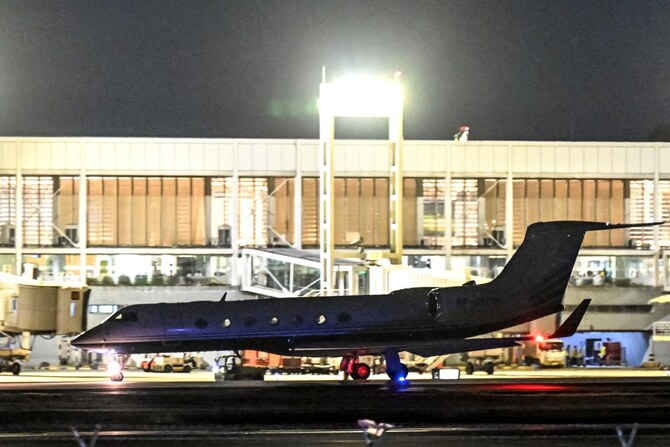
MANILA: Former Philippines leader Rodrigo Duterte left Manila on a jet on Tuesday bound for The Hague, President Ferdinand Marcos Jr said, hours after he was arrested at the request of the International Criminal Court over a “war on drugs” that defined his presidency.
Duterte, a firebrand ex-mayor and former prosecutor who led the Philippines from 2016 to 2022, was arrested at a Manila airport early on Tuesday, in a major step in the ICC’s investigation into thousands of killings in an anti-drugs crackdown that caused shock and condemnation around the world.
“I am confident the arrest was proper, correct and followed all necessary legal procedures,” Marcos told a press conference confirming Duterte had left the country bound for the Netherlands.
“We did not help the International Criminal Court in any way. The arrest was made in compliance with Interpol.”
The “war on drugs” was Duterte’s signature campaign platform that swept the mercurial crime-buster to power and he soon delivered on promises he made during vitriolic speeches to kill thousands of drug pushers and users.
Duterte has long insisted he instructed police to kill only in self-defense and has always defended the crackdown, repeatedly telling his supporters he was ready to “rot in jail” if it meant ridding the Philippines of drugs.
Veronica Duterte, the 79-year-old’s youngest daughter, said on Instagram her father had boarded the jet but the family had not been informed of its destination.
“The airplane used to kidnap my dad just left minutes ago,” she posted.
Duterte could become Asia’s first former head of state to go on trial at the ICC.
Rights groups
His arrest follows years of him rebuking and taunting the ICC since he unilaterally withdrew the Philippines from the court’s founding treaty in 2019 as it started looking into allegations of systematic murders of drug dealers on his watch.
The ICC, a court of last resort, is probing alleged crimes against humanity and says it has jurisdiction to investigate alleged crimes that took place while a country was a member.
Duterte and his family and allies expressed fury at the arrest, calling it unlawful.
A lawyer petitioned the Supreme Court on Duterte’s behalf on Tuesday seeking a temporary restraining order to prevent authorities from complying with the ICC’s request.
A copy of the warrant, seen by Reuters, said Duterte is accused of criminal responsibility for the murder of at least 43 people between 2011 and 2019, which would include time when he served as mayor of southern Davao City.
Human rights groups and families of victims said his detention was a key step toward accountability for the killings of thousands of people in the Philippines, where police investigations have moved at a snail’s pace. Duterte has not been charged with any crimes locally.
According to police, 6,200 suspects were killed during anti-drug operations under Duterte’s presidency that they say ended in shootouts. But activists say the real toll of the crackdown was far greater, with many thousands more slumland drug users, some named on community “watch lists,” killed in mysterious circumstances.
The prosecutor of the ICC has said as many as 30,000 people may have been killed by police or unidentified individuals.
Police have rejected allegations from rights groups of systematic murders, staged crime scenes and fabricated incident reports.

Philippine president says Duterte has left on jet bound for ICC
https://arab.news/m2724
Philippine president says Duterte has left on jet bound for ICC
- Duterte could become Asia’s first former head of state to go on trial at the ICC
- A copy of the warrant said Duterte is accused of criminal responsibility for the murder of at least 43 people between 2011 and 2019
Hong Kong election turnout in focus amid anger over deadly fire
- Security tight as city holds legislative elections
- Residents angry over blaze that killed at least 159
HONG KONG: Hong Kong’s citizens were voting on Sunday in an election where the focus is on turnout, with residents grieving and traumatized after the city’s worst fire in nearly 80 years and the authorities scrambling to avoid a broader public backlash.
Security was tight in the northern district of Tai Po, close to the border with mainland China, where the fire engulfed seven towers. The city is holding elections for the Legislative Council, in which only candidates vetted as “patriots” by the China-backed Hong Kong government may run.
Residents are angry over the blaze that killed at least 159 people and took nearly two days to extinguish after it broke out on November 26. The authorities say substandard building materials used in renovating a high-rise housing estate were responsible for fueling the fire.
Eager to contain the public dismay, authorities have launched criminal and corruption investigations into the blaze, and roughly 100 police patrolled the area around Wang Fuk Court, the site of the fire, early on Sunday.
A resident in his late 70s named Cheng, who lives near the charred buildings, said he would not vote.
“I’m very upset by the great fire,” he said during a morning walk. “This is a result of a flawed government ... There is not a healthy system now and I won’t vote to support those pro-establishment politicians who failed us.”
Cheng declined to give his full name, saying he feared authorities would target those who criticize the government.
At a memorial site near the burned-out residential development, a sign said authorities plan to clear the area after the election concludes close to midnight, suggesting government anxiety over public anger.
Beijing’s national security office in Hong Kong has said it would crack down on any “anti-China” protest in the wake of the fire and warned against using the disaster to “disrupt Hong Kong.”
China’s national security office in Hong Kong warned senior editors with a number of foreign media outlets at a meeting in the city on Saturday not to spread “false information” or “smear” government efforts to deal with the fire.
The blaze is a major test of Beijing’s grip on the former British colony, which it has transformed under a national security law after mass pro-democracy protests in 2019.
An election overhaul in 2021 also mandated that only pro-Beijing “patriots” could run for the global financial hub’s 90-seat legislature and, analysts say, further reduced the space for meaningful democratic participation.
Publicly inciting a vote boycott was criminalized as part of the sweeping changes that effectively squeezed out pro-democracy voices in Hong Kong. Pro-democracy voters, who traditionally made up about 60 percent of Hong Kong’s electorate, have since shunned elections.
The number of registered voters for Sunday’s polls — 4.13 million — has dropped for the fourth consecutive year since 2021, when a peak of 4.47 million people were registered.
Seven people had been arrested as of Thursday for inciting others not to vote, the city’s anti-corruption body said.
Hong Kong and Chinese officials have stepped up calls for people to vote.
“We absolutely need all voters to come out and vote today, because every vote represents our push for reform, our protection of the victims of disaster, and a representation of our will to unite and move forward together,” Hong Kong leader John Lee said after casting his vote.
Hong Kong’s national security office urged residents on Thursday to “actively participate in voting,” saying it was critical in supporting reconstruction efforts by the government after the fire.
“Every voter is a stakeholder in the homeland of Hong Kong,” the office said in a statement. “If you truly love Hong Kong, you will vote sincerely.”
The last Legislative Council elections in 2021 recorded the lowest voter turnout — 30.2 percent — since Britain returned Hong Kong to Chinese rule in 1997.