

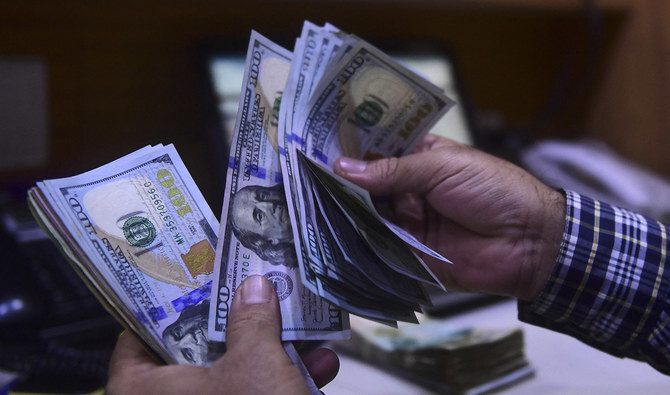

KARACHI: Pakistan hopes to receive record $36 billion remittances this fiscal year through June, the finance minister said on Tuesday, as the South Asian nation seeks to boost its foreign exchange reserves in line with the tough conditions of an International Monetary Fund (IMF) loan program.
The lender wants Islamabad to increase its foreign exchange reserves to a level that can finance three months of imports. Presently, the country holds $11 billion reserves, providing two months of import cover.
Remittances are a lifeline for Pakistan’s cash-strapped economy, playing a critical role in stabilizing foreign exchange reserves and supporting balance of payments.
Pakistan recorded year-on-year growth of 38.6 percent in remittances with record inflows of $3.1 billion in February, the central bank said on Monday.
“In this fiscal year [2024-2025], we will again complete it at an all-time high,” Finance Minister Muhammad Aurangzeb said in a televised speech. “At this moment, our estimate is that about $36 billion remittances inflow will come into the country.”
In February 2025, according to central bank data, Pakistan received its highest inflows from Saudi Arabia, $744.4 million, followed by the UAE, which contributed $652.2 million. Remittances received from the United Kingdom and the United States stood at $501.8 million and $309.4 million respectively.
“Cumulatively, with an inflow of $24 billion, workers’ remittances increased by 32.5 percent during July to February FY25 compared to $18.1 billion received during July to February FY24,” the central bank said in a statement.
Among factors driving an increase in remittances are reforms that have curbed illegal foreign exchange trading and incentives implemented by the State Bank of Pakistan. Decreased global inflation rates have encouraged Pakistani migrants to send more money back home.
Families in Pakistan are also relying more on financial support from relatives working abroad due to inflation at home.
Pakistan’s consumer inflation rate slowed to a near decade low of 1.5 percent in February, largely due to a high year-ago base. That was below the government’s forecast and significantly lower than a multi-decade high of around 40 percent in May 2023.
The central bank’s policy committee said on Monday it expected inflation to fall further before gradually inching up and stabilizing within the state bank’s 5-7 percent target range.
The state bank kept its forecast of full-year GDP growth at 2.5 percent to 3.5 percent and said it expected economic activity to gain further momentum.
Pakistan’s economy grew by 0.92 percent in the first quarter of the fiscal year 2024-25 which ends in June.
On Monday, the central bank unexpectedly halted its easing cycle, keeping its key policy rate at 12 percent, saying there could still be price risks including from an escalation in global tariffs even though inflation was falling for now.


