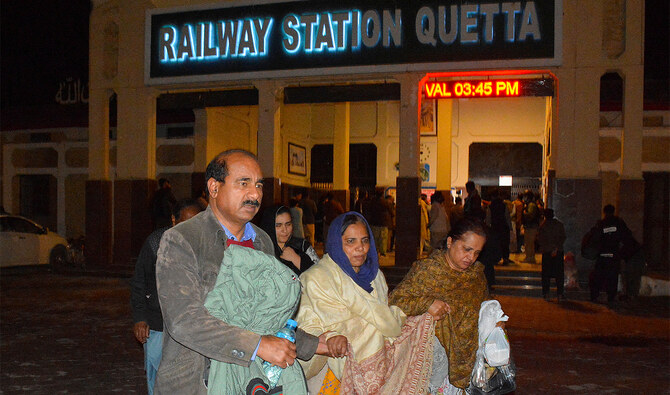

QUETTA/KARACHI: Pakistani security officials said on Tuesday 104 hostages had been freed after separatist militants hijacked a train carrying more than 400 passengers in Pakistan’s southwestern Balochistan province, with a gunbattle raging on hours after the assault began.
A low-level separatist insurgency in Balochistan is one of the chronic security problems undermining stability in Pakistan. The separatists accuse the government of stripping the province’s natural resources and leaving its people mired in poverty. They say security forces routinely abduct, torture and execute ethnic Baloch, accusations echoed by human rights campaigners. Government officials and security forces strongly deny violating human rights and say they are uplifting the province through development projects, including multi-billion-dollar schemes funded by China. Insurgents in the province also target civilians, especially Pakistanis from other ethnic groups who have settled in Balochistan.
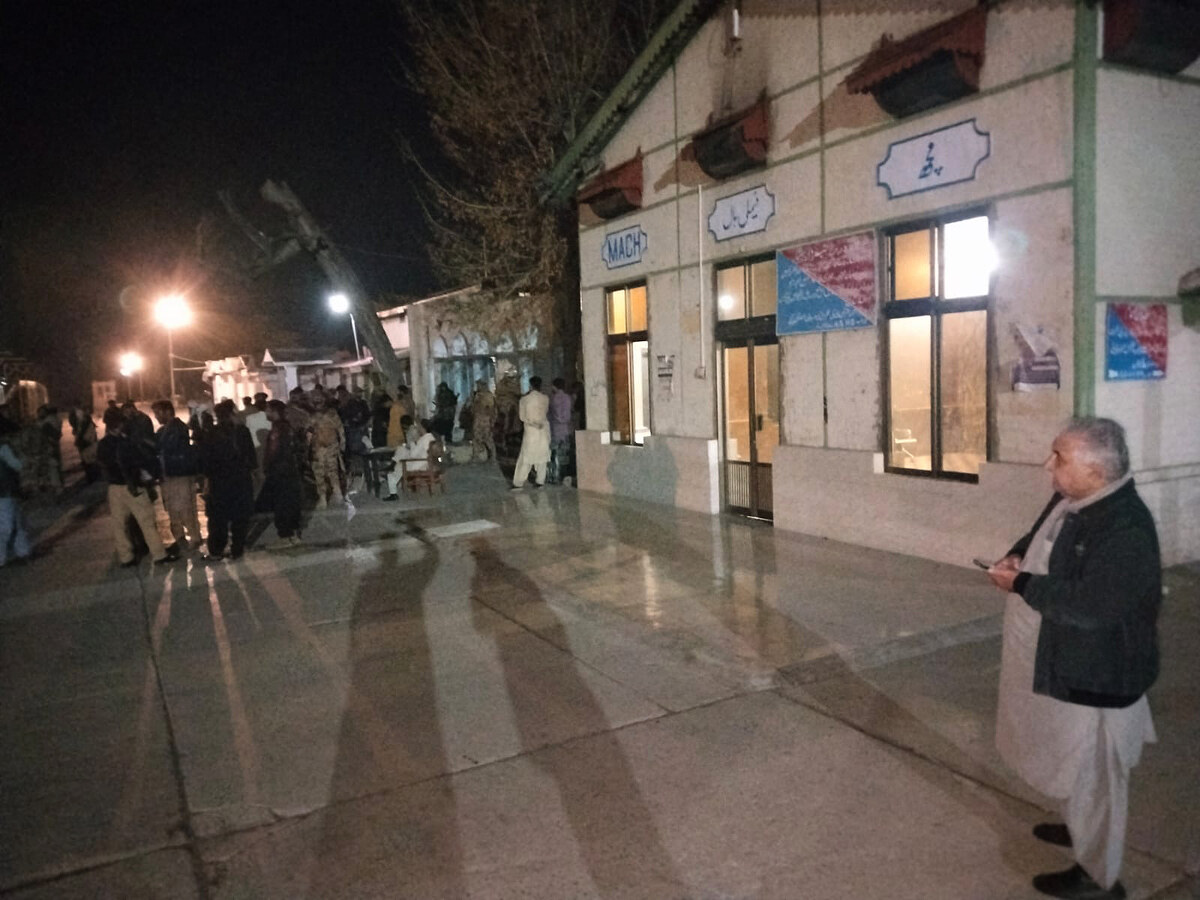
Freed train passengers gather at the Mach railway station after Pakistani security forces freed nearly 104 passengers following a security operation against armed militants who ambushed the train in the remote mountainous area, in Mach, southwestern Balochistan province on March 11, 2025. (AN Photo)
The latest attack on the Quetta-Peshawar bound Jaffar Express occurred in Mushkaaf, an area in the mountainous Bolan range of Balochistan. The Baloch Liberation Army, the most prominent among separatist outfits operating in the province, accepted responsibility in a statement sent to the media and said it was holding 214 people hostage.
The Jaffar Express train was hijacked while it was en route to the northwestern city of Peshawar from the provincial capital of Quetta, carrying 425 passengers, according to Muhammad Kashif, a spokesman for Pakistan Railways Quetta Division.
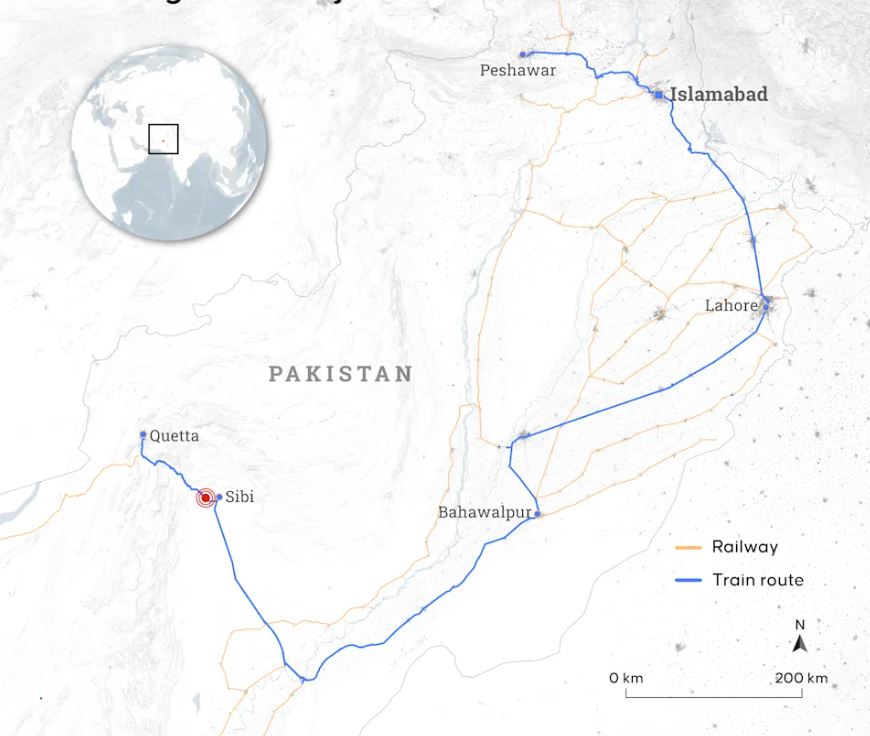
This infographic, created on March 11, 2025, shows route map of Pakistani train Jaffar Express that came under attack in Balochistan province. (Courtesy: Anadolu via Reuters Connect)
“Security forces have safely rescued 104 passengers from the terrorists,” a security official with direct knowledge of the matter said, requesting anonymity and adding that the released people included 58 men, 31 women and 115 children.
He said troops had surrounded the militants and an exchange of fire was ongoing, with 16 insurgents killed.
“The complex operation is being carried out with utmost caution due to the use of women and children as shields and the difficult terrain,” the official added.
“RULES OF WAR”
Balochistan is Pakistan’s largest province by area, covering 347,190 square kilometers and constituting 44 percent of the country’s total landmass. However, the remote province bordering Afghanistan and Iran is the country’s most backward region in terms of nearly all social and economic indicators. There are no Internet and mobile services in nearly 60 percent of the province, according to independent monitors, and areas which have such services often see shutdowns and months-long disruptions due to security reasons.
Speaking to Arab News, Imran Hayat, the divisional superintendent of Pakistan Railways in Quetta, said the department was unable to gather too many details of the attack or communicate with staff aboard the train as militants had carried out the assault in a “no-signal zone.”
“We haven’t retrieved a single body or injured from the area yet due to the communication blackout,” he said.
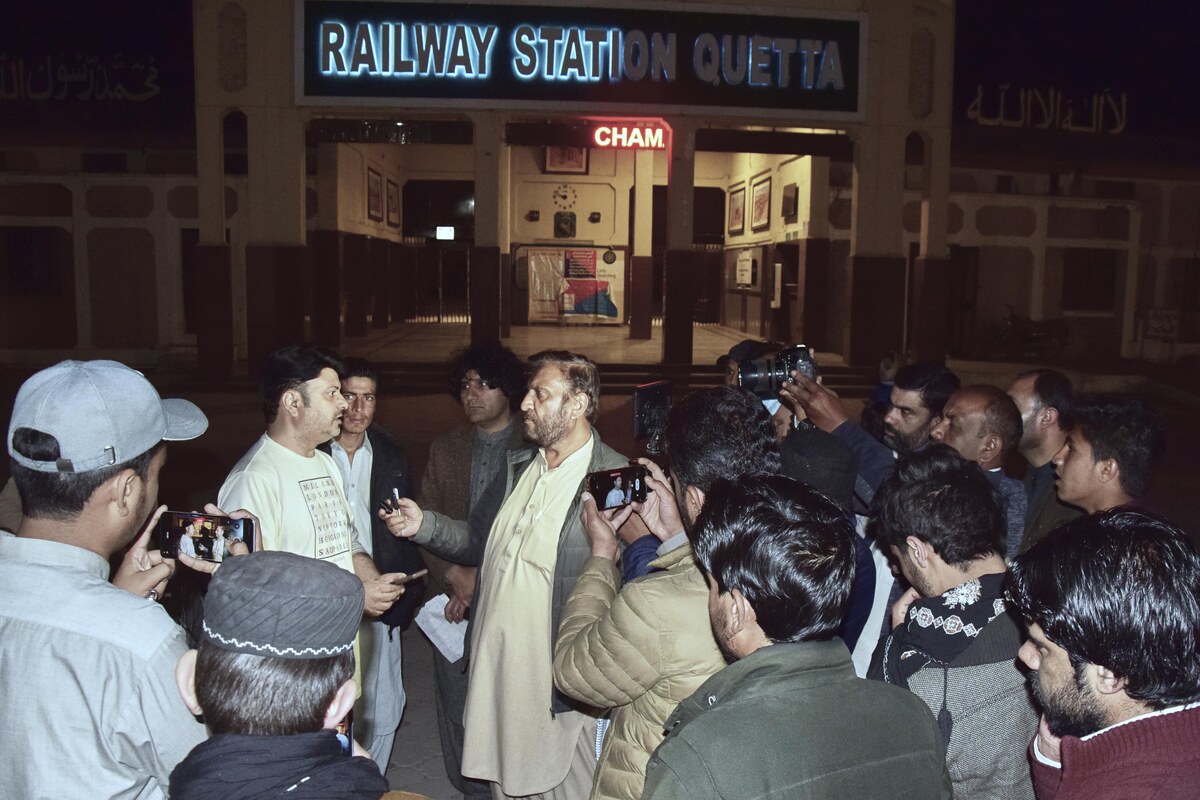
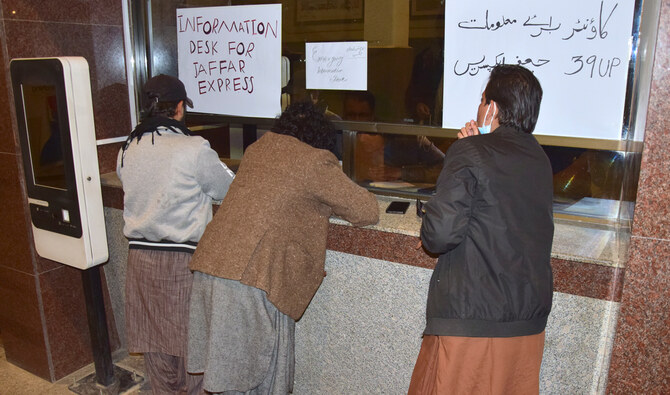
Relatives of passengers of a train, which is attacked by militants, gather to get information about passengers from special counter at a railway station in Quetta, Pakistan on March 11, 2025. (AP)
The BLA said it had blown up the railway track and taken control of the train.
“Under the rules of war, these 214 hostages are considered prisoners of war and BLA is prepared for a prisoner exchange,” the group said. “The occupying state of Pakistan is given 48 hours to immediately and unconditionally release Baloch political prisoners, forcibly disappeared persons and national resistance activists.”
The group warned that the hostages included military, paramilitary, police and intelligence officers, who would be killed if the BLA’s demands were not met within the stipulated period “or if the occupying state attempts any military action during this time.”
The separatists have also recently attacked projects being developed as part of the $65-billion China-Pakistan Economic Corridor (CPEC), part of President Xi Jinping’s Belt and Road Initiative, in Balochistan. The program is also developing a deep-water port close to the new $200-million airport in Gwadar, a joint venture between Pakistan, Oman and China.