

‘Really suffocating’: Pakistan emerges from record smog season

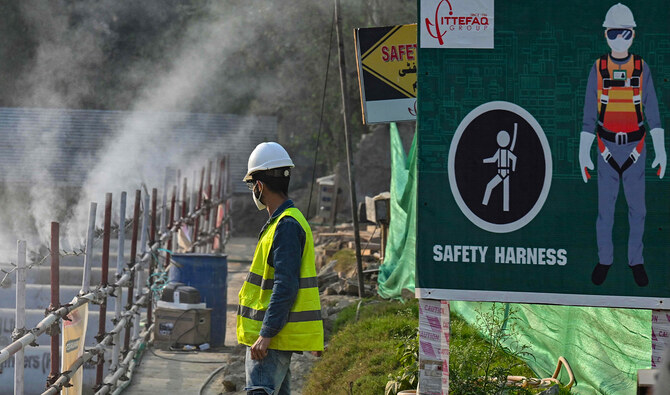
This photograph taken on February 17, 2025 shows a worker standing behind an anti-smog dust suppression sprayer installed at a construction site in Lahore. (AFP)
Updated 11 March 2025
Follow

‘Really suffocating’: Pakistan emerges from record smog season

  • Tens of millions of Pakistanis spent four months breathing toxic air 20 times above safe levels in worst winter smog season in years
  • This year, winter rains that bring relief did not arrive until February as climate change renders Pakistan’s weather patterns increasingly unpredictable

LAHORE: Tens of millions of Pakistanis spent at least four months breathing toxic air pollution 20 times above safe levels, in the worst winter smog season for several years, according to data analyzed by AFP.

Pakistan regularly ranks among the world’s most polluted countries, with Lahore often the most polluted megacity between November and February.

AFP’s analysis of data recorded since 2018 by independent air monitoring project AQICN shows the 2024-2025 winter smog season started a month earlier in October and persisted at higher levels, including in cities normally less affected by pollution.

Lahore’s 14 million residents spent six months breathing concentrations of PM2.5 — tiny particles that can penetrate the lungs and bloodstream — at levels 20 times or more than recommended by the World Health Organization.

Those in Karachi, Pakistan’s biggest city, and the capital Islamabad were subjected to 120 days of the same choking pollution levels.

“The smog is just getting worse every year,” admitted a factory owner in Lahore, who wished to remain anonymous after openly criticizing government policies.

“If I was rich, my first decision would be to leave Pakistan for Dubai, to protect my children and raise them in a smog-free environment,” he told AFP.
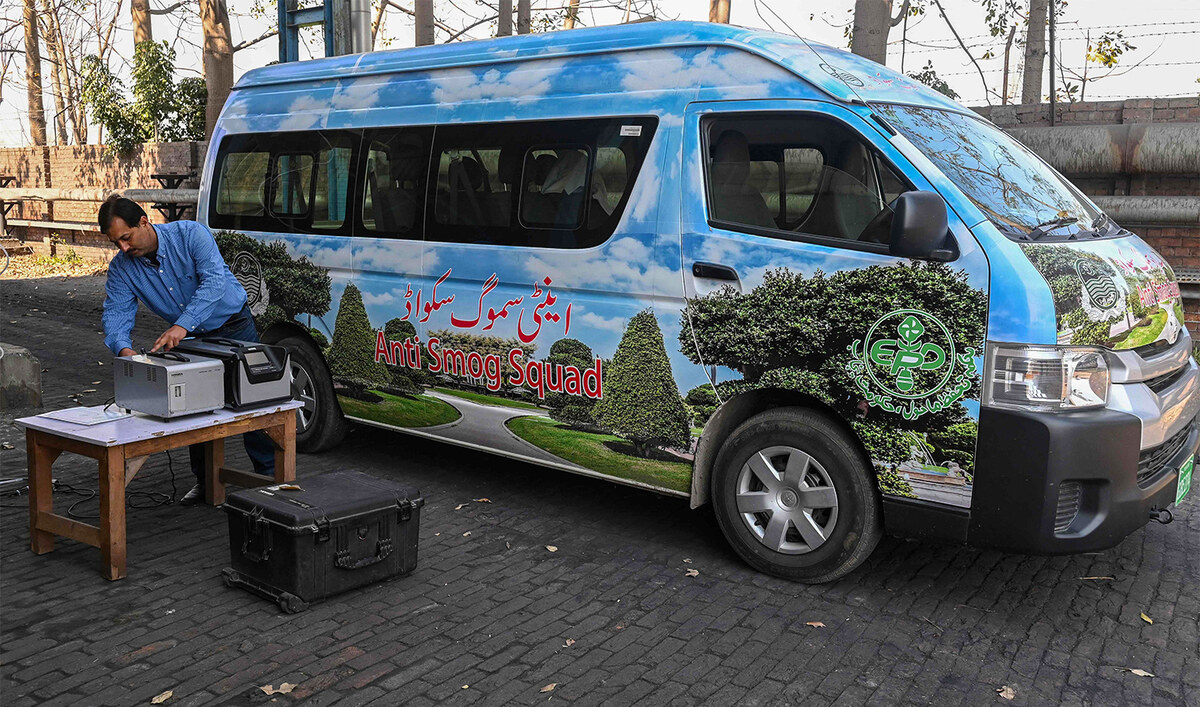


This photograph taken on February 18, 2025 shows an Anti-Smog Squad (ASS) lab technician preparing to inspect emissions at a factory using a gas analyser in Lahore. (AFP)

Experts say the pollution is primarily caused by factory and traffic emissions. It worsens in winter as farmers burn crop stubble and cooler temperatures and slow-moving winds trap the deadly pollutants.

This year, winter rains that typically bring relief did not arrive until late February, as climate change renders Pakistan’s weather patterns increasingly unpredictable.

The smog was so thick it could be seen from space and prompted authorities to close schools serving millions of students across the largest province Punjab, including its capital Lahore.

Young climate activist Risha Rashid said Islamabad is fast becoming “another Lahore” and has launched legal action against the government.

“It’s really suffocating,” the 21-year-old, who has asthma, told AFP.

“I cannot go out, even if I have exams. It’s not just affecting our physical health but our mental health as well.”

An Ipsos poll in November found four out of five Pakistanis said they were affected by the smog.

It can cause sore throats, stinging eyes and respiratory illnesses, while prolonged exposure can trigger strokes, heart disease and lung cancer.

Its effects are worse for children, who breathe more rapidly and have weaker immune systems.

This smog season, Punjab’s provincial government declared a “war on smog,” increasing public air quality monitoring devices tenfold to around 30 and offering farmers subsidised rentals of machinery to clear crop stubble and avoid burning.

It also pledged to increasingly enforce emissions regulations on tens of thousands of factories and more than 8,000 brick kilns, a major source of black carbon emissions.

But environmentalists and experts say action has been piecemeal and sometimes counterproductive, including restrictions on private air quality monitoring devices that the government claims give “misleading results that spread panic.”

And anti-smog machines, including a tower in Lahore shut down two months after installation, are effectively useless, experts say.

“It is like putting an air conditioner out in the open,” said one who spoke on condition of anonymity.

Efforts that tackle pollution’s effects, rather than its source, miss the point, said Ahmad Ali Gul at Lahore’s University of Management and Technology.

“It’s like when you have a bathtub and it’s overflowing and it’s creating a huge mess, do you first grab a towel or you first close the tap?” he said.

“First, we need to focus on reducing the emissions and then we talk about how to protect ourselves from smog.”

The government has blamed rival India, which borders Punjab province, for pollution blowing over into Lahore.

But Pakistan has limited vehicle emissions standards, and officials admit 83 percent of Lahore’s carbon emissions are from transport.

“Switching to a cleaner fuel would give immediate results, we’ve seen it in other countries,” said Frank Hammes, the global CEO of the Switzerland-based AQI air quality project.

But that “needs a pretty strong central effort to push down sometimes the painful changes that need to be made in order to reduce air pollution,” he added.

Pakistan’s government wants electric vehicles (EVs) to account for a third of new sales by 2030.

Cheaper Chinese models launched in Pakistan in 2024, but currently make up just a fraction of overall car sales in a country where 40 percent of the 240 million population lives in poverty, according to the World Bank.

Pakistan had a taste of clean air during the pandemic, when a lockdown forced vhicles off the streets and factories to close in March 2020, but it was short-lived as the economic impact was too great for many to bear.

“Air quality improved so much that we could even see the stars in Lahore in the evening,” said Omar Masud, a director of Urban Unit, which analyzes pollution data for the government.

While climate change can make air pollution worse, few Pakistanis worry about global warming, explained Abdul Sattar Babar, Ipsos director for Pakistan.

“Most Pakistanis are overwhelmed by the economic challenges that they are facing,” he said.

“When you can barely survive, climate issues are obviously not your primary concern.”


‘Look ahead or look up?’: Pakistan’s police face new challenge as militants take to drone warfare

Updated 09 January 2026
Follow

‘Look ahead or look up?’: Pakistan’s police face new challenge as militants take to drone warfare

  • Officials say militants are using weapons and equipment left behind after allied forces withdrew from Afghanistan
  • Police in northwest Pakistan say electronic jammers have helped repel more than 300 drone attacks since mid-2025

BANNU, Pakistan: On a quiet morning last July, Constable Hazrat Ali had just finished his prayers at the Miryan police station in Pakistan’s volatile northwest when the shouting began.

His colleagues in Bannu district spotted a small speck in the sky. Before Ali could take cover, an explosion tore through the compound behind him. It was not a mortar or a suicide vest, but an improvised explosive dropped from a drone.

“Now should we look ahead or look up [to sky]?” said Ali, who was wounded again in a second drone strike during an operation against militants last month. He still carries shrapnel scars on his back, hand and foot, physical reminders of how the battlefield has shifted upward.

For police in the northwestern Khyber Pakhtunkhwa (KP) province, the fight against militancy has become a three-dimensional conflict. Pakistani officials say armed groups, including the Tehreek-e-Taliban Pakistan (TTP), are increasingly deploying commercial drones modified to drop explosives, alongside other weapons they say were acquired after the US military withdrawal from neighboring Afghanistan.

Security analysts say the trend mirrors a wider global pattern, where low-cost, commercially available drones are being repurposed by non-state actors from the Middle East to Eastern Europe, challenging traditional policing and counterinsurgency tactics.

The escalation comes as militant violence has surged across Pakistan. Islamabad-based Pakistan Institute for Conflict and Security Studies (PICSS) reported a 73 percent rise in combat-related deaths in 2025, with fatalities climbing to 3,387 from 1,950 a year earlier. Militants have increasingly shifted operations from northern tribal belts to southern KP districts such as Bannu, Lakki Marwat and Dera Ismail Khan.

“Bannu is an important town of southern KP, and we are feeling the heat,” said Sajjad Khan, the region’s police chief. “There has been an enormous increase in the number of incidents of terrorism… It is a mix of local militants and Afghan militants.”

In 2025 alone, Bannu police recorded 134 attacks on stations, checkpoints and personnel. At least 27 police officers were killed, while authorities say 53 militants died in the clashes. Many assaults involved coordinated, multi-pronged attacks using heavy weapons.

Drones have also added a new layer of danger. What began as reconnaissance tools have been weaponized with improvised devices that rely on gravity rather than guidance systems.

“Earlier, they used to drop [explosives] in bottles. After that, they started cutting pipes for this purpose,” said Jamshed Khan, head of the regional bomb disposal unit. “Now we have encountered a new type: a pistol hand grenade.”

When dropped from above, he explained, a metal pin ignites the charge on impact.

Deputy Superintendent of Police Raza Khan, who narrowly survived a drone strike during construction at a checkpoint, described devices packed with nails, bullets and metal fragments.

“They attach a shuttlecock-like piece on top. When they drop it from a height, its direction remains straight toward the ground,” he said.

TARGETING CIVILIANS

Officials say militants’ rapid adoption of drone technology has been fueled by access to equipment on informal markets, while police procurement remains slower.

“It is easy for militants to get such things,” Sajjad Khan said. “And for us, I mean, we have to go through certain process and procedures as per rules.”

That imbalance began to shift in mid-2025, when authorities deployed electronic anti-drone systems in the region. Before that, officers relied on snipers or improvised nets strung over police compounds.

“Initially, when we did not have that anti-drone system, their strikes were effective,” the police chief said, adding that more than 300 attempted drone attacks have since been repelled or electronically disrupted. “That was a decisive moment.”

Police say militants have also targeted civilians, killing nine people in drone attacks this year, often in communities accused of cooperating with authorities. Several police stations suffered structural damage.

Bannu’s location as a gateway between Pakistan and Afghanistan has made it a security flashpoint since colonial times. But officials say the aerial dimension of the conflict has placed unprecedented strain on local forces.

For constables like Hazrat Ali, new technology offers some protection, but resolve remains central.

“Nowadays, they have ammunition and all kinds of the most modern weapons. They also have large drones,” he said. “When we fight them, we fight with our courage and determination.”