Bangladesh denies UN pressure in PM’s ouster last year

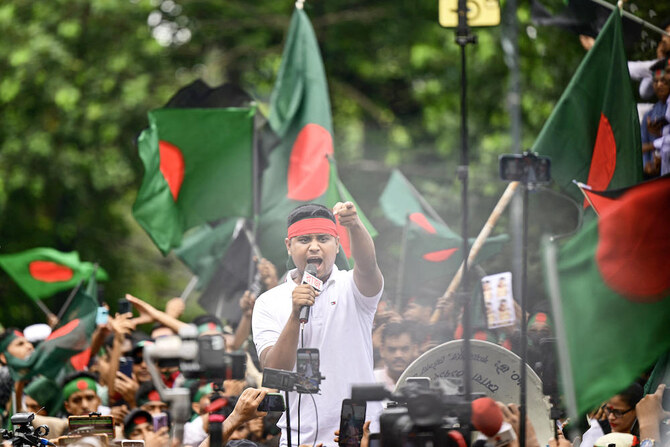
A student shouts slogans as demonstrators join the Martyr March, a rally organized by Students Against Discrimination to mark one month to the ousting of the country’s former Prime Minister Sheikh Hasina in Dhaka on Sept. 5, 2024. (AFP)
Short Url
Updated 10 March 2025
Follow

Bangladesh denies UN pressure in PM’s ouster last year

  • A student-led uprising ended Sheikh Hasina’s 15-year tenure last August
  • Thousands marched on her palace and forced autocratic premier into exile

DHAKA: Bangladesh’s armed forces denied on Monday that United Nations pressure played a role in the decision by top brass last year not to quash protests that ousted autocratic ex-premier Sheikh Hasina.
A student-led uprising ended Hasina’s 15-year tenure last August, with soldiers failing to intervene as thousands marched on her palace and forced her into exile.
UN human rights chief Volker Turk told the BBC last week that his office had warned that military involvement in any crackdown could result in Bangladeshi soldiers being banned from peacekeeping missions.
Bangladesh’s army said in a statement that it had not received “any direct communication” to that effect.
“This remark... appears to misrepresent the role of the Bangladesh Army and potentially undermines its reputation, sacrifice, and professionalism,” it said.
“During the July-August 2024 protests, the Army once again stood by the people, ensuring public safety without bias or external influence.”
Bangladesh is one of the largest contributors to UN peacekeeping forces globally and its operations are a lucrative source of income for the country’s soldiers.
Turk said in his comments to the BBC that he had been thanked by student leaders during his visit to Bangladesh last year.
“The students were so grateful to us for taking a stand, speaking out, and supporting them,” he said.
The UN Office of the High Commissioner for Human Rights sent a fact-finding mission to Bangladesh last year to investigate Hasina’s ouster.
Its report, published last month, found “reasonable grounds to believe that the top echelons” of Hasina’s government had committed “very serious” rights violations while attempting to suppress the protests that toppled her.
More than 800 people were killed during last year’s unrest.


Lawsuit challenges Trump administration’s ending of protections for Somalis

Updated 8 sec ago
Follow

Lawsuit challenges Trump administration’s ending of protections for Somalis

  • The lawsuit cites a series of statements Trump has made describing Somalis as “garbage” and “low IQ people” who “contribute nothing.”

BOSTON: Immigrant rights advocates filed a lawsuit on Monday seeking to stop US President Donald Trump’s administration from next ​week ending legal protections that allow nearly 1,100 Somalis to live and work in the United States. The lawsuit, brought by four Somalis and two advocacy groups, challenges the US Department of Homeland Security’s decision to end Temporary Protected Status for Somali immigrants, whom Trump has derided in public remarks. Outgoing Homeland Security Secretary Kristi Noem in January announced that TPS for Somalis would end on March 17, arguing that Somalia’s conditions had improved, despite fighting continuing between Somali forces and Al-Shabab militants. The plaintiffs, who ‌include the groups ‌African Communities Together and Partnership for the Advancement ​of ‌New ⁠Americans, in the ​lawsuit filed ⁠in Boston federal court argue the move was procedurally flawed and driven by a discriminatory, predetermined agenda.
The lawsuit cites a series of statements Trump has made describing Somalis as “garbage” and “low IQ people” who “contribute nothing.”
The plaintiffs said the administration is ending TPS for Somalia and other countries due to unconstitutional bias against non-white immigrants, not based on objective assessments of country conditions.
“The termination of TPS for Somalia is racism masking as immigration policy,” ⁠Omar Farah, executive director at the legal group Muslim Advocates, said ‌in a statement.
DHS did not respond to ‌a request for comment. It has previously said TPS ​was “never intended to be a de ‌facto amnesty program.”
TPS is a form of humanitarian immigration protection that shields eligible migrants ‌from deportation and allows them to work. Under Noem, DHS has moved to end TPS for a dozen countries, sparking legal challenges. The administration on Saturday announced plans to pursue an appeal at the US Supreme Court in order to end TPS for over 350,000 Haitians. It ‌also wants the high court to allow it to end TPS for about 6,000 Syrians.

SOMALI COMMUNITY TARGETED
Somalia was first designated ⁠for TPS in ⁠1991, with its latest extension in 2024. About 1,082 Somalis currently hold TPS, and 1,383 more have pending applications, according to DHS. Somalis in Minnesota in recent months had become a target of Trump’s immigration crackdown, with officials pointing to a fraud scandal in which many people charged come from the state’s large Somali community. The Trump administration cited those fraud allegations as a basis for a months-long immigration enforcement surge in Democratic-led Minnesota, during which about 3,000 immigration agents were deployed, spurring protests and leading to the killing of two US citizens by federal agents.
In November, Trump announced he would end TPS for Somalis in Minnesota, and a month later said ​he wanted them sent “back to where they ​came from.”
The US Department of State advises against traveling to Somalia, citing crime and civil unrest among numerous factors.