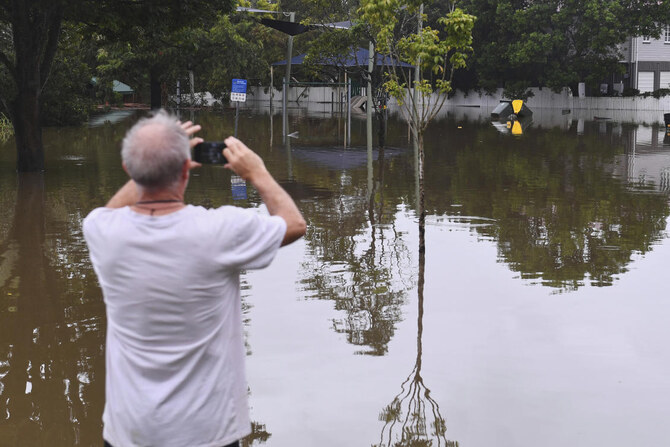
WELLINGTON: Australia’s prime minister cautioned that the fallout from a vicious tropical storm over the weekend was “far from over” as parts of two states remained inundated with perilous floodwaters on Monday, even as the initial threat from the deluge continued to recede.
One person was killed and several others injured after heavy rain lashed Australia’s east coast on Saturday, toppling trees and power lines and inundating some parts of Queensland and New South Wales with record downpours. The two states escaped the level of chaos forecast from the tropical low weather system, which was earlier expected to make landfall as the first tropical cyclone to hit south east Queensland in 51 years – before weakening as it approached.
Still, 200,000 homes and businesses were without power in the region on Monday afternoon – after the storm prompted the biggest blackout in Queensland’s history – and more than 700 schools were closed for the day.
Those living near rivers and creeks were urged to evacuate or stay indoors as water levels continued to rise in some areas – with more rain forecast triggering further warnings during the day. Disaster was declared for the city of Ipswich, west of Brisbane, where a river was expected to flood overnight. People in surrounding suburbs were ordered to leave their homes.
Meanwhile, in other towns where floodwaters began to recede a cleanup began as power was restored for tens of thousands of people. The scale of the damage was not immediately clear.
Workers whose livelihoods were hampered by the storm will be eligible for welfare payments for up to 13 weeks beginning Tuesday, Prime Minister Anthony Albanese told reporters on Monday.
In the city of Lismore in New South Wales, two military trucks helping with the rescue efforts on Saturday rolled over, injuring 13 of the 36 personnel traveling in them. One remained in hospital on Monday with injuries that were not life-threatening, Australia’s Defense Minister Richard Marles said.
The single casualty of the crisis was a 61-year-old man who disappeared in a flooded river near the New South Wales town of Dorrigo, police said. His body was recovered on Saturday.
Albanese warned residents of the two stricken states not to be “complacent” as flood warnings lingered.
“If it’s flooded, forget it,” he said, referring to traveling in or entering inundated areas.
Cyclones are common in Queensland’s tropical north but are rare in the state’s temperate and densely populated southeast corner that borders New South Wales. Tropical Cyclone Alfred was last week expected to become the first cyclone since 1974 to cross the Australian coast near Queensland’s state capital of Brisbane, Australia’s third-most populous city.
But it weakened Saturday to a tropical low, defined as carrying sustained winds of less than 63 kph (39 mph).
Authorities had feared similar scenes to those eastern Australia experienced during massive floods in 2011 and in a series of 2022 events – in which more than 20 people died.

Floodwaters still threaten parts of Australia’s east coast as tropical storm cleanup begins
Short Url
https://arab.news/7nhej
Floodwaters still threaten parts of Australia’s east coast as tropical storm cleanup begins
- Around 200,000 homes and businesses still without power in the region on Monday afternoon
- Workers whose livelihoods were hampered by the storm will be eligible for welfare payments
US pledges $2 bn for UN aid, with ‘adapt, shrink or die’ warning
GENEVA:Washington on Monday pledged an initial $2 billion for United Nations humanitarian aid in 2026 — far less than it has provided in recent years — warning individual UN agencies to “adapt, shrink or die.”
With its pledge, announced at the US mission in Geneva alongside the United Nations’ aid chief Tom Fletcher, the United States is pursuing a dramatic overhaul of how it funds UN humanitarian work.
Instead of handing funds to individual agencies, the United States will funnel its contributions through the UN aid agency OCHA, headed by Fletcher, which earlier this year launched a so-called Humanitarian Reset to improve efficiency and accountability.
The US funds will then be distributed to more than a dozen selected countries, including the Democratic Republic of Congo, Myanmar and Sudan.
“It is an initial anchor commitment,” Jeremy Lewin, the senior US official for foreign assistance, humanitarian affairs and religious freedom, told reporters.
“There are other countries that we will add, as we continue to get more funding into this mechanism.”
He challenged other countries to match or beat US funding for UN aid.
“This new model will better share the burden of UN humanitarian work with other developed countries and will require the UN to cut bloat, remove duplication, and commit to powerful new impact, accountability and oversight mechanisms,” US Secretary of State Marco Rubio said on X.
According to UN data, the United States remained the top humanitarian aid donor in the world in 2025, but that amount fell significantly to $2.7 billion, down from around $11 billion in 2023 and 2024, and from over $14 billion in 2022.
Other key donor countries have also been tightening their belts, triggering major upheaval in the global aid sector.
“Individual UN agencies will need to adapt, shrink, or die,” a State Department statement said.
Hard priority choices
Fletcher, who is British, said the US pledge was an “extraordinary” commitment.
“The US has long been the world’s humanitarian superpower,” he said in a statement.
“Hundreds of millions of people are alive today because of American generosity — and many millions more will survive in 2026 because of this landmark investment in humanity.”
Fletcher said reform of the humanitarian system was in the pipeline, and US taxpayers would be able to see how their money was delivering life-saving impacts.
“The US is also placing a significant and encouraging vote of trust and confidence in the Humanitarian Reset, through which we are making humanitarian action faster, smarter and closer to the people on the front lines of emergencies,” he said.
“We’re cutting red tape, eliminating duplication and prioritising hard.”
When Fletcher launched the UN’s annual Global Humanitarian Appeal for 2026 earlier this month, he requested $23 billion to provide assistance to 87 million of the world’s neediest people, with a heavy focus on dire conflicts like those in Gaza, Ukraine, Sudan, Haiti and Myanmar.
The amount and number of people covered by the appeal has been dramatically reduced over recent years, as the UN strives to adapt to a new reality after President Donald Trump slashed US foreign aid spending.
The United Nations has stressed that the smaller appeal does not mean needs have shrunk.
It estimates that some 240 million people — in conflict zones, suffering from epidemics, or victims of natural disasters and climate change — are in need of emergency aid.
In 2025, the UN’s appeal for more than $45 billion was only funded to the $12 billion mark, the lowest in a decade.
That only allowed it to help 98 million people, 25 million fewer than the year before.
With its pledge, announced at the US mission in Geneva alongside the United Nations’ aid chief Tom Fletcher, the United States is pursuing a dramatic overhaul of how it funds UN humanitarian work.
Instead of handing funds to individual agencies, the United States will funnel its contributions through the UN aid agency OCHA, headed by Fletcher, which earlier this year launched a so-called Humanitarian Reset to improve efficiency and accountability.
The US funds will then be distributed to more than a dozen selected countries, including the Democratic Republic of Congo, Myanmar and Sudan.
“It is an initial anchor commitment,” Jeremy Lewin, the senior US official for foreign assistance, humanitarian affairs and religious freedom, told reporters.
“There are other countries that we will add, as we continue to get more funding into this mechanism.”
He challenged other countries to match or beat US funding for UN aid.
“This new model will better share the burden of UN humanitarian work with other developed countries and will require the UN to cut bloat, remove duplication, and commit to powerful new impact, accountability and oversight mechanisms,” US Secretary of State Marco Rubio said on X.
According to UN data, the United States remained the top humanitarian aid donor in the world in 2025, but that amount fell significantly to $2.7 billion, down from around $11 billion in 2023 and 2024, and from over $14 billion in 2022.
Other key donor countries have also been tightening their belts, triggering major upheaval in the global aid sector.
“Individual UN agencies will need to adapt, shrink, or die,” a State Department statement said.
Hard priority choices
Fletcher, who is British, said the US pledge was an “extraordinary” commitment.
“The US has long been the world’s humanitarian superpower,” he said in a statement.
“Hundreds of millions of people are alive today because of American generosity — and many millions more will survive in 2026 because of this landmark investment in humanity.”
Fletcher said reform of the humanitarian system was in the pipeline, and US taxpayers would be able to see how their money was delivering life-saving impacts.
“The US is also placing a significant and encouraging vote of trust and confidence in the Humanitarian Reset, through which we are making humanitarian action faster, smarter and closer to the people on the front lines of emergencies,” he said.
“We’re cutting red tape, eliminating duplication and prioritising hard.”
When Fletcher launched the UN’s annual Global Humanitarian Appeal for 2026 earlier this month, he requested $23 billion to provide assistance to 87 million of the world’s neediest people, with a heavy focus on dire conflicts like those in Gaza, Ukraine, Sudan, Haiti and Myanmar.
The amount and number of people covered by the appeal has been dramatically reduced over recent years, as the UN strives to adapt to a new reality after President Donald Trump slashed US foreign aid spending.
The United Nations has stressed that the smaller appeal does not mean needs have shrunk.
It estimates that some 240 million people — in conflict zones, suffering from epidemics, or victims of natural disasters and climate change — are in need of emergency aid.
In 2025, the UN’s appeal for more than $45 billion was only funded to the $12 billion mark, the lowest in a decade.
That only allowed it to help 98 million people, 25 million fewer than the year before.
© 2025 SAUDI RESEARCH & PUBLISHING COMPANY, All Rights Reserved And subject to Terms of Use Agreement.


