Canada’s next PM Mark Carney vows to ‘win’ US trade war

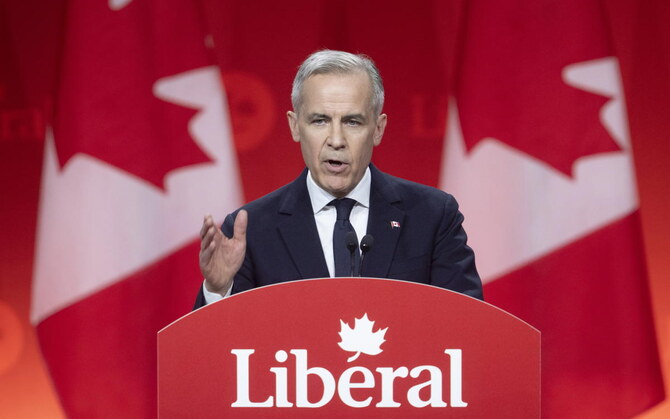
Incoming prime minister Mark Carney lost no time standing up for ‘the Canadian way of life’ after the Liberal Party overwhelmingly elected him to succeed Justin Trudeau. (The Canadian Press via AP)
Short Url
Updated 10 March 2025
Follow

Canada’s next PM Mark Carney vows to ‘win’ US trade war

  • Mark Carney warns the US under Trump was seeking to seize control of Canada
  • ‘The Americans want our resources, our water, our land, our country’

OTTAWA: Canada’s incoming prime minister Mark Carney struck a defiant note Sunday against the United States, as the former central banker vowed to win US President Donald Trump’s trade war.
Carney lost no time standing up for “the Canadian way of life” after the Liberal Party overwhelmingly elected him to succeed Prime Minister Justin Trudeau.
“We didn’t ask for this fight. But Canadians are always ready when someone else drops the gloves,” Carney told a boisterous crowd of party supporters in Ottawa.
“So the Americans, they should make no mistake, in trade as in hockey, Canada will win,” added the 59-year-old, who will take over from Trudeau in the coming days.
Carney may not have the job for long.
Canada must hold elections by October but could well see a snap poll within weeks. Current polls put the opposition Conservatives as slight favorites.
In his victory speech, Carney warned the United States under Trump was seeking to seize control of Canada.
“The Americans want our resources, our water, our land, our country,” he said.
“These are dark days, dark days brought on by a country we can no longer trust.”
He accused Trump of “attacking Canadian workers, families and businesses,” adding: “We cannot let him succeed.”
“We’re all being called to stand up for each other and for the Canadian way of life.”
Carney, who previously led both the Bank of Canada and the Bank of England, soundly defeated his main challenger, Trudeau’s former deputy prime minister Chrystia Freeland, who held several senior cabinet positions in the Liberal government that was first elected in 2015.
Carney won 85.9 percent of the nearly 152,000 votes cast. Freeland took just eight percent of the vote.
Carney campaigned on a promise to stand up to Trump.
The US president has repeatedly spoken about annexing Canada and thrown bilateral trade, the lifeblood of the Canadian economy, into chaos with dizzying tariff actions that have veered in various directions since he took office.
Delivering a farewell address, Trudeau said “Canadians face from our neighbor an existential challenge.”
Celebrating the outcome in Ottawa, party loyalist Cory Stevenson said “the Liberal party has the wind in its sails.”
“We chose the person who could best face off against (Tory leader) Pierre Poilievre in the next election and deal with Donald Trump,” he said.
Carney has argued that his experience makes him the ideal counter to the US president. He has portrayed himself as a seasoned economic crisis manager who led the Bank of Canada through the 2008-2009 financial crisis and the Bank of England through the turbulence that followed the 2016 Brexit vote.
Data released from the Angus Reid polling firm on Wednesday shows Canadians see Carney as the favorite choice to face off against Trump, potentially offering the Liberals a boost over the opposition Conservatives.
Forty-three percent of respondents said they trusted Carney the most to deal with Trump, with 34 percent backing Poilievre.
Before Trudeau announced his plans to resign in January, the Liberals were headed for an electoral wipeout, but the leadership change and Trump’s influence have dramatically tightened the race.
“We were written off about four months ago, and now we’re right back where we should be,” former MP Frank Baylis, who also ran for the leadership, said.
Carney made a fortune as an investment banker at Goldman Sachs before entering the Canadian civil service.
Since leaving the Bank of England in 2020, he has served as a United Nations envoy working to get the private sector to invest in climate-friendly technology and has held private sector roles.
He has never served in parliament nor held an elected public office.
Analysts say his untested campaign skills could prove a liability against a Conservative Party already running attack ads accusing Carney of shifting positions and misrepresenting his experience.
“It is absolutely a risk. He is unproven in the crucible of an election,” said Cameron Anderson, a political scientist at Ontario’s Western University.
But he said Carney’s tough anti-Trump rhetoric “is what Canadians want to hear from their leaders.”
“The average Canadian in the country is viewing these things in an existential way.”


Proposals on immigration enforcement flood into state legislatures, heightened by Minnesota action

Updated 16 January 2026
Follow

Proposals on immigration enforcement flood into state legislatures, heightened by Minnesota action

  • Oregon Democrats plan to introduce a bill to allow residents to sue federal officers for violating their Fourth Amendment rights against unlawful search and seizure

NASHVILLE, Tennessee: As Democrats across the country propose state law changes to restrict federal immigration officers after the shooting death of a protester in Minneapolis, Tennessee Republicans introduced a package of bills Thursday backed by the White House that would enlist the full force of the state to support President Donald Trump’s immigration crackdown.
Momentum in Democratic-led states for the measures, some of them proposed for years, is growing as legislatures return to work following the killing of Renee Good by an Immigration and Customs Enforcement officer. But Republicans are pushing back, blaming protesters for impeding the enforcement of immigration laws.

Democratic bills seek to limit ICE

Democratic Gov. Kathy Hochul wants New York to allow people to sue federal officers alleging violations of their constitutional rights. Another measure aims to keep immigration officers lacking judicial warrants out of schools, hospitals and houses of worship.
Oregon Democrats plan to introduce a bill to allow residents to sue federal officers for violating their Fourth Amendment rights against unlawful search and seizure.
New Jersey’s Democrat-led Legislature passed three bills Monday that immigrant rights groups have long pushed for, including a measure prohibiting state law enforcement officers from cooperating with federal immigration enforcement. Democratic Gov. Phil Murphy has until his last day in office Tuesday to sign or veto them.
California lawmakers are proposing to ban local and state law enforcement from taking second jobs with the Department of Homeland Security and make it a violation of state law when ICE officers make “indiscriminate” arrests around court appearances. Other measures are pending.
“Where you have government actions with no accountability, that is not true democracy,” Democratic state Sen. Scott Wiener of San Francisco said at a news conference.
Democrats also push bills in red states
Democrats in Georgia introduced four Senate bills designed to limit immigration enforcement — a package unlikely to become law because Georgia’s conservative upper chamber is led by Lt. Gov. Burt Jones, a close Trump ally. Democrats said it is still important to take a stand.
“Donald Trump has unleashed brutal aggression on our families and our communities across our country,” said state Sen. Sheikh Rahman, an immigrant from Bangladesh whose district in suburban Atlanta’s Gwinnett County is home to many immigrants.
Democrats in New Hampshire have proposed numerous measures seeking to limit federal immigration enforcement, but the state’s Republican majorities passed a new law taking effect this month that bans “sanctuary cities.”
Tennessee GOP works with White House on a response
The bills Tennessee Republicans are introducing appear to require government agencies to check the legal status of all residents before they can obtain public benefits; secure licenses for teaching, nursing and other professions; and get driver’s licenses or register their cars.
They also would include verifying K-12 students’ legal status, which appears to conflict with a US Supreme Court precedent. And they propose criminalizing illegal entry as a misdemeanor, a measure similar to several other states’ requirements, some of which are blocked in court.
“We’re going to do what we can to make sure that if you’re here illegally, we will have the data, we’ll have the transparency, and we’re not spending taxpayer dollars on you unless you’re in jail,” House Speaker Cameron Sexton said at a news conference Thursday.
Trump administration sues to stop laws
The Trump administration has opposed any effort to blunt ICE, including suing local governments whose “sanctuary” policies limit police interactions with federal officers.
States have broad power to regulate within their borders unless the US Constitution bars it, but many of these laws raise novel issues that courts will have to sort out, said Harrison Stark, senior counsel with the State Democracy Research Initiative at the University of Wisconsin Law School.
“There’s not a super clear, concrete legal answer to a lot of these questions,” he said. “It’s almost guaranteed there will be federal litigation over a lot of these policies.”
That is already happening.
California in September was the first to ban most law enforcement officers, including federal immigration officers, from covering their faces on duty. The Justice Department said its officers won’t comply and sued California, arguing that the laws threaten the safety of officers who are facing “unprecedented” harassment, doxing and violence.
The Justice Department also sued Illinois last month, challenging a law that bars federal civil arrests near courthouses, protects medical records and regulates how universities and day care centers manage information about immigration status. The Justice Department claims the law is unconstitutional and threatens federal officers’ safety.
Targeted states push back
Minnesota and Illinois, joined by their largest cities, sued the Trump administration this week. Minneapolis and Minnesota accuse the Republican administration of violating free speech rights by punishing a progressive state that favors Democrats and welcomes immigrants. Illinois and Chicago claim “Operation Midway Blitz” made residents afraid to leave their homes.
Homeland Security spokesperson Tricia McLaughlin accused Minnesota officials of ignoring public safety and called the Illinois lawsuit “baseless.”