


Saudi Ambassador to Japan highlights the country’s attractions ahead of Osaka Expo

1 / 2
Tour — held in various parts of Japan — aims to show how Saudi Arabia is not just a distant place, but an engaging destination for all. (Arab News Japan)
2 / 2
Tour — held in various parts of Japan — aims to show how Saudi Arabia is not just a distant place, but an engaging destination for all. (Arab News Japan)
Short Url
Updated 09 March 2025
Follow

Saudi Ambassador to Japan highlights the country’s attractions ahead of Osaka Expo

  • The tour — held in various parts of Japan — aims to show how Saudi Arabia is not just a distant place, but a relevant and engaging destination for all

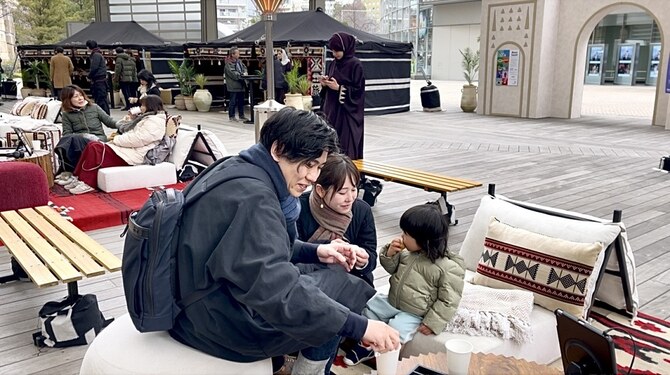
TOKYO: Saudi Arabia’s Ambassador to Japan Dr. Ghazi Faisal Binzagr attended the Tokyo stop of the “Meet Saudi Arabia Tour” to promote the Kingdom’s pavilion at the Osaka Kansai Expo, which opens on April 13.

The tour — held in various parts of Japan — aims to show how Saudi Arabia is not just a distant place, but a relevant and engaging destination for all.

Ambassador Binzagr, emphasizing the unique aspects of Saudi Arabia’s “rich culture and a fascinating history,” believes these elements have a special appeal to the people of Japan.

“We have beautiful, exciting things to showcase, but this is just a small glimpse of what we have to show about the past, the present and the future of Saudi Arabia,” Ambassador Binzagr told Arab News Japan.

“There are lots of things that you can touch and feel about our culture, from our heritage, from the emotion of our cities today and our life in the midst of a very exciting transformation that we are undergoing in Saudi Arabia.”

The Tour offers visitors a chance to experience various aspects of Saudi culture, including Saudi Arabian coffee and date pairing, a cooking demonstration of traditional sweets, and traditional Saudi music and costumes.

“We’re counting down to the last days before our opening in Osaka,” Ambassador Binzagr said about the Expo. “We’re almost completed and ready. I had the privilege of touring the site two days ago, and the final touches are being made now. With glimpses of the future we’re heading towards, I am very excited to welcome everyone to Osaka.”

One of the main themes of the Saudi Arabian pavilion is the building itself. The pavilion has been described as a “masterpiece” and is said to embody the flow of Saudi Vision 2030 and the transformation from past to future, sensitivity to the environment, and design elements that blend heritage with technology and vision.

“Looking at it, I see the transformation of Saudi Arabia and what’s happening in our vibrant country,” Dr. Binzagr said. “But our focus is not just on the present, but also on the promising future of Saudi Arabia. We want to inspire people with the potential and relevance of our future. We want people to see a sample of it so that they think not just about joining us in Osaka, but beyond that to visiting our country.”

Thematically, it projects an invitation to the world to step inside Saudi Arabia and to experience it. The building itself aims to reflect harmony – melding the desert environment with architectural aspects that both shield people from nature’s elements and celebrates those elements at the same time.


At top UN court, Myanmar denies deadly Rohingya campaign amounts to genocide

Updated 3 sec ago
Follow

At top UN court, Myanmar denies deadly Rohingya campaign amounts to genocide

  • “Myanmar was not obliged to remain idle and allow terrorists to have free reign of northern Rakhine state,” Hlaing told ICJ judges
  • Buddhist-majority Myanmar has long considered the Rohingya Muslim minority to be “Bengalis” from Bangladesh

THE HAGUE, Netherlands: Myanmar insisted Friday that its deadly military campaign against the Rohingya ethnic minority was a legitimate counter-terrorism operation and did not amount to genocide, as it defended itself at the top United Nations court against an allegation of breaching the genocide convention.
Myanmar launched the campaign in Rakhine state in 2017 after an attack by a Rohingya insurgent group. Security forces were accused of mass rapes, killings and torching thousands of homes as more than 700,000 Rohingya fled into neighboring Bangladesh.
“Myanmar was not obliged to remain idle and allow terrorists to have free reign of northern Rakhine state,” the country’s representative Ko Ko Hlaing told black-robed judges at the International Court of Justice.
Gambia filed genocide case in 2019
African nation Gambia brought a case at the court in 2019 alleging that Myanmar’s military actions amount to a breach of the Genocide Convention that was drawn up in the aftermath of World War II and the Holocaust.
Some 1.2 million members of the Rohingya minority are still languishing in chaotic, overcrowded camps in Bangladesh, where armed groups recruit children and girls as young as 12 are forced into prostitution. The sudden and severe foreign aid cuts imposed last year by US President Donald Trump shuttered thousands of the camps’ schools and have caused children to starve to death.
Buddhist-majority Myanmar has long considered the Rohingya Muslim minority to be “Bengalis” from Bangladesh even though their families have lived in the country for generations. Nearly all have been denied citizenship since 1982.
Myanmar denies Gambia claims of ‘genocidal intent’
As hearings opened Monday, Gambian Justice Minister Dawda Jallow said his nation filed the case after the Rohingya “endured decades of appalling persecution, and years of dehumanizing propaganda. This culminated in the savage, genocidal ‘clearance operations’ of 2016 and 2017, which were followed by continued genocidal policies meant to erase their existence in Myanmar.”
Hlaing disputed the evidence Gambia cited in its case, including the findings of an international fact-finding mission set up by the UN’s Human Rights Council.
“Myanmar’s position is that the Gambia has failed to meet its burden of proof,” he said. “This case will be decided on the basis of proven facts, not unsubstantiated allegations. Emotional anguish and blurry factual pictures are not a substitute for rigorous presentation of facts.”
Aung San Suu Kyi represented Myanmar at court in 2019. Now she’s imprisoned
Nobel Peace Prize winner Aung San Suu Kyi represented her country at jurisdiction hearings in the case in 2019, denying that Myanmar armed forces committed genocide and instead casting the mass exodus of Rohingya people from the country she led as an unfortunate result of a battle with insurgents.
The pro-democracy icon is now in prison after being convicted of what her supporters call trumped-up charges after a military takeover of power.
Myanmar contested the court’s jurisdiction, saying Gambia was not directly involved in the conflict and therefore could not initiate a case. Both countries are signatories to the genocide convention, and in 2022, judges rejected the argument, allowing the case to move forward.
Gambia rejects Myanmar’s claims that it was combating terrorism, with Jallow telling judges on Monday that “genocidal intent is the only reasonable inference that can be drawn from Myanmar’s pattern of conduct.”
In late 2024, prosecutors at another Hague-based tribunal, the International Criminal Court, requested an arrest warrant for the head of Myanmar’s military regime for crimes committed against the country’s Rohingya Muslim minority. Senior Gen. Min Aung Hlaing, who seized power from Suu Kyi in 2021, is accused of crimes against humanity for the persecution of the Rohingya. The request is still pending.