
ISTANBUL: Turkiye, with NATO’s second-largest army and a Black Sea coastline, is looking to play a key role in Europe’s security after Washington’s pivot away from the region.
After two rounds of crisis talks on Ukraine and security following Washington’s change of policy, Ankara has been quick to warn that European defenses cannot be ensured without its involvement.
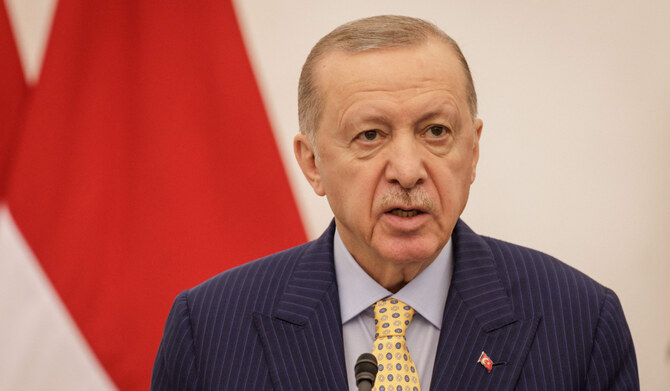
“It is inconceivable to establish European security without Turkiye,” President Recep Tayyip Erdogan said after Sunday’s London summit.
Without Turkiye, “it is becoming increasingly impossible for Europe to continue its role as a global actor,” he added.
A senior Turkish defense ministry returned to the issue on Thursday.
“With the security parameters being reshaped due to recent developments, it is impossible to ensure European security without Turkiye,” he said.
Even so, he said Turkiye would be ready to deploy troops to Ukraine as part of a peacekeeping mission “if deemed necessary.”
Ankara has consistently defended Ukraine’s territorial integrity since Russia’s 2022 invasion and supplied it with combat drones and naval vessels.
But it has also maintained good ties with Russia and remains the only NATO member not to have joined the sanctions against Moscow.
With its unique position between the two warring parties, Turkiye has repeatedly offered to host peace talks.
Erdogan and Foreign Minister Hakan Fidan have often received visitors such as Russian Foreign Minister Sergei Lavrov and Ukraine’s President Volodymyr Zelensky.
In recent years, Turkiye has considerably developed its defense industries, with exports growing by 29 percent to reach $7.1 billion in 2024, placing it 11th in global defense exports, Erdogan said in January.
Driving its success are the Bayraktar TB2 drones which have been sold to more than 25 nations, among them Poland and Romania, according to the International Institute for Strategic Studies’ Military Balance survey.
“Sales to European countries, particularly EU members, add credibility to Turkiye’s argument it is an important player in European security,” said IISS expert Tom Waldyn.
Its military, strategically located on the eastern flank of the Atlantic Alliance and south of the Black Sea — to which it controls access via the Bosphorus — counts 373,200 active troops and another 378,700 reservists, IISS figures show.
And these troops have been engaged in regular combat in northeastern Syria and northern Iraq fighting Kurdish insurgents, according to a Western diplomat.
“Turkiye has maintained a consistent attitude in line with the UN Charter on the sovereignty and territorial integrity” of Ukraine, he told AFP.
“It has the second largest military in NATO but also the most effective as it’s been in combat for decades,” he explained.
But EU cooperation with Ankara has been hampered by the Cyprus dispute, he said with a trace of exasperation.
“How long can we afford to continue this stance?“
For Nebahat Tanriverdi Yasar, an independent researcher and policy analyst who works in Ankara and Berlin, Turkiye’s careful management of its ties with both Kyiv and Moscow has left it in a unique position.
“Turkiye aims to carefully navigate its relations with Russia and its strategic defense support to Ukraine — potentially with EU backing — to reshape the balance of power in the region amid the emergence of a ‘new order’ where the EU seeks to assume greater responsibility for its security amid shifting US policies,” she told AFP.
Given the challenges that entailed, Ankara was “likely to pursue a pragmatic approach in the short term, focusing on expanding its mediation efforts, deepening defense cooperation with select European states, and leveraging its defense industry to address emerging gaps in military support,” she added.
But Sumbul Kaya, a political scientist in France argued that Turkiye was “above all, driven by a desire to defend its own interests.
“It only intervenes in neighboring countries for internal security reasons, such as in Syria and Iraq,” she said.
“But there’s no question of sending troops to fight wars everywhere — that would not go down well with the population.
“This crisis is an opportunity to stress that Turkiye is both a NATO member and a candidate for membership in the EU.”