KARACHI: Pakistan’s government is negotiating a 1.25 trillion Pakistani rupee ($4.47 billion) loan with commercial banks to reduce its bulging energy sector debt, the power minister and banking association said.
Plugging unresolved debt across the sector is a top priority under an ongoing $7 billion International Monetary Fund (IMF) bailout, which has helped Pakistan dig its way out of an economic crisis.
“The loan will be repaid over a period of 5 to 7 years,” Power Minister, Awais Leghari told Reuters, adding that the term sheets are yet to be signed.
Pakistan’s government, the largest shareholder or owner of most power companies, faces a challenge in resolving debt due to fiscal constraints. To address this, Islamabad has raised energy prices, as recommended by the IMF, but still needs to settle the accumulated debt.
“We’ve approached many banks, let’s see how many participate. It’s a commercial transaction and they have the choice of participating, however, we think there is liquidity in the system for it and banks have the appetite,” Leghari said.
The government plans to reduce “circular debt” — public liabilities that build up in the power sector due to subsidies and unpaid bills — this year by eliminating government-guaranteed debt and moving to a revenue-based system.
This approach is expected to lower financing costs, enabling the government to pay off interest and service debt obligations, he added.
“Such repricing of liabilities induces more efficiency, and reduces cost for consumers,” said Ammar Habib Khan, adviser to the power minister.
Zafar Masud, Chairman of the Pakistan Banks Association, told Reuters that the interest rate would be a floating exchange rate and the country’s top banks would participate, in addition to those who are already part of the outstanding loan.
“This will help in clearing up all the debt in the next 4 to 6 years which has been sitting on banks’ balance sheets,” he said.
Masud added that more than half of the 1.25 trillion debt is already on the banks’ books and is undergoing restructuring through self-liquidating facilities, which currently lack identifiable cash flows to support them.
($1 = 279.9000 Pakistani rupees)


Pakistan nearing $4.4 billion loan to ease power sector debt

https://arab.news/c56dw
Pakistan nearing $4.4 billion loan to ease power sector debt

- Pakistan’s government is negotiating 1.25 trillion Pakistani rupee loan with commercial banks
- Plugging unresolved power sector debt is top priority under ongoing IMF bailout program

Pakistan PM urges pressure on Afghan Taliban to rein in militants, credits Gulf mediation
- PM says ceasefire agreed last month remains fragile
- Sharif raises Gaza, climate risks at forum in Turkmenistan
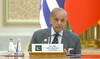
ISLAMABAD: Prime Minister Shehbaz Sharif on Friday urged the international community to press Afghanistan’s Taliban authorities to prevent militant groups from operating from Afghan soil, while praising Gulf and regional countries for their efforts to mediate a fragile ceasefire amid heightened tensions between the two neighboring nations.
Sharif was addressing the International Forum dedicated to the International Year of Peace and Trust 2025, the International Day of Neutrality, and the 30th anniversary of Turkmenistan’s permanent neutrality, hosted in Ashgabat.
Pakistan has accused Afghanistan’s Taliban-led government of failing to curb cross-border militancy, including attacks by the Pakistani Taliban, allegations Kabul denies. Relations between the two neighbors have deteriorated since October, when border clashes killed dozens, prompting emergency talks in Doha, Istanbul and Saudi Arabia. While understandings were reached with regional mediation, Pakistani officials say the ceasefire remains fragile.
“We need the international community to urge the Afghan Taliban regime to fulfill its international obligation and commitments, and reigning terrorist elements, operating from its territory,” Sharif said in his address at the forum in Turkmenistan.
“In the meanwhile, we are very grateful to our brotherly countries Qatar, Turkiye, the Kingdom of Saudi Arabia, UAE and Iran for their sincere desire and efforts to achieve permanent ceasefire, which as I speak, is still very fragile.”
This week, Afghan Foreign Minister Amir Khan Muttaqi pledged in a speech that Afghan territory will not be used to harm other countries and warned that anyone found violating that directive would face action by the Islamic Emirate. A gathering of Afghan religious scholars also reportedly passed a resolution barring the use of Afghan soil for attacks abroad. According to Afghan broadcaster Tolo News, around 1,000 scholars attended the meeting and endorsed measures allowing the government to act against violators.
PEACEFUL DISPUTE RESOLUTION
Speaking at the Ashgabat summit, Sharif said Pakistan’s foreign policy prioritized peaceful dispute resolution and multilateral engagement, noting Islamabad’s recent election as a non-permanent member of the United Nations Security Council, where it aims to contribute to global peace and security.
Turning to the Middle East, the prime minister reiterated Pakistan’s support for efforts to end the conflict in Gaza, calling for a lasting ceasefire to protect civilians, allow humanitarian aid to flow and support reconstruction. He reaffirmed Pakistan’s backing for the Palestinian people’s right to self-determination and also reiterated support for the Kashmiri people.
Sharif linked peace with sustainable development, warning that climate change, poverty and inequality posed transnational threats requiring collective international responses. He said Pakistan had suffered severe human and economic losses from climate-induced disasters in recent years, underlining the need for equitable access to technology and climate finance.
The forum in Ashgabat brought together regional and international leaders to discuss neutrality, trust and cooperation in addressing global security and development challenges.