

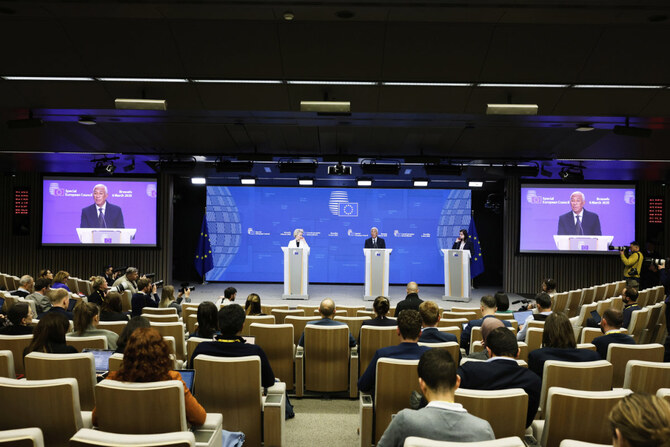
EU leaders commit to working together after Trump signals that Europe must defend itself

Short Url
Updated 07 March 2025
Follow

EU leaders commit to working together after Trump signals that Europe must defend itself

  • “Europe faces a clear and present danger, and therefore Europe has to be able to protect itself, to defend itself,” said European Commission President Ursula von der Leyen
  • Pledge underscores sea change in geopolitics spurred on by Trump, who has undermined 80 years of cooperation

BRUSSELS: European Union leaders on Thursday committed to working together to bolster the continent’s defenses and to free up hundreds of billions of euros for security after US President Donald Trump’s repeated warnings that he would cut them adrift to face the threat of Russia alone.
With the growing conviction that they will now have to fend for themselves, countries that have faltered on defense spending for decades held emergency talks in Brussels to explore new ways to beef up their security and ensure future protection for Ukraine.
“Today history is being written,” European Commission President Ursula von der Leyen told reporters after the summit ended.
She said the 27 EU leaders are “determined to ensure Europe’s security and to act with the scale, the speed and the resolve that this situation demands. We are determined to invest more, to invest better and to invest faster together.”
The pledge underscored a sea change in geopolitics spurred on by Trump, who has undermined 80 years of cooperation based on the understanding that the US would help protect European nations following World War II.
The leaders signed off on a move to loosen budget restrictions so that willing EU countries can increase their military spending. They also urged the European Commission to seek new ways “to facilitate significant defense spending” in all member states, a statement said.
The EU’s executive branch estimates that around 650 billion euros ($702 billion) could be freed up that way.
The leaders also took note of a commission offer of loans worth 150 billion euros ($162 billion) to buy new military equipment and invited EU headquarters staff “to examine this proposal as a matter of urgency.”
Hungarian Prime Minister Viktor Orbán, a staunch supporter of Trump and considered to be Russian President Vladimir Putin’s closest ally in Europe, refused to endorse part of the summit statement in favor of Ukraine.
But the 26 other EU leaders approved the bloc’s stance that there can be no negotiations on Ukraine without Ukraine and that the Europeans must be involved in any talks involving their security. The Europeans have so far been sidelined in the US-led negotiations with Russia.

In other developments, Ukrainian President Volodymyr Zelensky said talks between Ukraine and the US on ending the war will take place in Saudi Arabia next week. In his nightly address, Zelensky said he would travel to Saudi Arabia on Monday to meet the country’s crown prince, and his team would stay on to hold talks with US officials.
In recent weeks, Trump has overturned old certainties about the reliability of the US as a security partner as he embraces Russia, withdraws American support for Ukraine and upends the tradition of cooperation with Europe that has been the bedrock of Western security for generations.
Polish Prime Minister Donald Tusk, whose country holds the EU’s rotating presidency, said that three years of war in Ukraine and a shift in attitudes in Washington “pose entirely new challenges for us, and Europe must take up this challenge ... and it must win.”
“We will arm ourselves faster, smarter and more efficiently than Russia,” Tusk said.
Spending plans win early support
Zelensky welcomed the plan to loosen budget rules and expressed hopes that some of the new spending could be used to strengthen Ukraine’s own defense industry, which can produce weapons more cheaply than elsewhere in Europe and closer to the battlefields where they are needed.
“We are very thankful that we are not alone, and these are not just words. We feel it. It’s very important,” Zelensky said, looking far more relaxed among Europe’s leaders in Brussels than almost a week ago when he received a verbal lashing from Trump in Washington.
Friedrich Merz, the likely next chancellor of Germany, and summit chairman Antonio Costa discussed ways to fortify Europe’s defenses on a short deadline. Merz pushed plans this week to loosen his nation’s rules on running up debt to allow for higher defense spending.


Others too appeared ready to do more.
“Spend, spend, spend on defense and deterrence. That’s the most important message,” Danish Prime Minister Mette Frederiksen told reporters.
The call is a sharp departure from decades of decline in military spending in Europe, where defense often ranked low in many budgetary considerations after the Cold War.
In an address to his country Wednesday evening, French President Emmanuel Macron said the bloc would “take decisive steps.”
“Member states will be able to increase their military spending,” he said, noting that “massive joint funding will be provided to buy and produce some of the most innovative munitions, tanks, weapons and equipment in Europe.”
Macron conferred with his EU counterparts about the possibility of using France’s nuclear deterrent to protect the continent from Russian threats.
Helping EU countries find more money
The short-term benefits of the budget plan offered by von der Leyen were not obvious. Most of the increased defense spending would have to come from national budgets at a time when many countries are already overburdened with debt.
Part of the proposal includes measures to ensure struggling member states will not be punished for going too deep into the red if additional spending is earmarked for defense.
“Europe faces a clear and present danger, and therefore Europe has to be able to protect itself, to defend itself,” she said.


France is struggling to reduce an excessive annual budget deficit of 5 percent of GDP, after running up its total debt burden to 112 percent of GDP with spending on relief for businesses and consumers during the COVID-19 pandemic and the energy crisis that followed Russia’s invasion of Ukraine.
Five other countries using the euro currency have debt levels over 100 percent of GDP: Belgium, Greece, Spain, Italy and Portugal.
Europe’s largest economy, Germany, has more room to borrow, with a debt level of 62 percent of GDP.
Pressing security needs in Ukraine
Part of any security plan would be to help Ukraine defend itself from Russian attacks such as the one that hit Zelensky’s hometown overnight.
A Russian missile killed four people staying at a hotel in Kryvyi Rih, in central Ukraine, shortly after volunteers from a humanitarian organization moved in. The volunteers included Ukrainian, American and British nationals, but it wasn’t clear whether those people were among the 31 who were wounded.
Early this week, Trump ordered a pause in US military supplies being sent to Ukraine as he sought to press Zelensky to engage in negotiations to end the war with Russia. The move brought fresh urgency to Thursday’s summit.
But the meeting in Brussels did not address Ukraine’s most pressing needs. It was not aimed at drumming up more arms and ammunition to fill any supply vacuum created by the US freeze. Nor will all nations agree to unblock the estimated 183 billion euros ($196 billion) in frozen Russian assets held in a Belgian clearing house, a pot of ready cash that could be seized.


With Iran war exit elusive, Trump aides vie to affect outcome

Updated 13 sec ago
Follow

With Iran war exit elusive, Trump aides vie to affect outcome

  • Aides debate when and how to declare victory even as the conflict spreads across the Middle East
  • In taking America to war, US President Donald Trump offered little explanation

WASHINGTON: A complex tug-of-war inside the White House is driving US President Donald Trump’s shifting public statements on the course of the Iran war, as aides debate when and how to declare victory even as the conflict spreads across the Middle East.

Some officials and advisers are warning Trump that surging gasoline prices could exact a political cost from the US-Israeli attacks on Iran, while some hawks are pressing the president to maintain the offensive against the Islamic Republic, according to interviews with a Trump adviser and others close to the deliberations.

Their observations to Reuters offer a previously unreported glimpse inside White House decision-making as it adjusts its approach to the biggest US military operation since the 2003 Iraq war.

Shifting messages, various internal viewpoints

The behind-the-scenes maneuvering underscores the high stakes Trump, who returned to office last year promising to avoid “stupid” military interventions, faces nearly two weeks after plunging the nation into a war that has rattled global financial markets and disrupted the international oil trade.

The jockeying for Trump’s ear is a feature of his presidency, but this time the consequences are a matter of war and peace in one of the world’s most volatile and economically critical regions.

Shifting from the sweeping goals he framed in launching the war on February 28, Trump in recent days has emphasized that he views the conflict as a limited campaign whose objectives have mostly been met.

But the message remains unclear to many, including the energy markets, which have lurched in both directions in response to Trump’s statements.

He told a campaign-style rally in Kentucky on Wednesday that “we won” the war, then abruptly pivoted: “We don’t want to leave early, do we? We’ve got to finish the job.”

Economic advisers and officials, including from the Treasury Department and the National Economic Council, have warned Trump that an oil shock and rising gasoline prices could quickly erode domestic support for the war, said the adviser and two others close to the deliberations, speaking on the condition of anonymity to disclose internal discussions.

Political advisers, including Chief of Staff Susie Wiles and deputy chief James Blair, are making similar arguments, focusing on the political fallout from higher gas prices and urging Trump to define victory narrowly and signal the operation is limited and nearly finished, the sources said.

Pushing in the other direction are hawkish voices urging Trump to sustain military pressure on Iran, including Republican lawmakers such as US Senators Lindsey Graham and Tom Cotton, and media commentators such as Mark Levin, according to people familiar with the matter.

They argue the US must prevent Iran from obtaining a nuclear weapon and respond forcefully to attacks on American troops and shipping.

A third force comes from Trump’s populist base and figures such as strategist Steve Bannon and right-wing television personality Tucker Carlson, who have been pressing him and his top aides to avoid getting dragged into another prolonged Middle East conflict.

“He is allowing the hawks to believe the campaign continues, wants markets to believe the war might end soon and his base to believe escalation will be limited,” the Trump adviser said.

Asked for comment, White House press secretary Karoline Leavitt said in a statement: “This story is based on gossip and speculation from anonymous sources who aren’t even in the room for any discussions with President Trump.

“The President is known for being a good listener and seeking the opinions of many people, but ultimately everyone knows he’s the final decision maker and his own best messenger,” she said. “The President’s entire team is focused on ensuring the objectives of Operation Epic Fury are fully achieved.”

Other people named for their roles in the deliberations did not immediately respond to Reuters’ questions.

Looking for an exit

In taking America to war, Trump offered little explanation, and the administration’s stated war aims have ranged from thwarting an imminent attack by Iran to crippling its nuclear program to replacing its government.

As he seeks an exit from an unpopular conflict, Trump is trying to juggle competing narratives that some critics say have complicated an already difficult situation, with Iran defiant despite the devastating US-Israeli air assault.

Top political aides and economic advisers, whose warnings before the war of the potential economic shock were largely ignored, appear to have played a major role in pushing Trump’s efforts this week to reassure skittish markets and contain rising oil and gas prices.

His public shift to downplaying the war’s impact, describing it as a “short-term excursion,” and his insistence that gas price hikes would be short-lived appeared aimed at calming fears of an open-ended conflict.

Some top aides have advised him to work toward a conclusion to the conflict that he can call a triumph, at least militarily, the sources said, even if much of the Iranian leadership survives, along with remnants of a nuclear program that the campaign was meant to target.

Wave after wave of US and Israeli air strikes have killed a number of top Iranian leaders among some 2,000 people overall – some as far away as Lebanon – devastated its ballistic missile arsenal, sunk much of its navy and degraded its ability to support armed proxies around the Middle East.

But the military achievements have been seriously undercut by Iran’s stepped-up attacks on oil tankers and transport facilities in the Gulf, driving up oil prices.

Trump has said he will decide when to end the campaign. He and his aides say they are far ahead of the four- to six-week timeframe Trump initially announced.

The shifting reasons for launching the conflict, which has spilled over into more than half a dozen other countries, have only made it more difficult to predict what comes next.

For their part, Iran’s rulers will claim victory, analysts say, for simply surviving the US-Israeli onslaught, especially after demonstrating their ability to fight back and inflict damage on Israel, the US and its allies.

Venezuela miscalculation

Critical to the war’s final trajectory will be the Strait of Hormuz. A fifth of the world’s oil shipments, which normally traverses the narrow waterway, has come to a near-standstill. Iran in recent days has struck tankers in Iraqi waters and other ships near the strait, and the new Supreme Leader Mojtaba Khamenei has vowed to keep it shut.

If Iran’s stranglehold on the waterway pushes US gas prices high enough, that could increase political pressure on Trump to end the military campaign to help his Republican Party, which is defending narrow majorities in Congress in November’s midterm elections.

Trump has recently refrained from pushing the idea that the war seeks to topple the government in Tehran. US intelligence indicates that Iran’s leadership is not at risk of collapse anytime soon, Reuters reported on Wednesday.

At least some of the confusion over the war’s trajectory appears rooted in the quick US military success in Venezuela.

Since the start of the war, some aides have struggled to convince Trump that the Iran campaign was unlikely to unfold in the same way as the January 3 Venezuela raid that captured President Nicolas Maduro, according to another source familiar with the administration’s thinking.

That operation opened the way for Trump to coerce former Maduro loyalists into giving him considerable sway over the country’s vast oil reserves – without requiring extended US military action.

Iran, by contrast, has proved a much tougher, better-armed foe with an entrenched clerical and security establishment.

Experts have rejected claims by Trump aides that Iran had been within weeks of being able to produce a nuclear weapon, despite the president’s insistence in June that US-Israeli bombing had “obliterated” its nuclear program.

Most of Iran’s stockpile of highly enriched uranium is believed to have been buried by the June strikes, meaning the material potentially could be retrieved and purified to bomb grade. Iran has always denied seeking nuclear weapons.

If the war drags on, American casualties mount and the economic costs multiply, some analysts say it could erode backing from Trump’s political base. But despite criticism from some supporters opposed to military interventions, members of his “Make America Great Again” movement have so far largely stayed with him on Iran.

“The MAGA base is going to give the president wiggle room,” said Republican strategist Ford O’Connell.