Thailand repatriates hundreds more Chinese scam center workers

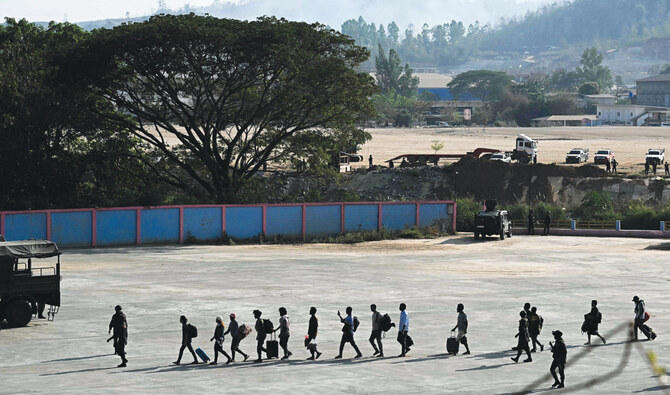
Alleged victims of scam centers in Kyauk Khet in Myanmar’s Kayin State walk in line as they are met by the Thai Army. (AFP)
Short Url
Updated 07 March 2025
Follow

Thailand repatriates hundreds more Chinese scam center workers

BANGKOK: Hundreds of Chinese nationals freed from Myanmar online scam centers flew home through Thailand on Thursday, as the kingdom said it aimed to repatriate 1,500 such workers a week. Thailand, Myanmar and China have been making efforts in recent weeks to clear out illegal cyberscam compounds on the Thai-Myanmar border where thousands of foreigners — mostly Chinese nationals — have been working.

Under pressure from key ally Beijing, Myanmar has cracked down on some of the compounds, freeing around 7,000 workers from more than two dozen countries.

Around 600 Chinese nationals were returned from Myanmar through Thailand two weeks ago, and last week the three countries held talks in Bangkok to arrange further transferrals.

Thai media broadcast footage on Thursday of coaches bringing hundreds of Chinese workers from Myanmar and offloading them on to planes destined for China at Mae Sot airport.

The Thai border force later said that 456 Chinese nationals were sent back on six China Southern chartered aircraft.

Thai Foreign Ministry Spokesperson Nikorndej Balankura told reporters that the government plans to repatriate 1,500 people per week, or 300 each weekday, with “regular repatriations of Chinese nationals every Wednesday, Thursday and Friday.”

Mondays and Tuesdays will see other foreign nationals including Africans repatriated, he said, with the ministry coordinating with foreign embassies to help with “immediate” repatriations.

The remaining freed workers have been languishing for weeks in sometimes squalid conditions in holding camps near the Thai border while officials organize their repatriation.


Indonesia sets rules limiting use of AI for schoolchildren

Updated 4 sec ago
Follow

Indonesia sets rules limiting use of AI for schoolchildren

  • Indonesian children spend about 7.5 hours daily on tablets, smartphones
  • Gen Zs make up the majority of AI users in the country of 280m people

JAKARTA: The Indonesian government introduced on Thursday a new policy regulating the use of digital technology in education, limiting access to artificial intelligence for students.

Generation Alphas and Gen Zs make up almost half of Indonesia’s online population, which reached nearly 230 million people in 2025, according to a survey conducted by the Association of Indonesian Internet Service Providers.

As Indonesian children clock around 7.5 hours of daily screen time, the joint ministerial decree seeks to boost the benefits of digital technology and AI in formal and informal educational institutions, while also protecting the youth from risks in digital spaces.

“There are a lot of factors but the number of teenagers with mental health issues are high and continue to increase, and one of the suspected triggers — that have been proven academically — is the uncontrolled, unmitigated use of digital technology,” said Pratikno, Indonesia’s Coordinating Minister for Human Development and Cultural Affairs.

“The effects on education are also concerning, such as how it weakens brain activity due to dependence on digital technology tools and reduces critical thinking and cognitive and reflective abilities. This is what we have to regulate.”

Among Indonesia’s 280 million population, around a quarter of internet users are already using AI, with Gen Zs making up about 43 percent of that segment.

The joint decree, which Pratikno described as “comprehensive” and encompasses early childhood education to higher education, was signed in Jakarta by seven ministers, including Higher Education, Science and Technology Minister Brian Yuliarto and Primary and Secondary Education Minister Abdul Mu’ti.

“This decree seeks to ensure that our children are not controlled by technology but become the masters of technology for good, that is our goal. (It prioritizes) digital wellness, (for tech to be used) wisely and intelligently,” Pratikno said.

The policy is important to support young Indonesians, many of whom are internet users from adolescence, said Communication and Digital Affairs Minister Meutya Hafid, who also signed the ministerial decree.

“Indonesia has a significant number of children using the internet. Therefore, we must ensure that they are not only a target market for the technology industry, but also able to utilize technology according to their readiness,” she said.

“Every kind of technological advance has to consider the readiness of its users, especially children.”