

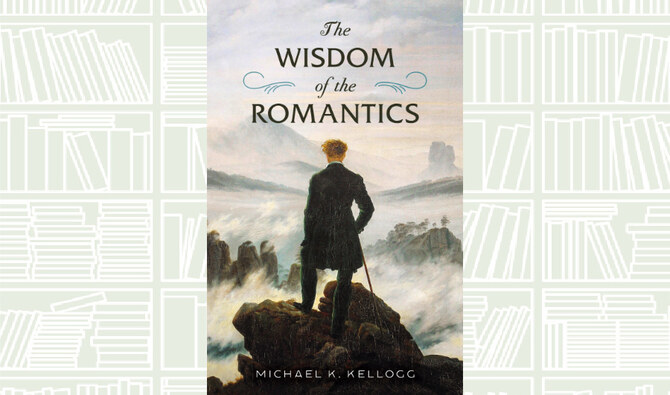

Due for publication by the imprint Prometheus in May 2025 and now available for preorder, “The Wisdom of the Romantics” by Michael K. Kellogg explores the complexities and contradictions of the artistic and intellectual movement Romanticism.
Kellogg, a philosopher and author of several books on intellectual history, including “The Wisdom of the Renaissance,” “The Wisdom of the Middle Ages,” and “The Greek Search for Wisdom,” delves into how Romanticism emphasized “sensibility, inspiration, individual freedom, emotional intensity, introspection, sincerity, and heightened imagination,” in reaction to the “over-reliance on reason” during the Enlightenment period.
Kellogg highlights the contradictions within Romanticism itself, noting that it “is beauty and ugliness. It is art for art’s sake, and art as an instrument of social salvation. It is strength and weakness, individualism and collectivism, purity and corruption, revolution and reaction, peace and war, love of life and love of death.” These attributes, Kellogg argues, were fully embraced by the Romantics, in contrast to the rationalists who rejected them.
Romanticism, which lasted between 1780 and 1850, emerged as a reaction against the Enlightenment’s rigid focus on reason and the Industrial Revolution’s emphasis on progress and rationality. It flourished across literature, art, music and philosophy, embracing intense emotion and highly individual expression. It romanticized the very notion of romanticism.
Kellogg also slips into the world of words from a range of writers that fit that timeframe, from Jean-Jacques Rousseau to Honore de Balzac, Johann Wolfgang von Goethe to Friedrich Hegel, and William Wordsworth to Jane Austen. He argues that Romanticism is a “highly subjective enterprise,” where defining it is not about finding a fixed definition but about embracing its contradictions and diversity.
The book is slightly dense; it feels drawn from a college mandatory reading list. At the same time, it is witty and playful. It almost requires the reader to also be a dreamer and a romantic to enjoy the writing of this era — and about this era.
In addition to writing several books, Kellogg is a founding and managing partner at the law firm Kellogg, Huber, Hansen, Todd, Evans & Figel, PLLC. He also holds degrees from Stanford, Oxford and Harvard Law School, proving that he is, in fact, the perfect person to merge logic and heart within a book — and, dare I declare, a true Romantic.


