ATHENS: Greece’s center-right government faces a no-confidence vote this week over a deadly 2023 train disaster, days after protesters brought the country to a standstill to press their demands for political accountability.
Hundreds of thousands of people took to the streets to mark the second anniversary of the country’s worst rail crash, demanding justice for the victims. Fifty-seven people, most of them students, were killed in the disaster.
Lawmakers from the main opposition, the center-left PASOK party, and from leftist parties submitted a censure motion against Prime Minister Kyriakos Mitsotakis’ government during a parliamentary debate on the disaster on Wednesday.
They said the government has lost its popular mandate since some of the biggest protests in Greece for years, accusing it of shirking responsibility over the crash and failing to fix critical safety gaps and covering up evidence.
“Being aware of our duty toward society and history and toward the Greek people ... we submit a motion of no-confidence against the government,” said the document signed by 85 lawmakers.
The government has denied any wrongdoing and, with 156 seats in the 300-seat parliament, is expected to survive the motion.
The vote will be held on Friday afternoon.
Addressing parliament earlier on Wednesday, Mitsotakis said the allegations by opposition parties threatened domestic political stability during turbulent international times.
“It would be fatal if stability in Greece was threatened at this point,” he said, adding that his government would modernize by 2027 the railway network, which is operated by a state-run company, and would hire a foreign company to take over its maintenance.
For many Greeks the accident has become a painful emblem of the perceived neglect of infrastructure for decades before the crash and two years since.
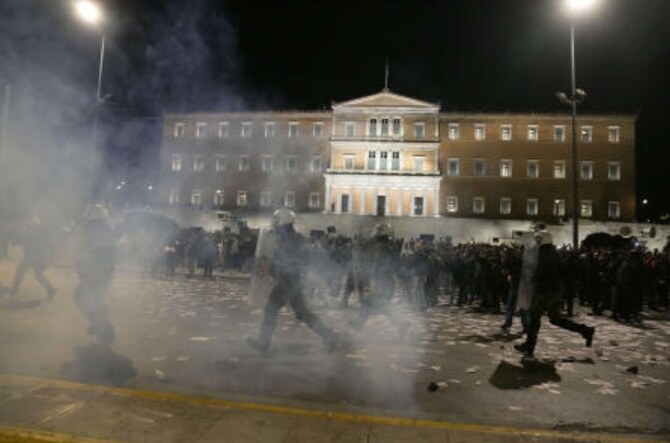
On Wednesday evening, thousands of people rallied peacefully outside parliament and held a moment of silence to honor the victims. Some of the demonstrators released lanterns into the air and lit candles shaped like the number “57” on the ground.
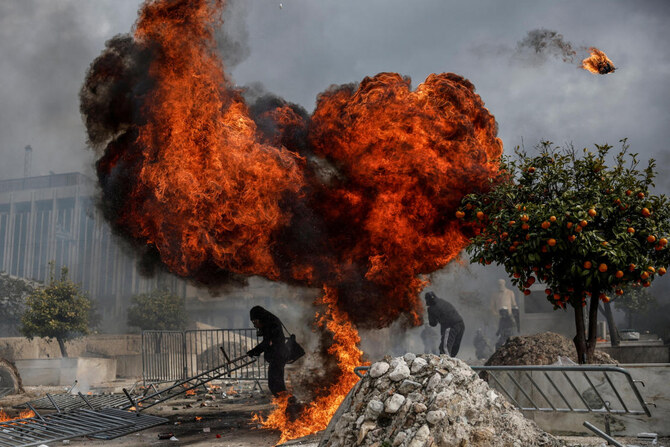
Later, clashes broke out between police and a group of protesters. Police responded with several rounds of teargas to disperse them and violence spread in other areas of Athens.
More protests are scheduled this week, meant to coincide with the no-confidence vote.
On Tuesday, a majority of 277 lawmakers voted to set up a committee to investigate how a former minister handled the aftermath of the crash and a potential breach of duty.
Christos Triantopoulos, who was minister for state aid at the time of the crash, has denied any wrongdoing. On Tuesday, he resigned from his post as deputy civil protection minister to support the inquiry by parliament, the only Greek body that can lift politicians’ immunity and probe them.
A judicial investigation into the crash is expected to be completed later this year.
Relatives of the victims have criticized the government, which won re-election after the crash, for not initiating or backing a parliamentary inquiry into political responsibility.
They say the authorities tried to cover up evidence by laying down gravel at the scene soon after the crash. Triantopoulos, who went to the crash site shortly after the incident, has dismissed the allegations as groundless.
The Air and Rail Accident Investigation Authority (HARSIA), an independent agency set up hastily after the crash, reported last week that the disaster had been caused by chronic safety shortfalls that still need to be addressed to prevent a repeat.
Christos Papadimitriou, head of HARSIA’s rail division, told the Kathimerini newspaper on Sunday that authorities’ ignorance and lack of experience were possible reasons for the loss of significant evidence from the scene.


![]()
![]()

Greek government faces no-confidence vote over deadly 2023 train crash
Short Url
https://arab.news/nafv5
Greek government faces no-confidence vote over deadly 2023 train crash
- “Being aware of our duty toward society and history and toward the Greek people ... we submit a motion of no-confidence,” said the document signed by 85 lawmakers
- The government has denied any wrongdoing and, with 156 seats in the 300-seat parliament, is expected to survive the motion


Latest updates




Recommended


© 2026 SAUDI RESEARCH & PUBLISHING COMPANY, All Rights Reserved And subject to Terms of Use Agreement.