

New Philippine degree recognition to boost job prospects for Filipinos in UAE

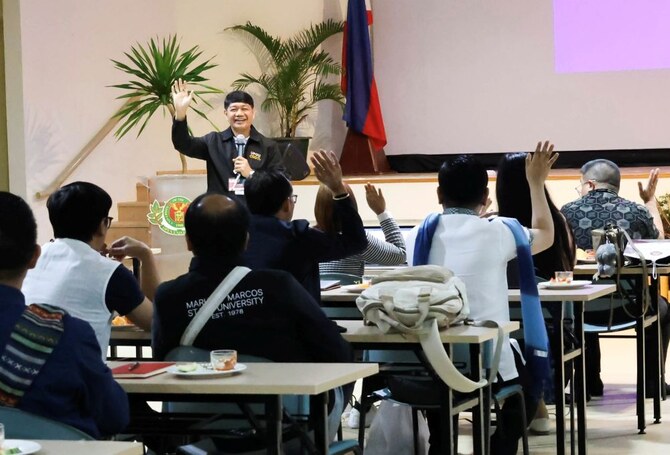
An instructor conducts a session in the auditorium at the University of the Philippines Open University campus in Los Banos, Philippines, Feb. 10, 2025. (UPOU)
Short Url
Updated 05 March 2025
Follow

New Philippine degree recognition to boost job prospects for Filipinos in UAE

  • UPOU recognized for equivalency by the UAE’s Ministry of Higher Education
  • New degree recognition expected to help overseas Filipinos get higher-income jobs

MANILA: The Philippine government on Wednesday welcomed the UAE’s recognition of University of the Philippines Open University degrees as paving the way for better job opportunities and career advancement for Filipinos in the Gulf state.

UPOU, a public research university located south of Metro Manila, has been recognized for equivalency by the UAE’s Ministry of Higher Education and Scientific Research.

“Equivalency is a big help for Filipino professionals working abroad. That allows them to practice their trade and get the same recognition that they enjoy here in the Philippines,” Dante Francis Ang II, secretary of the Commission on Filipinos Overseas, said in an interview with the Philippine News Agency.

His office will be reaching out to Filipinos based in the UAE and encouraging them to get a degree or take further studies, he said.

UPOU operates as part of the Philippines’ national university, the University of the Philippines.

It said that the “landmark accreditation” is expected to pave the way for overseas Filipino workers, or OFWs, in the UAE to leverage their UPOU degrees for career advancement and employment opportunities.

“Prior to the said accreditation, OFWs with UPOU degrees reportedly faced challenges in career advancement since their graduate programs were not recognized by the UAE,” UPOU said.

UP President Angelo Jimenez said that the recognition will likely strengthen the Philippines’ macroeconomic stability “by increasing overseas remittances and reducing the final strain on welfare services extended to OFWs,” as it would enable them to earn higher salaries.

“This development will have a profound impact on the professional and economic mobility of our OFWs, enabling them to transition from high-risk, low-paying jobs to safer, more stable and higher-income positions,” Jimenez said.

Out of more than 2 million overseas Filipino workers, whose remittance inflows account for about 9 percent of their country’s gross domestic product, about 700,000 live in the UAE — the second-largest employer of Philippine expats after Saudi Arabia.


Venezuela says oil exports continue normally despite Trump blockade

Updated 9 sec ago
Follow

Venezuela says oil exports continue normally despite Trump blockade

  • Trump warned “Venezuela is completely surrounded by the largest Armada ever assembled in the History of South America”
  • Oil prices surged in early trading Wednesday in London on news of the blockade, which comes a week after US troops seized a sanctioned oil tanker

CARACAS: Venezuela struck a defiant note Wednesday, insisting that its crude oil exports were not impacted by US President Donald Trump’s announcement of a potentially crippling blockade.
Trump’s declaration on Tuesday marked a new escalation in his months-long campaign of military and economic pressure on Venezuela’s leftist authoritarian President Nicolas Maduro.
Venezuela, which has the world’s largest proven oil reserves, shrugged off the threat of more pain, insisting that it was proceeding with business as usual.
“Export operations for crude and byproducts continue normally. Oil tankers linked to PDVSA operations continue to sail with full security,” state oil company Petroleos de Venezuela (PDVSA) said.
Trump said Tuesday he was imposing “A TOTAL AND COMPLETE BLOCKADE OF ALL SANCTIONED OIL TANKERS going into, and out of, Venezuela.”
Referring to the heavy US military presence in the Caribbean — including the world’s largest aircraft carrier — he warned “Venezuela is completely surrounded by the largest Armada ever assembled in the History of South America.”
Oil prices surged in early trading Wednesday in London on news of the blockade, which comes a week after US troops seized a sanctioned oil tanker that had just left Venezuela with over 1 million barrels of crude.
Maduro held telephone talks with UN Secretary-General Antonio Guterres to discuss what he called the “escalation of threats” from Washington and their “implications for regional peace.”
Guterres’s spokesman said the UN chief was working to avoid “further escalation.”

- ‘We are not intimidated’ -

Venezuela’s economy, which has been in freefall over the last decade of increasingly hard-line rule by Maduro, relies heavily on petroleum exports.
Trump’s campaign appears aimed at undermining domestic support for Maduro but the Venezuelan military said Wednesday it was “not intimidated” by the threats.
The foreign minister of China, the main market for Venezuelan oil, defended Caracas in a phone call with his Venezuelan counterpart Yvan Gi against the US “bullying.”
“China opposes all unilateral bullying and supports all countries in defending their sovereignty and national dignity,” he said.
Last week’s seizure of the M/T Skipper, in a dramatic raid involving US forces rappelling from a helicopter, marked a shift in Trump’s offensive against Maduro.
In August, the US leader ordered the biggest military deployment in the Caribbean Sea since the 1989 US invasion of Panama — purportedly to combat drug trafficking, but taking particular aim at Venezuela, a minnow in the global drug trade.
US strikes on alleged drug-smuggling boats in the Caribbean and eastern Pacific have left at least 95 people dead since.
Caracas believes that the anti-narcotics operations are a cover for a bid to topple Maduro and steal Venezuelan oil.
The escalating tensions have raised fears of a potential US intervention to dislodge Maduro.
Mexican President Claudia Sheinbaum waded into the dispute on Wednesday, declaring that the United Nations was “nowhere to be seen” and asked that it step up to “prevent any bloodshed.”

- Oil lifeline -

The US blockade threatens major pain for Venezuela’s crumbling economy.
Venezuela has been under a US oil embargo since 2019, forcing it to sell its production on the black market at significantly lower prices, primarily to Asian countries.
The country produces one million barrels of oil per day, down from more than three million in the early 2000s.
Capital Economics analysts predicted that the blockade “would cut off a key lifeline for Venezuela’s economy” in the short term.
“The medium-term impact will hinge largely on how tensions with the US evolve — and what the US administration’s goals are in Venezuela.”