Saudi consumer spending surges 35% to $4.6bn ahead of Ramadan 

The food and beverage sector saw spending soaring 74.9 percent week on week. Shutterstock
Short Url
Updated 05 March 2025
Follow

Saudi consumer spending surges 35% to $4.6bn ahead of Ramadan 

RIYADH: Consumer spending in Saudi Arabia jumped 34.7 percent to SR17.5 billion ($4.6 billion) in the week leading up to Ramadan, driven by increased food purchases and retail activity, official data showed. 

The latest point-of-sale transaction data from the Saudi Central Bank, also known as SAMA, revealed a sharp increase in spending across most of the economy from Feb. 23 to March 1, with 231.3 million transactions. 

The food and beverage sector led the surge, with spending soaring 74.9 percent week on week to SR3.3 billion, reflecting a seasonal spike in demand as Saudis prepare for Ramadan, a month characterized by large daily iftar and suhoor meals. 

Spending on public utilities followed closely, with a 55.9 percent rise, amounting to SR81.5 million. Expenditure on furniture also recorded a notable surge at 46 percent to SR524.5 million. 

According to the latest POS transactions bulletin, the education sector was one of the two areas that registered negative change during this period. Spending on education dipped by 33.6 percent to settle at SR82 million, while spending in hotels fell by 0.5 percent to SR365 million. 

Spending on clothing and footwear saw a 43.9 percent increase in transaction value to SR1.2 billion, with the number of deals growing by 30.8 percent to 8.5 million. 

Expenditure on telecommunication also saw increases, surging 42.9 percent to SR146.9 million, while recreation and culture recorded a 25.4 percent uptick to SR338.1 million. 

Similarly, spending on jewelry recorded an increase of 27.2 percent to SR334.2 million. 

Expenditure in restaurants and cafes followed, recording a 10.5 percent increase to SR2.1 billion. 

Miscellaneous goods and services accounted for the second-biggest POS share with a 36.9 percent upstick, reaching SR2.1 billion. 

Spending in the leading three categories accounted for approximately 42.9 percent or SR7.5 billion of the week’s total value. 
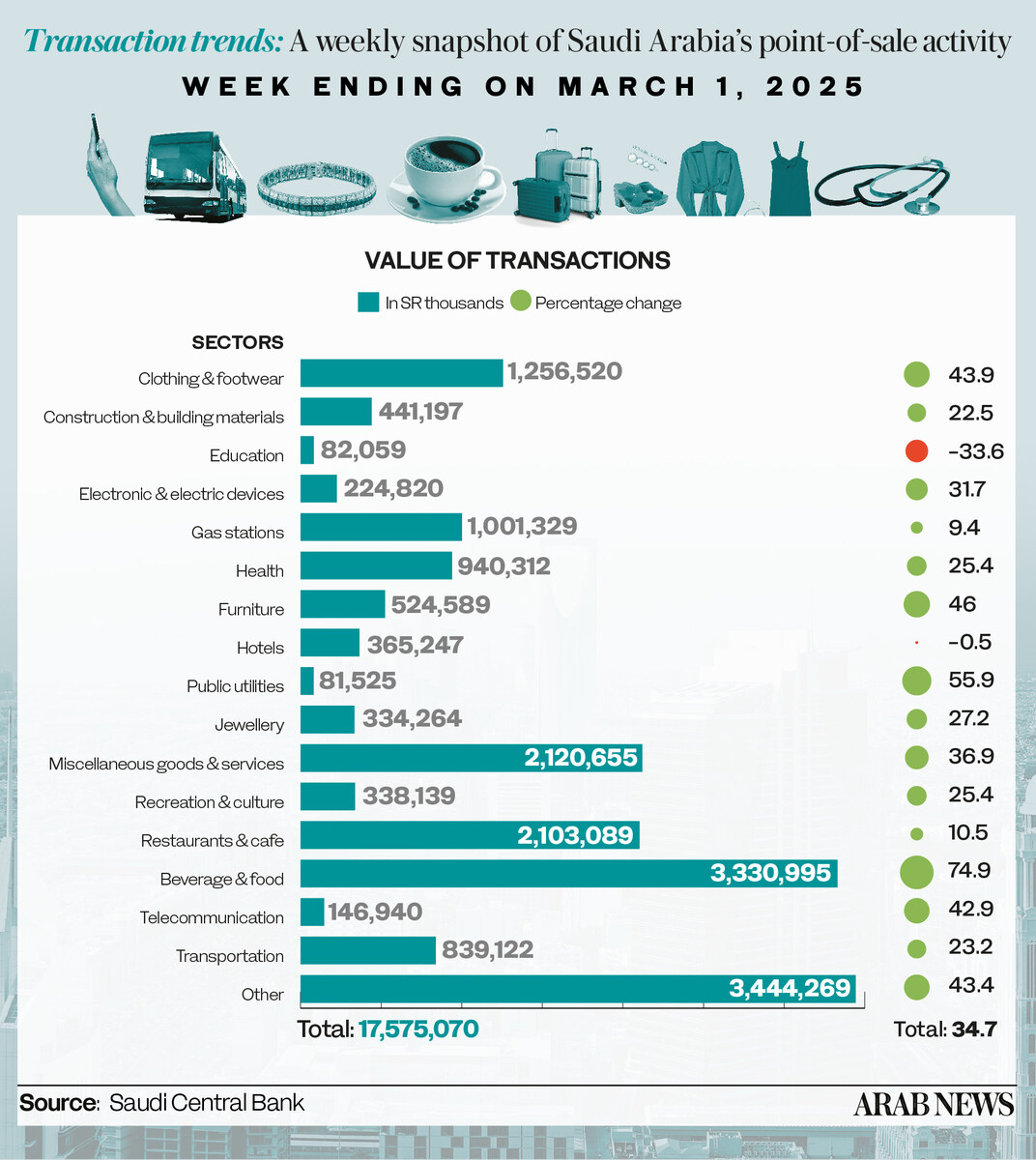
At 9.4 percent, the smallest increase occurred in spending in gas stations, leading total payments to reach SR1 billion. 

Expenditures on construction and building materials surged by 22.5 percent to SR441.1 million, and spending on electronics recorded a 31.7 percent increase to SR224.8 million. 

Geographically, Riyadh dominated POS transactions, representing around 33 percent of the total, with expenses in the capital reaching SR5.8 billion — a 27.1 percent increase from the previous week. 

Jeddah followed with a 29.5 percent surge to SR2.4 billion, and Dammam came in third at SR847.6 million, up 31.2 percent. 

Hail experienced the most significant increase in spending, surging by 49.5 percent to SR294.4 million. Tabuk followed with a 46 percent surge to SR334.9 million. 

Makkah and Madinah saw the largest increases in terms of the number of transactions, surging 16.5 percent and 14 percent, respectively, to 9.8 million and 9.6 million transactions.


Iran conflict intensifies risk for specialty insurers: Moody’s 

Updated 8 sec ago
Follow

Iran conflict intensifies risk for specialty insurers: Moody’s 

RIYADH: The Iran conflict has increased tail risk for Gulf specialty insurers according to Moody’s Ratings, although diversified firms are expected to face manageable losses under its baseline scenario.

The agency said the conflict has effectively blocked the Strait of Hormuz, through which just five vessels per day transited in the first eight days of March, down from a pre-conflict average of around 100 daily transits, citing Portwatch data. 

Moody’s baseline scenario assumed the conflict would be relatively short-lived with navigation through the passage eventually resuming at scale. In this scenario, losses are expected to be manageable for large, diversified insurers due to careful risk selection, aggregate claims limits and reinsurance protection. 

Amid widening conflict that has disrupted shipping in the region, the US International Development Finance Corp. on March 11 announced a $20 billion reinsurance facility, with Chubb serving as lead partner, according to Reuters. 

Without such war-risk coverage, ships and cargo worth hundreds of millions of dollars remain exposed to attacks in the waterway, through which about one-fifth of global oil flows normally pass. 

“Specialty insurers and reinsurers, which provide tailored coverage of complex risks such as marine, aviation and political violence, face increased likelihood of severe events leading to outsized claims as a result of the Iran conflict,” the report said. 

Moody’s added that “they are also benefiting from an increase in the price of political violence and terrorism coverage amid rising demand from businesses looking to protect assets in the region.” 

Since Feb. 28, the UK Maritime Trade Operations has recorded 17 incidents affecting vessels in the Arabian Gulf, Strait of Hormuz and Gulf of Oman, including 13 attacks and four reports of suspicious activity.

Marine insurers on March 5 issued notices of cancelation to terminate or reprice hull and cargo war-risk cover, which protects ships and cargo from damage caused by acts of war. 

“In fast-moving conflicts, war-risk cover can become more expensive or may be canceled on short notice depending on the wording,” said Pillsbury Winthrop Shaw Pittman LLP, the international law firm, in a blog post. 

The Lloyd’s Market Association confirmed that the vast majority of approximately 1,000 vessels in the Arabian Gulf, with an aggregate insured value exceeding $25 billion, remain covered in the London market, although at higher prices and under more restrictive terms. 

Beyond the immediate insurance implications, the disruption is creating cascading operational challenges for ship operators. “Longer maritime voyages can mean more fuel, more crew time and missed contractual delivery windows as chokepoints become chokeholds,” Pillsbury added. 

Protection and indemnity clubs, which cover liability risks such as oil spills, have reinstated some war-risk cover but halved liability limits for the Gulf to $250 million per event, forcing ship owners to retain more risk. 

On March 6, the US International Development Finance Corp. announced a reinsurance facility to cover losses up to approximately $20 billion on a rolling basis to facilitate passage through the Strait of Hormuz, initially focusing on hull and cargo coverage. 

Moody’s noted that prolonged vessel detention could trigger “blocking and trapping” provisions in war risk policies, allowing total loss claims after 12 months of detention, a scenario that could lead to clustered claims and legal disputes. 

Aviation sector on alert 

Aviation insurers face similar challenges, with airspace closures and missile activity increasing risks to aircraft on the ground at major regional airports. While insurers have largely maintained coverage, they have intensified monitoring and retain options for rapid repricing if conflict escalates. 

The report drew parallels to the Russia-Ukraine conflict, where approximately 400 aircraft valued at over $10 billion were detained in Russia, leading to complex litigation and ultimately exposing contingency war risk policies to significant losses. 

Moody’s added: “We see few parallels with the current conflict, where physical damage is the main driver of loss. We also estimate that there is more risk to primary war risk insurance than to contingency covers in this case.” 

Political violence coverage in focus 

Demand for political violence and terrorism insurance has risen sharply at significantly increased prices, a positive for insurer business volumes but one that increases exposure to potential further escalation. 

Loss reports are already emerging, with Bapco Energies in Bahrain reportedly notifying insurers of damage to its refinery complex from recent attacks. 

Legal uncertainty surrounds these policies, the report warns, as distinctions between war, terrorism and civil commotion are frequently contested in scenarios involving coordinated attacks or proxy actors. 

Outlook 

The concentration of high-value assets in the Gulf region increases potential for loss accumulation compared to recent geopolitical tensions such as Russia’s invasion of Ukraine. A prolonged conflict would raise the probability of larger, more complex loss scenarios. 

“War exclusion clauses will also provide some insulation, although these will likely face legal challenges in some cases,” Moody’s noted.

The conflict has also heightened cyber risk exposure for global insurers, with potential for Iranian state-aligned cyberattacks on Western corporates representing a material tail risk. 

Past Iranian state-backed cyberattacks have not breached cyber insurance attachment points, but legal uncertainty remains over the application of war exclusions. 

Energy insurance is considered less vulnerable due to well-dispersed assets, though attacks on infrastructure or prolonged production disruption could generate correlated claims across property, energy, marine and credit lines.